

Isolating Soil Microbes to Heal the World
Location
CoLab, COM 193
Start Date
30-4-2026 10:45 AM
Document Type
Poster
Description
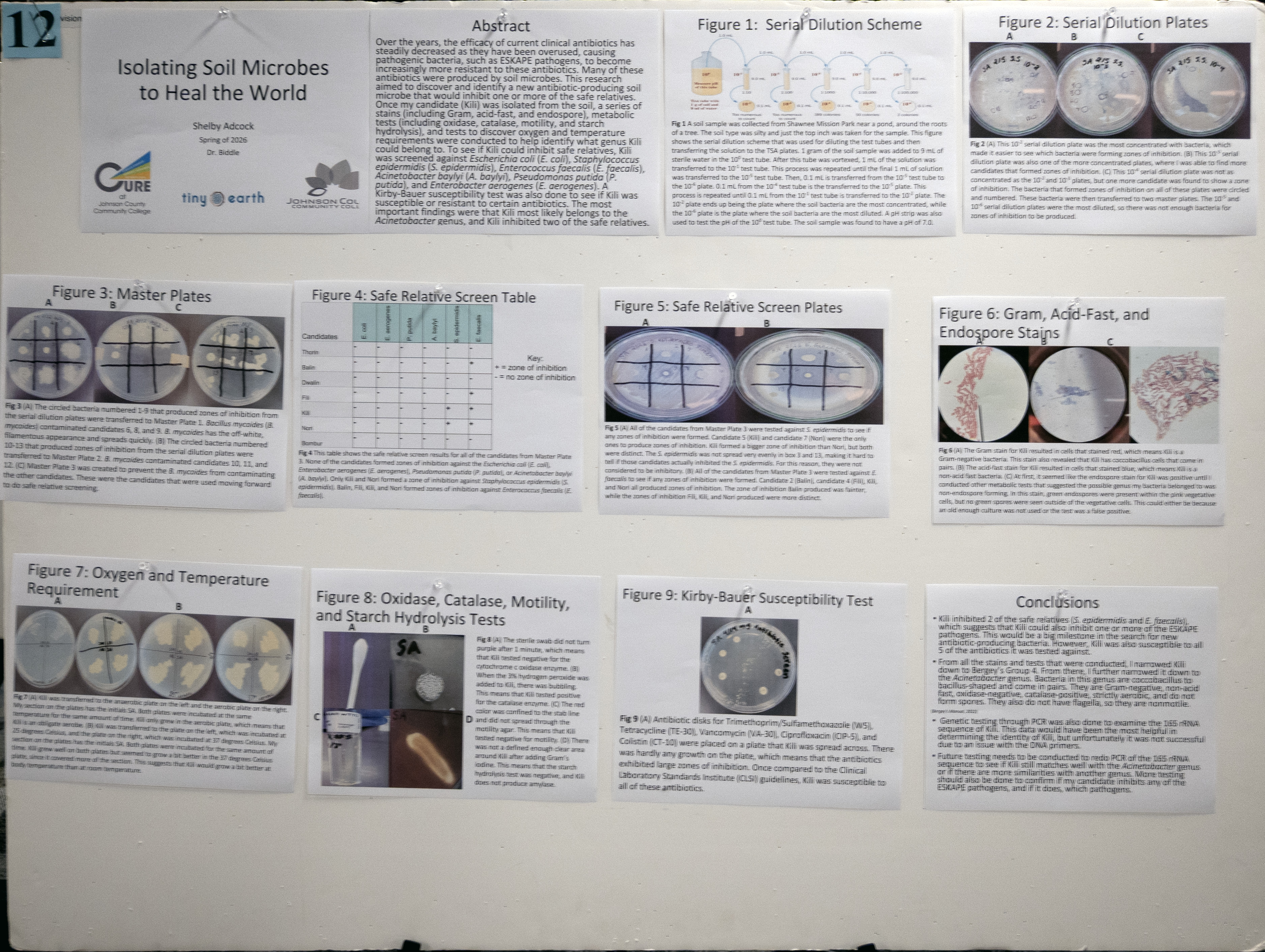
Over the years, the efficacy of current clinical antibiotics has steadily decreased as they have been overused, causing pathogenic bacteria, such as ESKAPE pathogens, to become increasingly more resistant to these antibiotics. Many of these antibiotics were produced by soil microbes. Due to the competitive nature of the environment they occupy, these antibiotics help them survive by killing other microbes so that they can have the nutrients they need. This research aimed to discover new antibiotic-producing soil microbes that would inhibit one or more of the safe relatives. Once my candidate was isolated from the soil through a serial dilution scheme, a series of tests were performed to screen my candidate against the safe relatives Escherichia coli (E. coli), Staphylococcus epidermidis (S. epidermidis), Enterococcus faecalis (E. faecalis), Acinetobacter baylyi (A. baylyi), Pseudomonas putida (P. putida), and Enterobacter aerogenes (E. aerogenes). Genetic testing through PCR was done to examine its 16S rRNA sequence, and a series of stains (including Gram, acid-fast, and endospore) were conducted to further identify my candidate. The stains identified my candidate as Gram negative, non-acid-fast, and endospore-producing. From the screens performed, my candidate inhibited S. epidermidis and E. faecalis. These results are interesting because most of the ESKAPE pathogens are Gram-negative, but my candidate inhibited the two Gram-positive safe relatives. This means that my candidate could inhibit both Gram-positive and Gram-negative bacteria. Future testing needs to be conducted to confirm if my candidate inhibits any of the ESKAPE pathogens, and if it does, which pathogens.
Image
Isolating Soil Microbes to Heal the World
CoLab, COM 193
Over the years, the efficacy of current clinical antibiotics has steadily decreased as they have been overused, causing pathogenic bacteria, such as ESKAPE pathogens, to become increasingly more resistant to these antibiotics. Many of these antibiotics were produced by soil microbes. Due to the competitive nature of the environment they occupy, these antibiotics help them survive by killing other microbes so that they can have the nutrients they need. This research aimed to discover new antibiotic-producing soil microbes that would inhibit one or more of the safe relatives. Once my candidate was isolated from the soil through a serial dilution scheme, a series of tests were performed to screen my candidate against the safe relatives Escherichia coli (E. coli), Staphylococcus epidermidis (S. epidermidis), Enterococcus faecalis (E. faecalis), Acinetobacter baylyi (A. baylyi), Pseudomonas putida (P. putida), and Enterobacter aerogenes (E. aerogenes). Genetic testing through PCR was done to examine its 16S rRNA sequence, and a series of stains (including Gram, acid-fast, and endospore) were conducted to further identify my candidate. The stains identified my candidate as Gram negative, non-acid-fast, and endospore-producing. From the screens performed, my candidate inhibited S. epidermidis and E. faecalis. These results are interesting because most of the ESKAPE pathogens are Gram-negative, but my candidate inhibited the two Gram-positive safe relatives. This means that my candidate could inhibit both Gram-positive and Gram-negative bacteria. Future testing needs to be conducted to confirm if my candidate inhibits any of the ESKAPE pathogens, and if it does, which pathogens.
Comments
The faculty mentor for this project was Eulandria Biddle.