

JCCC Post Drain Water Quality Study
Location
CoLab, COM 210
Start Date
30-4-2026 10:45 AM
Document Type
Poster
Description
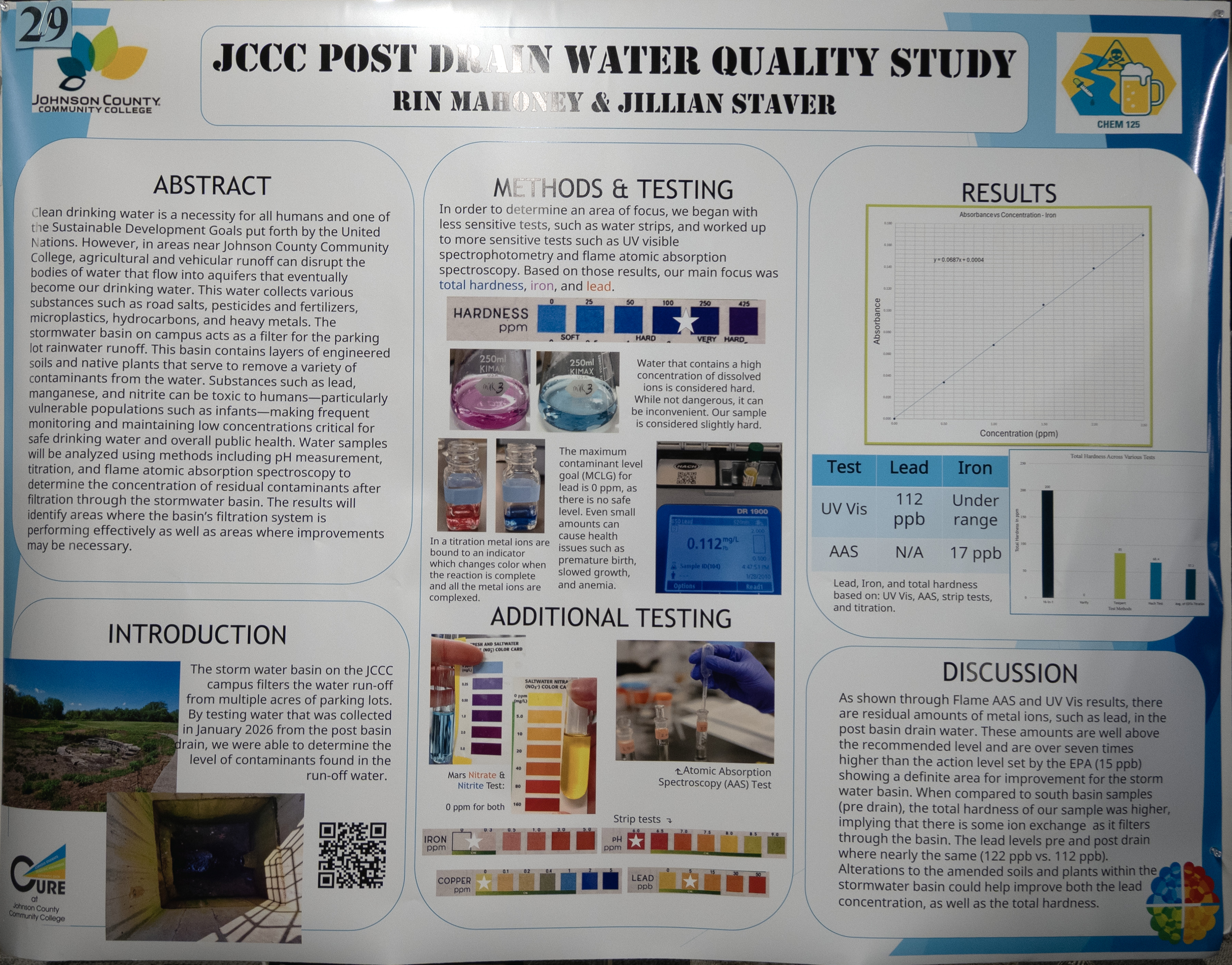
Clean drinking water is a necessity for all humans and one of the Sustainable Development Goals put forth by the United Nations. However, in areas near Johnson County Community College, agricultural and vehicular runoff can disrupt the bodies of water that flow into aquifers that eventually become our drinking water. This water collects various substances such as road salts, pesticides and fertilizers, microplastics, hydrocarbons, and heavy metals. The stormwater basin on campus acts as a filter for the parking lot rainwater runoff. This basin contains layers of engineered soils and native plants that serve to remove a variety of contaminants from the water. Substances such as lead, manganese, and nitrite can be toxic to humans—particularly vulnerable populations such as infants—making frequent monitoring and maintaining low concentrations critical for safe drinking water and overall public health. Water samples will be analyzed using methods including pH measurement, titration, and flame atomic absorption spectroscopy to determine the concentration of residual contaminants after filtration through the stormwater basin. The results will identify areas where the basin’s filtration system is performing effectively as well as areas where improvements may be necessary.
Image
JCCC Post Drain Water Quality Study
CoLab, COM 210
Clean drinking water is a necessity for all humans and one of the Sustainable Development Goals put forth by the United Nations. However, in areas near Johnson County Community College, agricultural and vehicular runoff can disrupt the bodies of water that flow into aquifers that eventually become our drinking water. This water collects various substances such as road salts, pesticides and fertilizers, microplastics, hydrocarbons, and heavy metals. The stormwater basin on campus acts as a filter for the parking lot rainwater runoff. This basin contains layers of engineered soils and native plants that serve to remove a variety of contaminants from the water. Substances such as lead, manganese, and nitrite can be toxic to humans—particularly vulnerable populations such as infants—making frequent monitoring and maintaining low concentrations critical for safe drinking water and overall public health. Water samples will be analyzed using methods including pH measurement, titration, and flame atomic absorption spectroscopy to determine the concentration of residual contaminants after filtration through the stormwater basin. The results will identify areas where the basin’s filtration system is performing effectively as well as areas where improvements may be necessary.
Comments
The faculty mentor for this project was Lori Slavin.