

Testing Cold Stratification Germination Methods for Common Milkweed (Asclepias syriaca) and Whorled Milkweed (Asclepias verticillata)
Location
CoLab, COM 180
Start Date
30-4-2026 9:30 AM
Document Type
Poster
Description
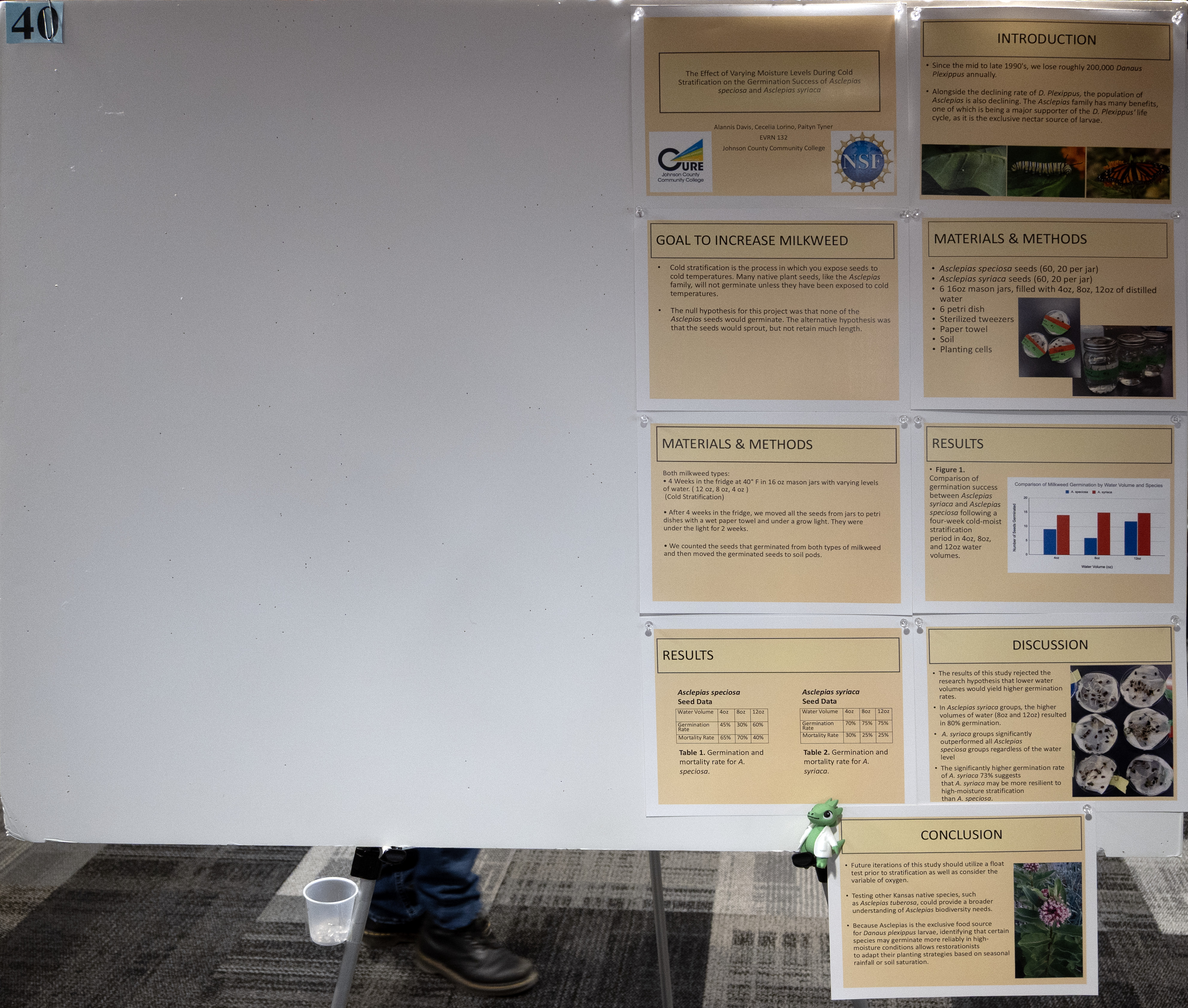
Monarch butterflies (Danaus plexippus) rely on milkweed (Asclepias spp.) as a food source while in caterpillar form, but the milkweed supply is becoming increasingly scarce as the seeds’ germination process is difficult and extensive. It is known that milkweed seeds undergo natural cold stratification that breaks dormancy during winter months, so the following tests will be conducted to break seed dormancy through artificial cold stratification with a goal of determining the most effective methods at accelerating and ameliorating milkweed seed germination. To test the following methods and provide accurate results, 40 common milkweed (Asclepias syriaca) and 40 whorled milkweed (Asclepias verticillata) will be split into 4 groups of 20 and put through 2 different methods of cold stratification. The first method allows the seeds to undergo cold stratification through 2 weeks in a freezer bag filled with 40 mL of distilled water, then 2 weeks in a petri dish lined with a wet paper towel fragment placed in sunlight. The second follows the same steps, but is preceded by 1 week in a freezer. After completing the tests, it can be concluded that freezing had no effect on common milkweed, as seed germination remained constant, but had a negative effect on whorled milkweed. Common milkweed sprouted 8 seeds with and without freezing, while whorled milkweed sprouted 2 seeds (with a mean length of ~1.15 cm) with freezing and 6 seeds without freezing (with a mean length of ~3.85 cm). These results suggest that the temperature required for cold stratification to break dormancy and promote milkweed seed germination is ideal around 35°F to 38°F, and anything lower can either have no effect or harm the germination process.
Image
Testing Cold Stratification Germination Methods for Common Milkweed (Asclepias syriaca) and Whorled Milkweed (Asclepias verticillata)
CoLab, COM 180
Monarch butterflies (Danaus plexippus) rely on milkweed (Asclepias spp.) as a food source while in caterpillar form, but the milkweed supply is becoming increasingly scarce as the seeds’ germination process is difficult and extensive. It is known that milkweed seeds undergo natural cold stratification that breaks dormancy during winter months, so the following tests will be conducted to break seed dormancy through artificial cold stratification with a goal of determining the most effective methods at accelerating and ameliorating milkweed seed germination. To test the following methods and provide accurate results, 40 common milkweed (Asclepias syriaca) and 40 whorled milkweed (Asclepias verticillata) will be split into 4 groups of 20 and put through 2 different methods of cold stratification. The first method allows the seeds to undergo cold stratification through 2 weeks in a freezer bag filled with 40 mL of distilled water, then 2 weeks in a petri dish lined with a wet paper towel fragment placed in sunlight. The second follows the same steps, but is preceded by 1 week in a freezer. After completing the tests, it can be concluded that freezing had no effect on common milkweed, as seed germination remained constant, but had a negative effect on whorled milkweed. Common milkweed sprouted 8 seeds with and without freezing, while whorled milkweed sprouted 2 seeds (with a mean length of ~1.15 cm) with freezing and 6 seeds without freezing (with a mean length of ~3.85 cm). These results suggest that the temperature required for cold stratification to break dormancy and promote milkweed seed germination is ideal around 35°F to 38°F, and anything lower can either have no effect or harm the germination process.
Comments
The faculty mentor for this project was Sarah Powell.