

Southern Flying Squirrels Population in Local Johnson County Parks
Location
CoLab, COM 179
Start Date
30-4-2026 9:30 AM
Document Type
Poster
Description
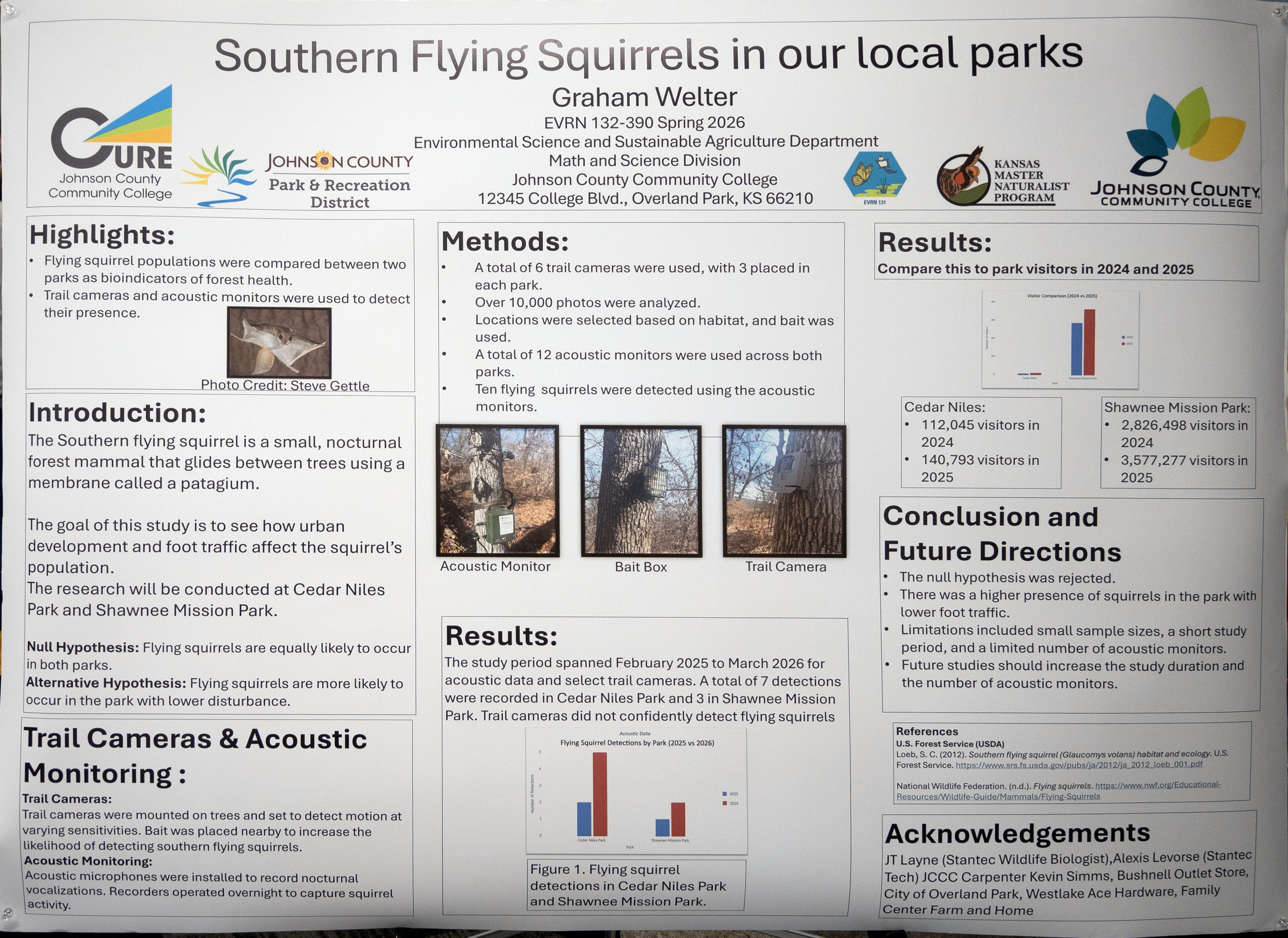
First and foremost, the goal of this research is to locate and better understand southern flying squirrels in the Johnson County area, as the KC metro area becomes increasingly urban, with more people moving in and new buildings being built every day. The goal is to help protect the southern flying squirrel by understanding their habitat and how foot traffic affects them, so local government officials can zone these areas if needed to prevent development and protect their habitat. The research will be conducted in two parks, Cedar Niles and Shawnee Mission Park. We will be using trail cameras at varying sensitivities and acoustic mics to monitor the southern flying squirrel population in these parks. We will also use nest boxes with bait as another means of data collection. We will thoroughly analyse this data, but I expect to find that the disturbance of humans in these areas affects the squirrels and how abundant they are. We already know that most of these forests are younger; knowing this, we can assume that there aren’t too many trees high enough for the southern flying squirrel to truly glide. This is due to most of the forests being very young. We expect to find more squirrels in Cedar Niles Park because it is a less popular park, meaning less foot traffic compared to Shawnee Mission Park. In conclusion, we hope to help protect the southern flying squirrel while also still being able to develop as a society.
Image
Southern Flying Squirrels Population in Local Johnson County Parks
CoLab, COM 179
First and foremost, the goal of this research is to locate and better understand southern flying squirrels in the Johnson County area, as the KC metro area becomes increasingly urban, with more people moving in and new buildings being built every day. The goal is to help protect the southern flying squirrel by understanding their habitat and how foot traffic affects them, so local government officials can zone these areas if needed to prevent development and protect their habitat. The research will be conducted in two parks, Cedar Niles and Shawnee Mission Park. We will be using trail cameras at varying sensitivities and acoustic mics to monitor the southern flying squirrel population in these parks. We will also use nest boxes with bait as another means of data collection. We will thoroughly analyse this data, but I expect to find that the disturbance of humans in these areas affects the squirrels and how abundant they are. We already know that most of these forests are younger; knowing this, we can assume that there aren’t too many trees high enough for the southern flying squirrel to truly glide. This is due to most of the forests being very young. We expect to find more squirrels in Cedar Niles Park because it is a less popular park, meaning less foot traffic compared to Shawnee Mission Park. In conclusion, we hope to help protect the southern flying squirrel while also still being able to develop as a society.
Comments
The faculty mentor for this project was Stephanie Ferrero.