

Flying Squirrel Observations
Location
CoLab, COM 176
Start Date
30-4-2026 9:30 AM
Document Type
Poster
Description
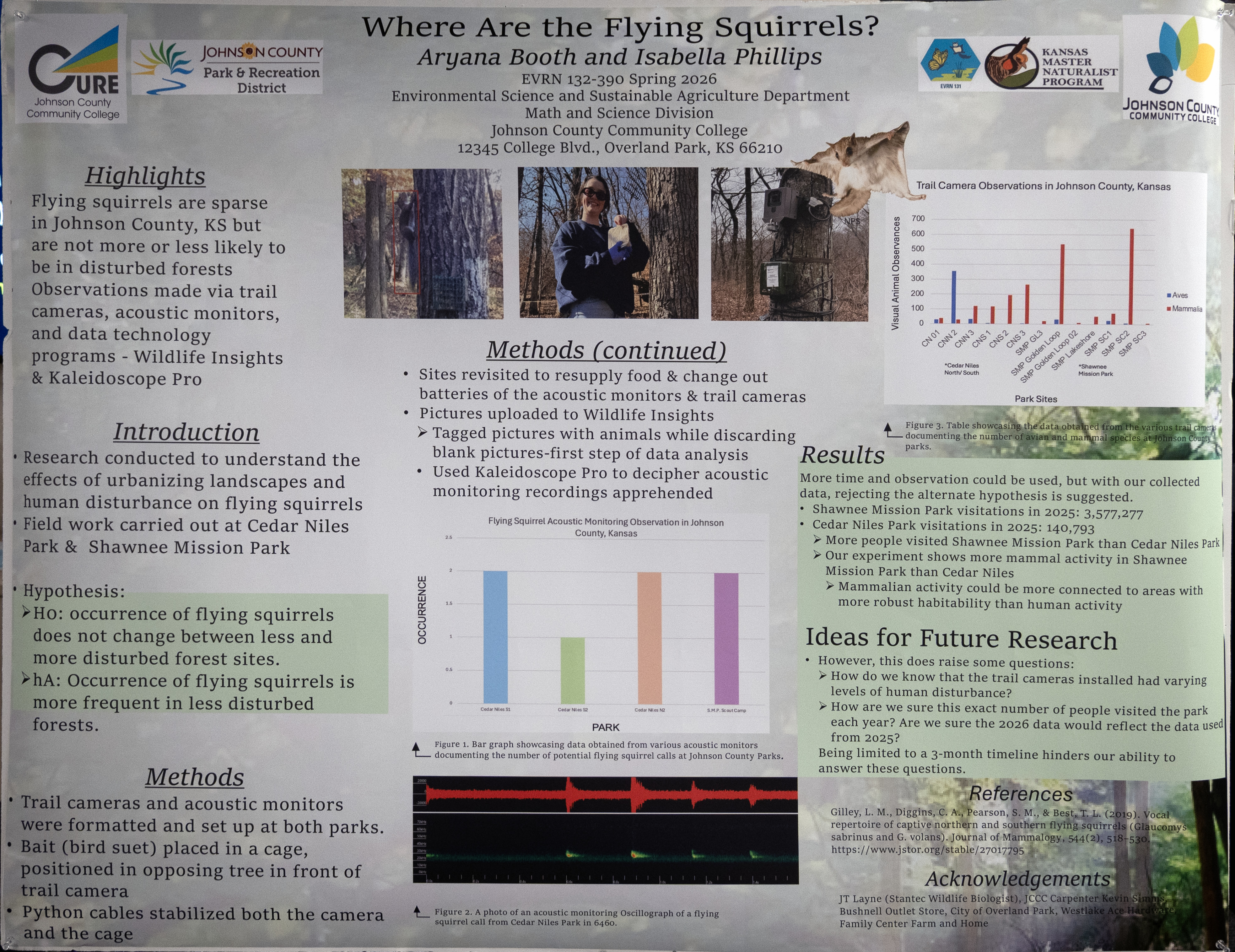
Southern flying squirrels, or Glaucomys volans, are mammals who are associated with mast-producing forests and are considered to be an indicator of forest health. Although they retain a level of high ecological importance, their habitat usage and population are poorly documented in northeastern Kansas. These instances of inadequate documentation have aligned with rapidly urbanizing landscapes of which is taking place in Johnson County, Kansas. This research aims to assess the occurrence of southern flying squirrels in the area while evaluating the best non-invasive methods for detecting this elusive species. To understand their distribution and habitat use is also to better understand biodiversity and forest conservation within urban environments. These findings can be used by local nature workers, wildlife researchers, and urban planners. This study utilizes non-invasive sampling techniques, with anticipation that acoustic monitoring will produce the most results, followed by trail-cameras, and nest boxes providing the least amount of data. There are external variables, such as weather and other species, within the forest sites that could impact the results of the experiment. However, it is anticipated that despite these potential confounding variables that our non-invasive sampling methods will be effective in observation.
Image
Flying Squirrel Observations
CoLab, COM 176
Southern flying squirrels, or Glaucomys volans, are mammals who are associated with mast-producing forests and are considered to be an indicator of forest health. Although they retain a level of high ecological importance, their habitat usage and population are poorly documented in northeastern Kansas. These instances of inadequate documentation have aligned with rapidly urbanizing landscapes of which is taking place in Johnson County, Kansas. This research aims to assess the occurrence of southern flying squirrels in the area while evaluating the best non-invasive methods for detecting this elusive species. To understand their distribution and habitat use is also to better understand biodiversity and forest conservation within urban environments. These findings can be used by local nature workers, wildlife researchers, and urban planners. This study utilizes non-invasive sampling techniques, with anticipation that acoustic monitoring will produce the most results, followed by trail-cameras, and nest boxes providing the least amount of data. There are external variables, such as weather and other species, within the forest sites that could impact the results of the experiment. However, it is anticipated that despite these potential confounding variables that our non-invasive sampling methods will be effective in observation.
Comments
The faculty mentor for this project was Stephanie Ferrero.