

Does the Basin Save Money?
Location
CoLab, COM 133
Start Date
30-4-2026 8:15 AM
Document Type
Poster
Description
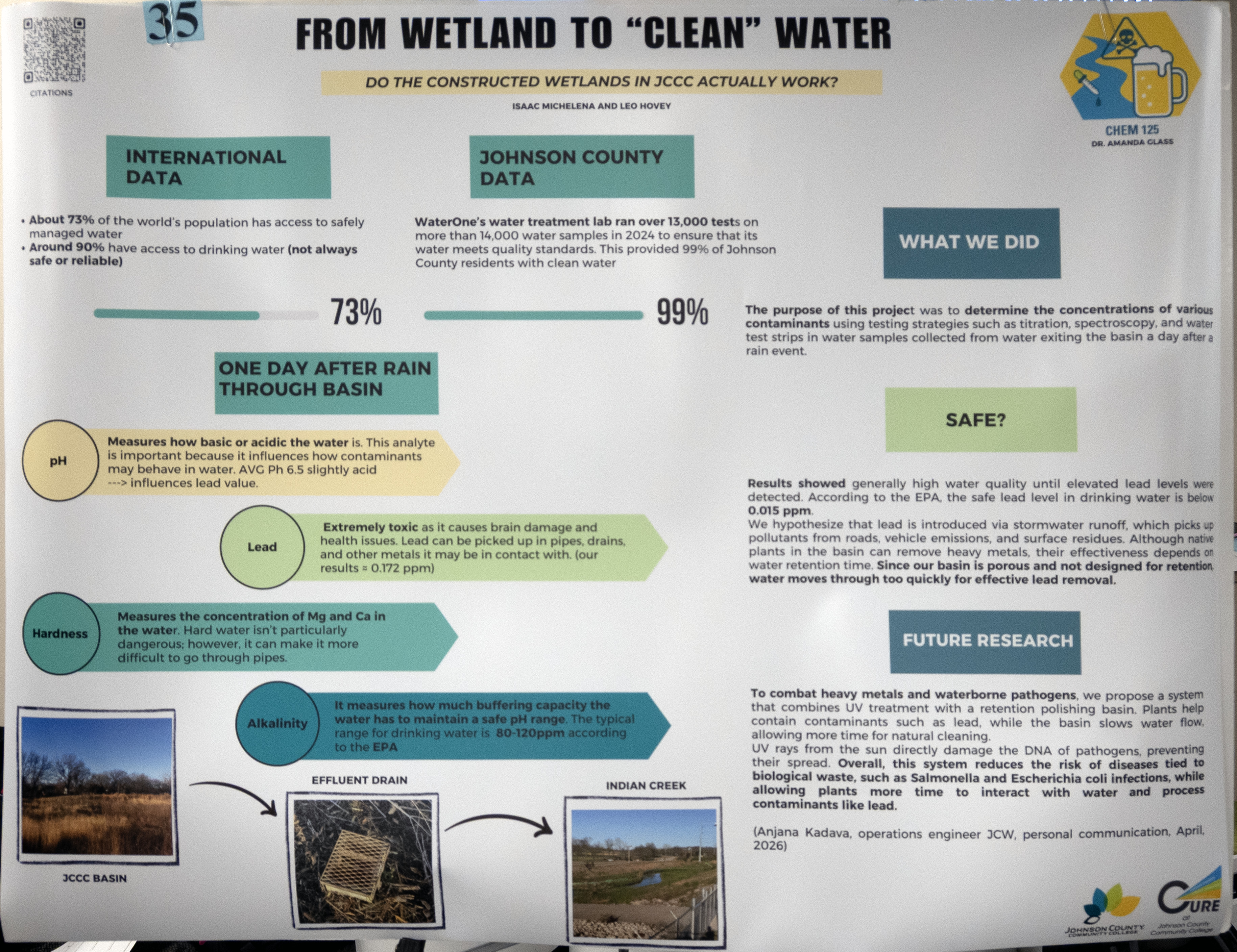
Throughout history, it has been supported by years of scientific evidence that water quality is very important for human health and environmental wellness. That’s why the U.S. Congress passed the Clean Water Act on October 18, 1972, highlighting that clean water is not only a human right but also a responsibility to remove pollutants and ensure environmental protection. This is why the filtration basin for rain runoff water was built at JCCC in 2010 as part of the sustainability goal that our community shares. The main function of the wetlands is to collect runoff water from adjacent streets near JCCC and around campus through storm drains, as well as to remove synthetic and organic pollutants that the water may contain. After chemical testing to ensure efficacy and identify weak points, the focus was on contaminants like lead, iron, nitrate, nitrite, calcium, and magnesium (hardness), and chemical properties such as pH and alkalinity. These values represent whether the water can be harmful to humans. However, using test strips, titration, and spectroscopy, we found that all analytes are within a safe range in the filtered water from the basin. This highlights how effective JCCC’s wetlands are in the removal of contaminants
Image
Does the Basin Save Money?
CoLab, COM 133
Throughout history, it has been supported by years of scientific evidence that water quality is very important for human health and environmental wellness. That’s why the U.S. Congress passed the Clean Water Act on October 18, 1972, highlighting that clean water is not only a human right but also a responsibility to remove pollutants and ensure environmental protection. This is why the filtration basin for rain runoff water was built at JCCC in 2010 as part of the sustainability goal that our community shares. The main function of the wetlands is to collect runoff water from adjacent streets near JCCC and around campus through storm drains, as well as to remove synthetic and organic pollutants that the water may contain. After chemical testing to ensure efficacy and identify weak points, the focus was on contaminants like lead, iron, nitrate, nitrite, calcium, and magnesium (hardness), and chemical properties such as pH and alkalinity. These values represent whether the water can be harmful to humans. However, using test strips, titration, and spectroscopy, we found that all analytes are within a safe range in the filtered water from the basin. This highlights how effective JCCC’s wetlands are in the removal of contaminants
Comments
The faculty mentor for this project was Amanda Glass.