

Peptide Synthesis
Location
CoLab, COM 413
Start Date
30-4-2026 5:30 PM
Document Type
Poster
Description
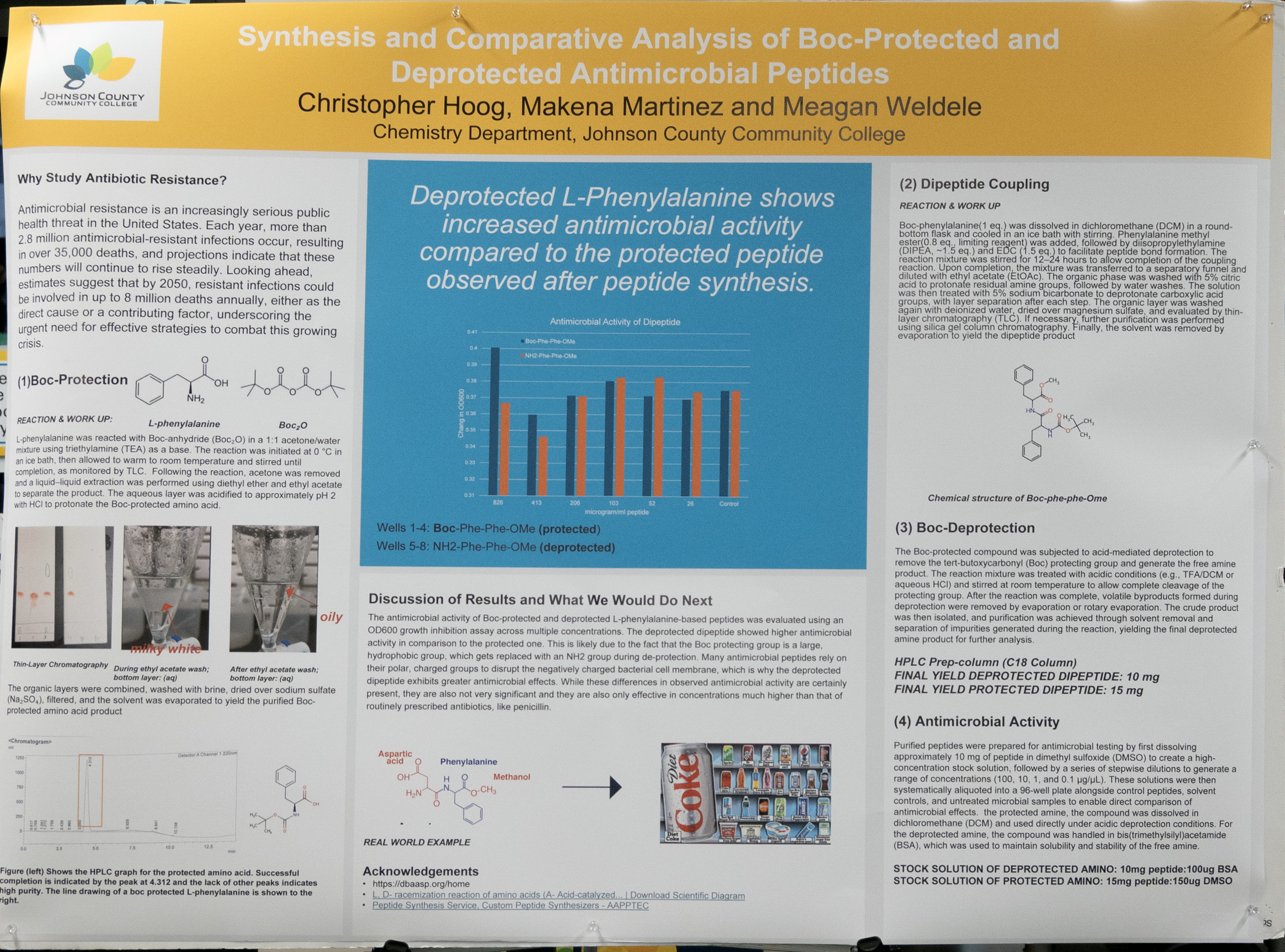
Due to the rise in antimicrobial-resistant deaths in the United States, the continued research and exploration of peptide therapy is important. In an experiment to further this research, the goal is to synthesize a dipeptide in three important steps: N Boc-protection, utilizing a coupling reagent EDC to free the CO2H group, and to then remove the Boc-protecting group. In order to successfully synthesize two amino acids together, protecting an amino group and carboxyl group is vital. The starting material, Lysine, is first protected twice due to the amine functional group on the alpha carbon and the additional amino group on the side chain. After Lysine is adequately protected, an ester will be coupled to allow the CO2H group to be used. 25% TFA in DCM will be used to deprotonate the dipeptide, eliminating only the Boc-protecting group. Once removed the amino group will be free. Deprotonation is important in antimicrobial peptide therapy because studies have shown more activity with a net (+) charge. Testing utilizing HNMR, TLC, and HPLC will be used to qualitatively show the results.
Image
Peptide Synthesis
CoLab, COM 413
Due to the rise in antimicrobial-resistant deaths in the United States, the continued research and exploration of peptide therapy is important. In an experiment to further this research, the goal is to synthesize a dipeptide in three important steps: N Boc-protection, utilizing a coupling reagent EDC to free the CO2H group, and to then remove the Boc-protecting group. In order to successfully synthesize two amino acids together, protecting an amino group and carboxyl group is vital. The starting material, Lysine, is first protected twice due to the amine functional group on the alpha carbon and the additional amino group on the side chain. After Lysine is adequately protected, an ester will be coupled to allow the CO2H group to be used. 25% TFA in DCM will be used to deprotonate the dipeptide, eliminating only the Boc-protecting group. Once removed the amino group will be free. Deprotonation is important in antimicrobial peptide therapy because studies have shown more activity with a net (+) charge. Testing utilizing HNMR, TLC, and HPLC will be used to qualitatively show the results.
Comments
The faculty mentor for this project was Meagan Weldele.