

Peak Pungency: GC-MS Analysis of Garlic Before and After Freeze-Drying
Location
CoLab, COM 411
Start Date
30-4-2026 5:30 PM
Document Type
Poster
Description
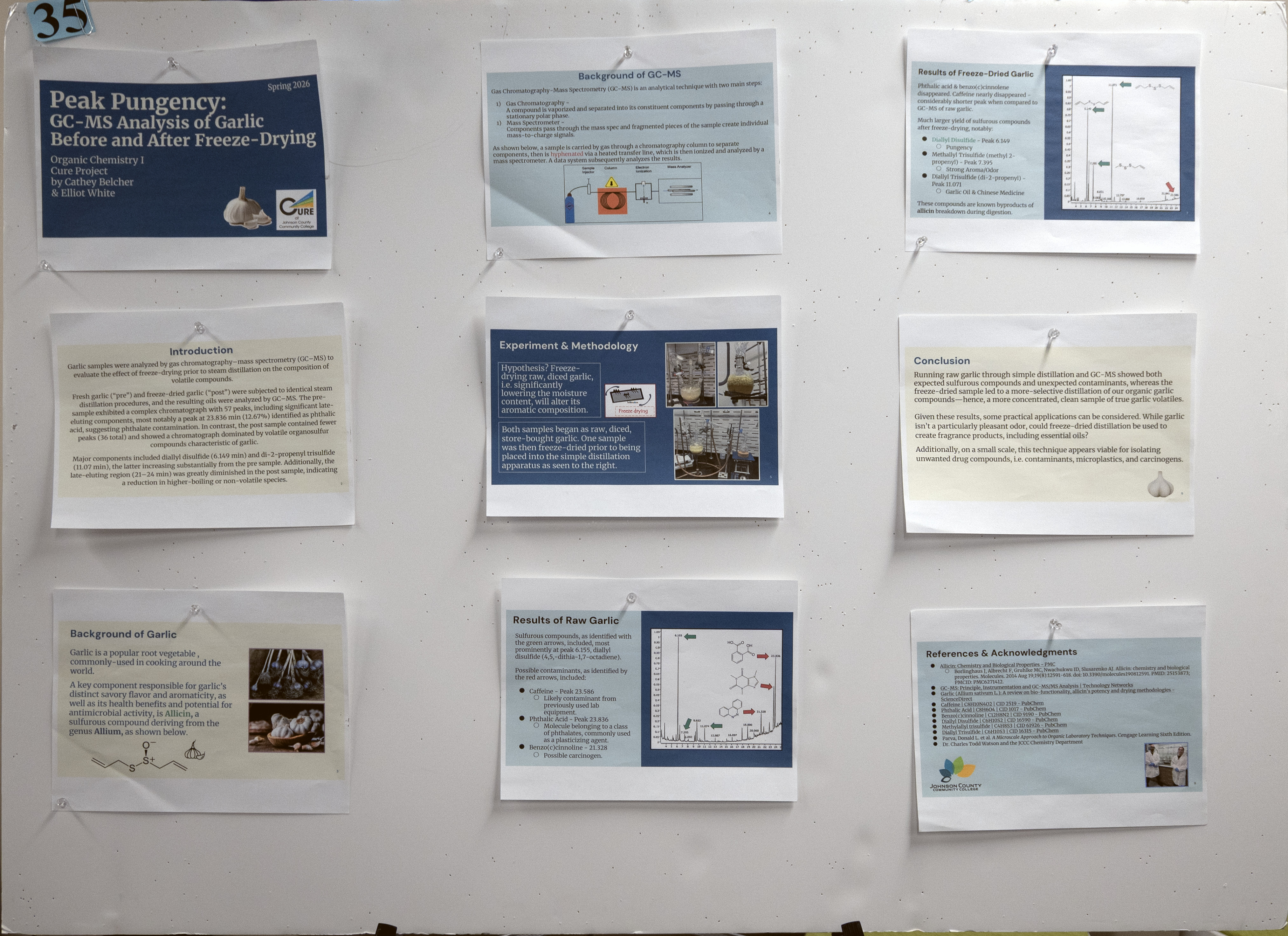
Garlic samples were analyzed by gas chromatography–mass spectrometry (GC–MS) to evaluate the effect of freeze-drying prior to steam distillation on the composition of volatile compounds. Fresh garlic (“pre”) and freeze-dried garlic (“post”) were subjected to identical steam distillation procedures, and the resulting oils were analyzed by GC–MS. The pre sample exhibited a complex chromatogram with 57 peaks, including significant late-eluting components, most notably a peak at 23.836 min (12.67%) identified as phthalic acid, suggesting phthalate/plasticizer contamination. In contrast, the post sample contained fewer peaks (36 total) and showed a chromatogram dominated by volatile organosulfur compounds characteristic of garlic. Major components included diallyl disulfide (6.149 min) and di-2-propenyl trisulfide (11.07 min), the latter increasing substantially from the pre sample. Additionally, the late-eluting region (21–24 min) was greatly diminished in the post sample, indicating a reduction in higher-boiling or non-volatile species. These results indicate that freeze-drying prior to steam distillation can enhance the relative abundance of garlic-derived sulfur compounds while reducing extraneous or contaminant signals, yielding a cleaner and more compositionally representative volatile oil profile.
Image
Peak Pungency: GC-MS Analysis of Garlic Before and After Freeze-Drying
CoLab, COM 411
Garlic samples were analyzed by gas chromatography–mass spectrometry (GC–MS) to evaluate the effect of freeze-drying prior to steam distillation on the composition of volatile compounds. Fresh garlic (“pre”) and freeze-dried garlic (“post”) were subjected to identical steam distillation procedures, and the resulting oils were analyzed by GC–MS. The pre sample exhibited a complex chromatogram with 57 peaks, including significant late-eluting components, most notably a peak at 23.836 min (12.67%) identified as phthalic acid, suggesting phthalate/plasticizer contamination. In contrast, the post sample contained fewer peaks (36 total) and showed a chromatogram dominated by volatile organosulfur compounds characteristic of garlic. Major components included diallyl disulfide (6.149 min) and di-2-propenyl trisulfide (11.07 min), the latter increasing substantially from the pre sample. Additionally, the late-eluting region (21–24 min) was greatly diminished in the post sample, indicating a reduction in higher-boiling or non-volatile species. These results indicate that freeze-drying prior to steam distillation can enhance the relative abundance of garlic-derived sulfur compounds while reducing extraneous or contaminant signals, yielding a cleaner and more compositionally representative volatile oil profile.
Comments
The faculty mentor for this project was Todd Watson.