

Poster Synopsium Project
Location
CoLab, COM 386
Start Date
30-4-2026 5:30 PM
Document Type
Poster
Description
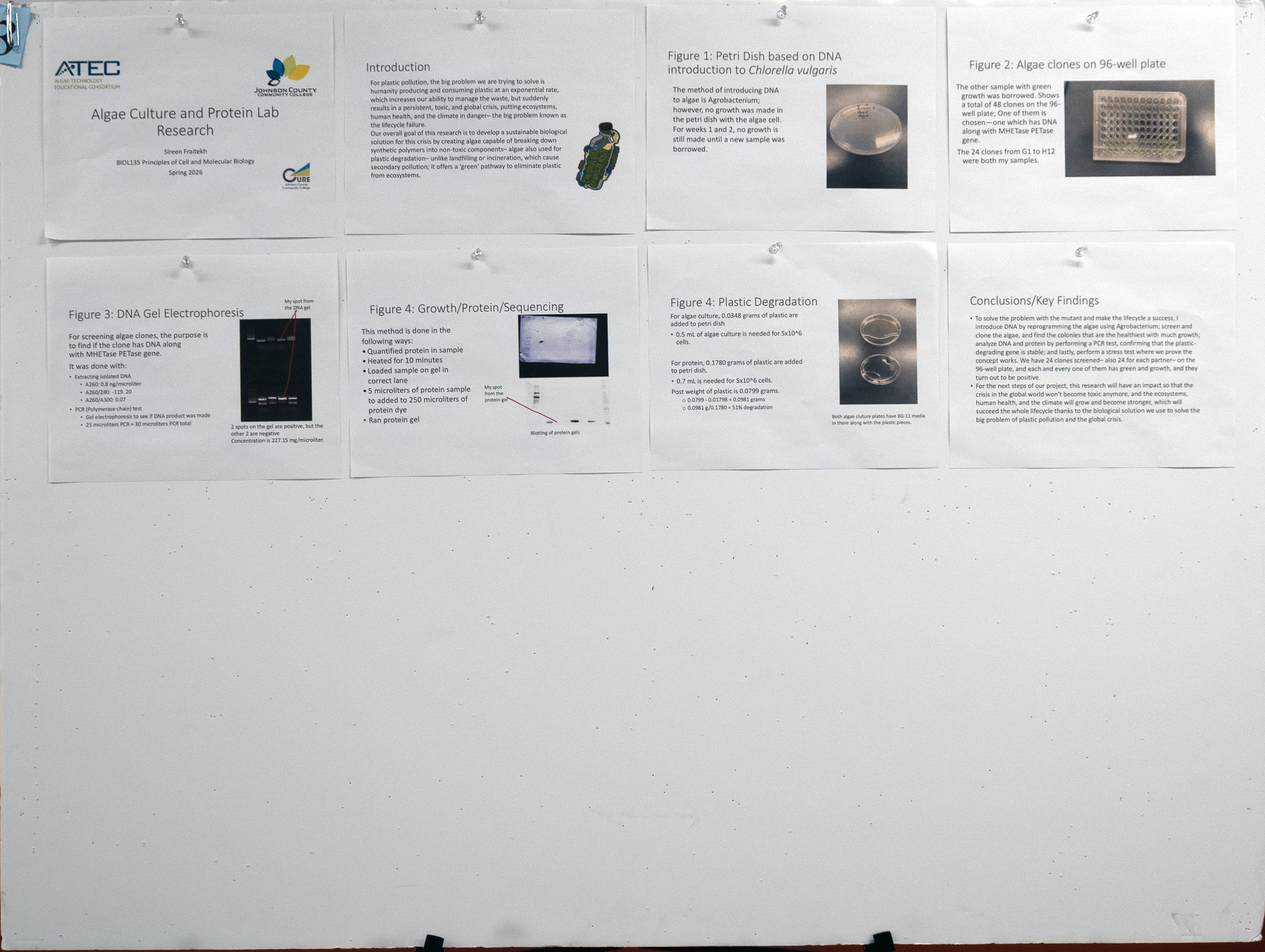
For plastic pollution, the big problem we are trying to solve is humanity producing and consuming plastic at an exponential rate, which increases our ability to manage the waste, but suddenly results in a persistent, toxic, and global crisis, putting ecosystems, human health, and the climate in danger– the big problem known as the lifecycle failure. Our overall goal of this research is to develop a sustainable biological solution for this crisis by creating algae capable of breaking down synthetic polymers into non-toxic components– algae also used for plastic degradation– unlike landfilling or incineration, which cause secondary pollution; it offers a ‘green’ pathway to eliminate plastic from ecosystems. To solve this, we introduce DNA by reprogramming the algae using electroporation or Agrobacterium; screen and clone the algae, and find the colonies that are the healthiest with much growth; analyze DNA and protein by performing a PCR test, confirming that the plastic-degrading gene is stable; and lastly, perform a stress test where we prove the concept works. We have 24 clones screened– also 24 for each partner– on the 96-well plate, and each and every one of them has green and growth, and they turn out to be positive. For the next steps of our project, this research will have an impact so that the crisis in the global world won’t become toxic anymore, and the ecosystems, human health, and the climate will grow and become stronger, which will succeed the whole lifecycle thanks to the biological solution we use to solve the big problem of plastic pollution and the global crisis.
Image
Poster Synopsium Project
CoLab, COM 386
For plastic pollution, the big problem we are trying to solve is humanity producing and consuming plastic at an exponential rate, which increases our ability to manage the waste, but suddenly results in a persistent, toxic, and global crisis, putting ecosystems, human health, and the climate in danger– the big problem known as the lifecycle failure. Our overall goal of this research is to develop a sustainable biological solution for this crisis by creating algae capable of breaking down synthetic polymers into non-toxic components– algae also used for plastic degradation– unlike landfilling or incineration, which cause secondary pollution; it offers a ‘green’ pathway to eliminate plastic from ecosystems. To solve this, we introduce DNA by reprogramming the algae using electroporation or Agrobacterium; screen and clone the algae, and find the colonies that are the healthiest with much growth; analyze DNA and protein by performing a PCR test, confirming that the plastic-degrading gene is stable; and lastly, perform a stress test where we prove the concept works. We have 24 clones screened– also 24 for each partner– on the 96-well plate, and each and every one of them has green and growth, and they turn out to be positive. For the next steps of our project, this research will have an impact so that the crisis in the global world won’t become toxic anymore, and the ecosystems, human health, and the climate will grow and become stronger, which will succeed the whole lifecycle thanks to the biological solution we use to solve the big problem of plastic pollution and the global crisis.
Comments
The faculty mentor for this project was Heather Seitz.