

Separation and Isolation of Antimicrobial Compounds Produced by a Bacteria Isolated from Soil
Location
CoLab, COM 378
Start Date
30-4-2026 3:45 PM
Document Type
Poster
Description
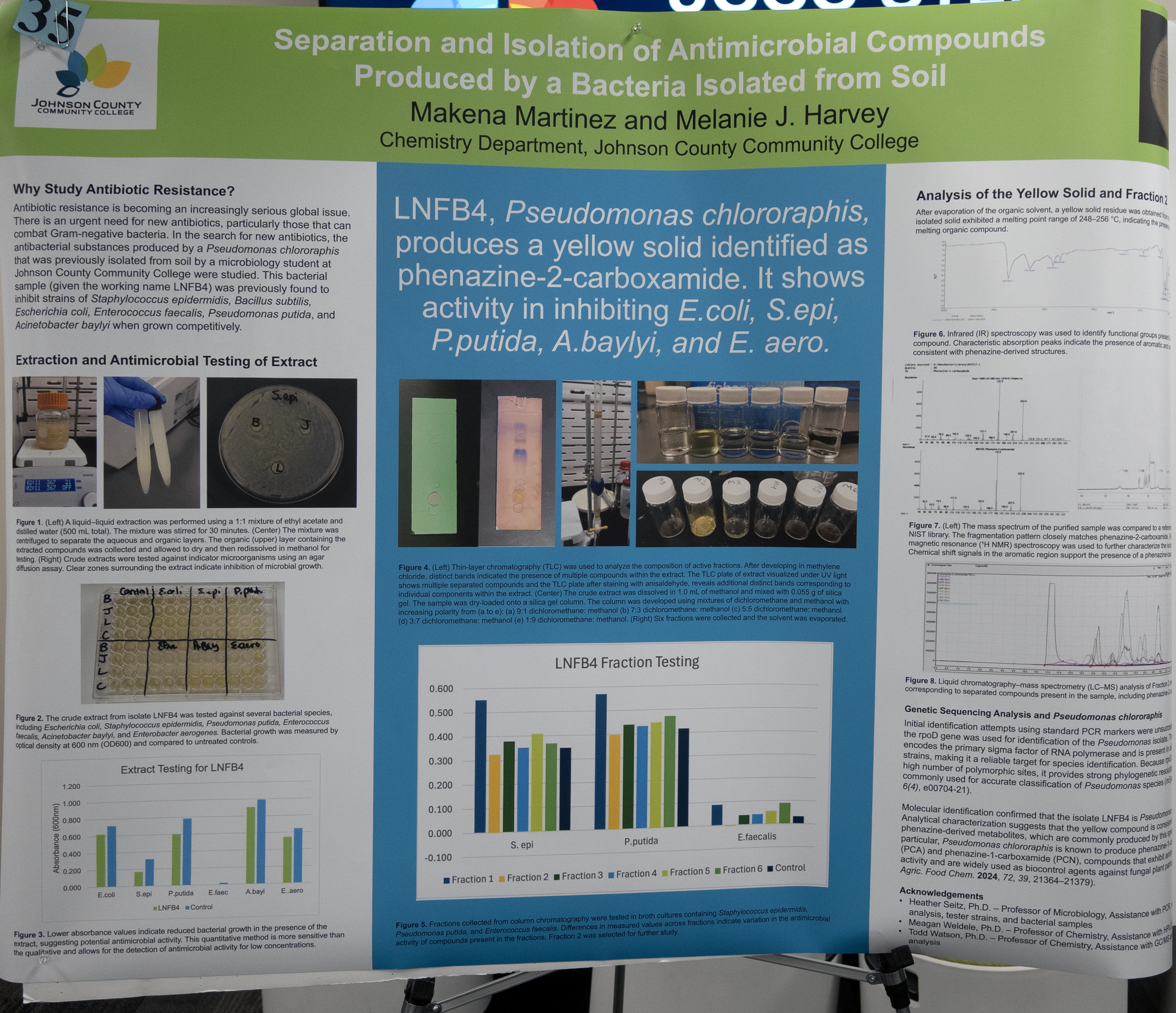
Antibiotic resistance is becoming an increasingly serious global issue. There is an urgent demand for new antibiotics, especially ones that can combat Gram-negative bacteria. In the search for new antibiotics, the antibacterial substances produced by a putative Pseudomonas marginalis that was previously isolated from soil by a microbiology student at Johnson County Community College were studied. This bacteria sample was previously found to inhibit strains of Staphylococcus epidermidis, Bacillus subtilis, Escherichia coli, Enterococcus faecalis, Pseudomonas putida, and Acenitobacter baylyi when grown competitively. Extracts of this bacteria were found to contain copious amounts of a yellow crystalline solid. In this research we isolated, tested, and characterized the yellow solid using IR, GC/MS, and NMR. The other compounds of interest produced by this bacteria sample were separated and tested using various chromatography techniques, including column chromatography, HPLC and HPLC-MS. The methods used and results will be discussed.
Image
Separation and Isolation of Antimicrobial Compounds Produced by a Bacteria Isolated from Soil
CoLab, COM 378
Antibiotic resistance is becoming an increasingly serious global issue. There is an urgent demand for new antibiotics, especially ones that can combat Gram-negative bacteria. In the search for new antibiotics, the antibacterial substances produced by a putative Pseudomonas marginalis that was previously isolated from soil by a microbiology student at Johnson County Community College were studied. This bacteria sample was previously found to inhibit strains of Staphylococcus epidermidis, Bacillus subtilis, Escherichia coli, Enterococcus faecalis, Pseudomonas putida, and Acenitobacter baylyi when grown competitively. Extracts of this bacteria were found to contain copious amounts of a yellow crystalline solid. In this research we isolated, tested, and characterized the yellow solid using IR, GC/MS, and NMR. The other compounds of interest produced by this bacteria sample were separated and tested using various chromatography techniques, including column chromatography, HPLC and HPLC-MS. The methods used and results will be discussed.
Comments
The faculty mentor for this project was Melanie Harvey.