

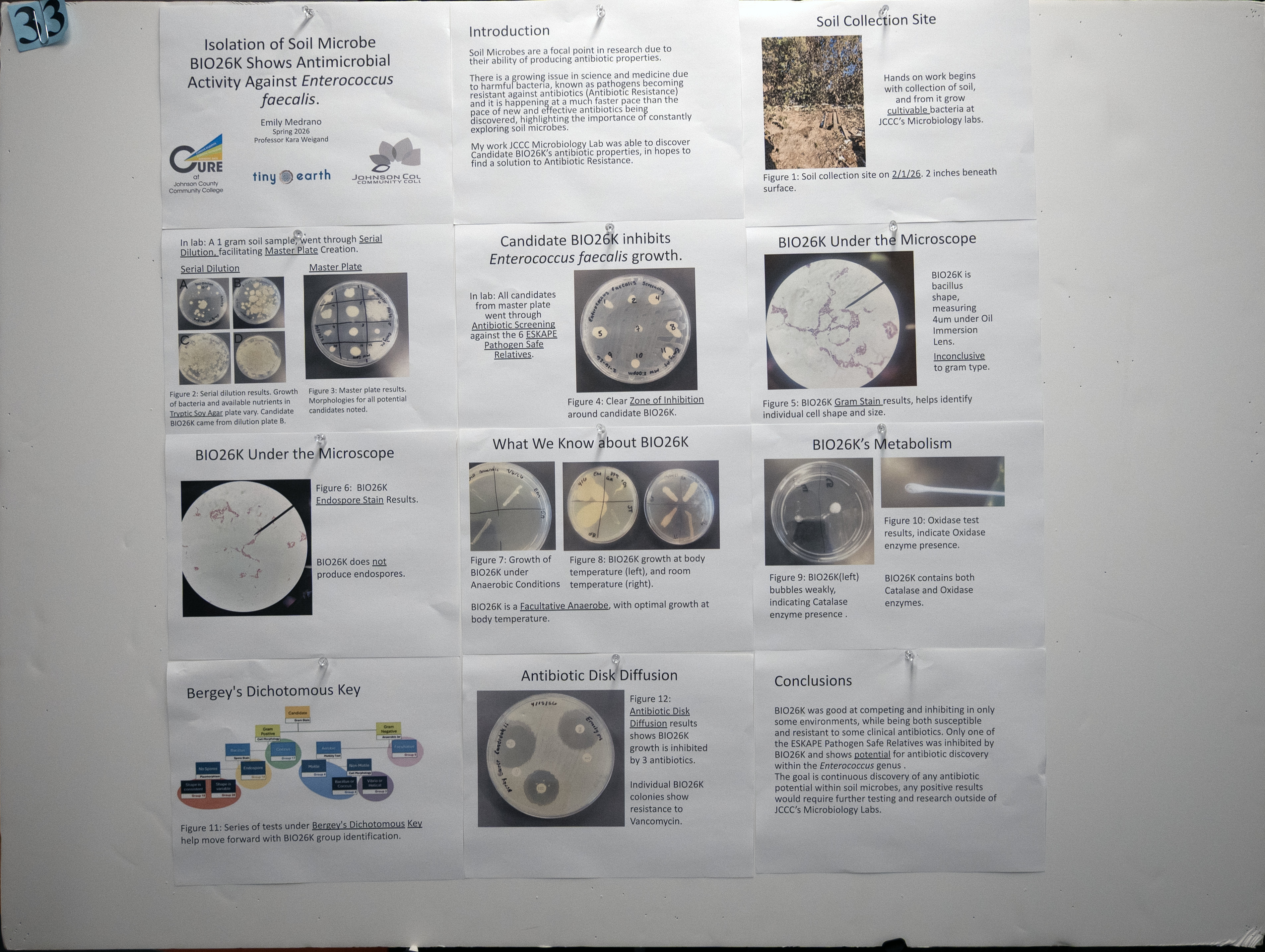
Isolation of Soil Microbe BIO26K Shows Antimicrobial Activity Against Enterococcus Faecalis
Location
CoLab, COM 376
Start Date
30-4-2026 3:45 PM
Document Type
Poster
Description
Soil microbes have been a focal point in research due to their capability of producing antibiotic properties in given environments. The work done here at JCCC’s Microbiology labs goes hand in hand with the growing issue in science and medicine of antibiotic resistance. This means that harmful bacteria, also known as pathogens, are able to grow resistance against antibiotics, and it is happening at a faster pace than the pace of new antibiotics being discovered, highlighting the importance of exploring soil microbes. With the work done in Microbiology labs, we are able to work with 1 gram of our soil, predominantly from various areas within the county and neighboring counties, and from it grow cultivable bacteria in the lab. Part of the process is individually picking the groups of bacteria we want to work with from what we grew in the lab. Isolating the best candidates can come from observing a zone of inhibition among candidates we choose to work with and put through tests. This is a good sign, as a zone of inhibition means other bacteria are unable to grow around a candidate. Candidate BIO26K, a soil microbe, was able to produce a zone of inhibition on Enterococcus faecalis, a safe relief to ESCAPE pathogens. These results indicate antimicrobial compounds and a potential antibiotic-producing microbe.
Image
Isolation of Soil Microbe BIO26K Shows Antimicrobial Activity Against Enterococcus Faecalis
CoLab, COM 376
Soil microbes have been a focal point in research due to their capability of producing antibiotic properties in given environments. The work done here at JCCC’s Microbiology labs goes hand in hand with the growing issue in science and medicine of antibiotic resistance. This means that harmful bacteria, also known as pathogens, are able to grow resistance against antibiotics, and it is happening at a faster pace than the pace of new antibiotics being discovered, highlighting the importance of exploring soil microbes. With the work done in Microbiology labs, we are able to work with 1 gram of our soil, predominantly from various areas within the county and neighboring counties, and from it grow cultivable bacteria in the lab. Part of the process is individually picking the groups of bacteria we want to work with from what we grew in the lab. Isolating the best candidates can come from observing a zone of inhibition among candidates we choose to work with and put through tests. This is a good sign, as a zone of inhibition means other bacteria are unable to grow around a candidate. Candidate BIO26K, a soil microbe, was able to produce a zone of inhibition on Enterococcus faecalis, a safe relief to ESCAPE pathogens. These results indicate antimicrobial compounds and a potential antibiotic-producing microbe.
Comments
The faculty mentor for this project was Kara Weigand.