

Isolation of Bacteria Capable of Antimicrobial Activity
Location
CoLab, COM 362
Start Date
30-4-2026 3:45 PM
Document Type
Poster
Description
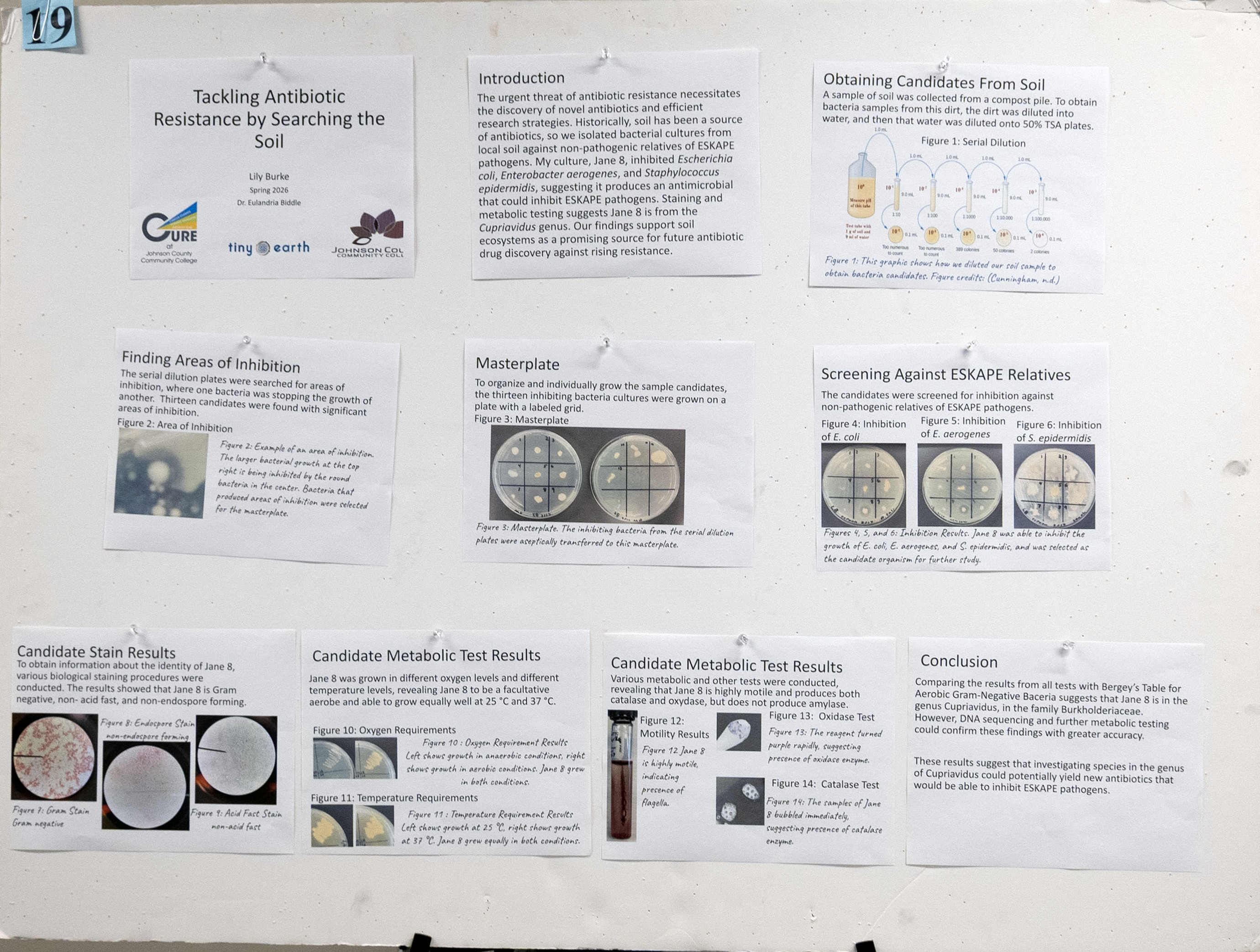
The rise of antibiotic resistance has created an urgent need for the discovery of novel antibiotics and improved research strategies for finding them. Historically, the soil has been the source of most antibiotics, so in this study, we isolated bacterial cultures from local soil samples and screened for inhibition of non-pathogenic relatives of ESKAPE pathogens. My candidate culture, Jane8, demonstrated clear inhibition of Escherichia coli, Enterobacter aerogenes, and Staphylococcus epidermidis, and partial inhibition of Acinetobacter baylyi and Enterococcus faecalis. These results suggest that Jane8 produces an antimicrobial that can possibly inhibit the growth of the ESKAPE pathogens related to the non-pathogens. Our findings support the idea that soil ecosystems remain a promising source of antibiotic-producing microorganisms, providing a pathway for future drug discovery efforts to face the growing threat of antibiotic resistance.
Image
Isolation of Bacteria Capable of Antimicrobial Activity
CoLab, COM 362
The rise of antibiotic resistance has created an urgent need for the discovery of novel antibiotics and improved research strategies for finding them. Historically, the soil has been the source of most antibiotics, so in this study, we isolated bacterial cultures from local soil samples and screened for inhibition of non-pathogenic relatives of ESKAPE pathogens. My candidate culture, Jane8, demonstrated clear inhibition of Escherichia coli, Enterobacter aerogenes, and Staphylococcus epidermidis, and partial inhibition of Acinetobacter baylyi and Enterococcus faecalis. These results suggest that Jane8 produces an antimicrobial that can possibly inhibit the growth of the ESKAPE pathogens related to the non-pathogens. Our findings support the idea that soil ecosystems remain a promising source of antibiotic-producing microorganisms, providing a pathway for future drug discovery efforts to face the growing threat of antibiotic resistance.
Comments
The faculty mentor for this project was Eulandria Biddle.