

Microbes Beneath Our Feet
Location
CoLab, COM 363
Start Date
30-4-2026 3:45 PM
Document Type
Poster
Description
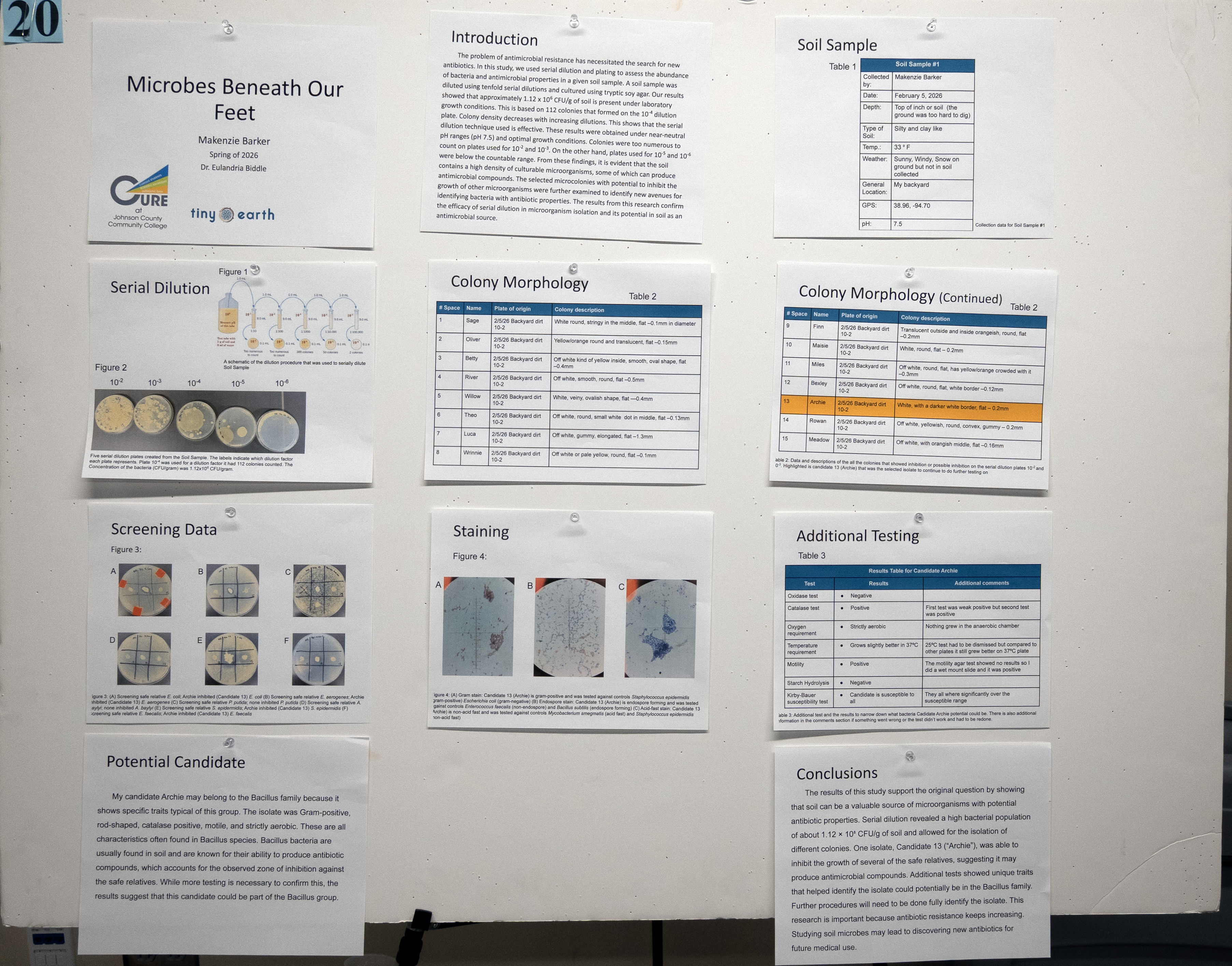
The problem of antimicrobial resistance has necessitated the search for new antibiotics. In this study, we used serial dilution and plating to assess the abundance of bacteria and antimicrobial properties in a given soil sample. A soil sample was diluted using tenfold serial dilutions and cultured using tryptic soy agar. Our results showed that approximately 1.12 x 10^6 CFU/g of soil is present under laboratory growth conditions. This is based on 112 colonies that formed on the 10^-4 dilution plate. Colony density decreases with increasing dilutions. This shows that the serial dilution technique used is effective. These results were obtained under near-neutral pH ranges (pH 7.5) and optimal growth conditions. Colonies were too numerous to count on plates used for 10^-2 and 10^-3. On the other hand, plates used for 10^-5 and 10^-6 were below the countable range. From these findings, it is evident that the soil contains a high density of culturable microorganisms, some of which can produce antimicrobial compounds. The selected microcolonies with potential to inhibit the growth of other microorganisms were further examined to identify new avenues for identifying bacteria with antibiotic properties. The results from this research confirm the efficacy of serial dilution in microorganism isolation and its potential in soil as an antimicrobial source.
Image
Microbes Beneath Our Feet
CoLab, COM 363
The problem of antimicrobial resistance has necessitated the search for new antibiotics. In this study, we used serial dilution and plating to assess the abundance of bacteria and antimicrobial properties in a given soil sample. A soil sample was diluted using tenfold serial dilutions and cultured using tryptic soy agar. Our results showed that approximately 1.12 x 10^6 CFU/g of soil is present under laboratory growth conditions. This is based on 112 colonies that formed on the 10^-4 dilution plate. Colony density decreases with increasing dilutions. This shows that the serial dilution technique used is effective. These results were obtained under near-neutral pH ranges (pH 7.5) and optimal growth conditions. Colonies were too numerous to count on plates used for 10^-2 and 10^-3. On the other hand, plates used for 10^-5 and 10^-6 were below the countable range. From these findings, it is evident that the soil contains a high density of culturable microorganisms, some of which can produce antimicrobial compounds. The selected microcolonies with potential to inhibit the growth of other microorganisms were further examined to identify new avenues for identifying bacteria with antibiotic properties. The results from this research confirm the efficacy of serial dilution in microorganism isolation and its potential in soil as an antimicrobial source.
Comments
The faculty mentor for this project was Eulandria Biddle.