

Earth Operative: Unearthing Natural Microbial Defenses
Location
CoLab, COM 127
Start Date
30-4-2026 8:15 AM
Document Type
Poster
Description
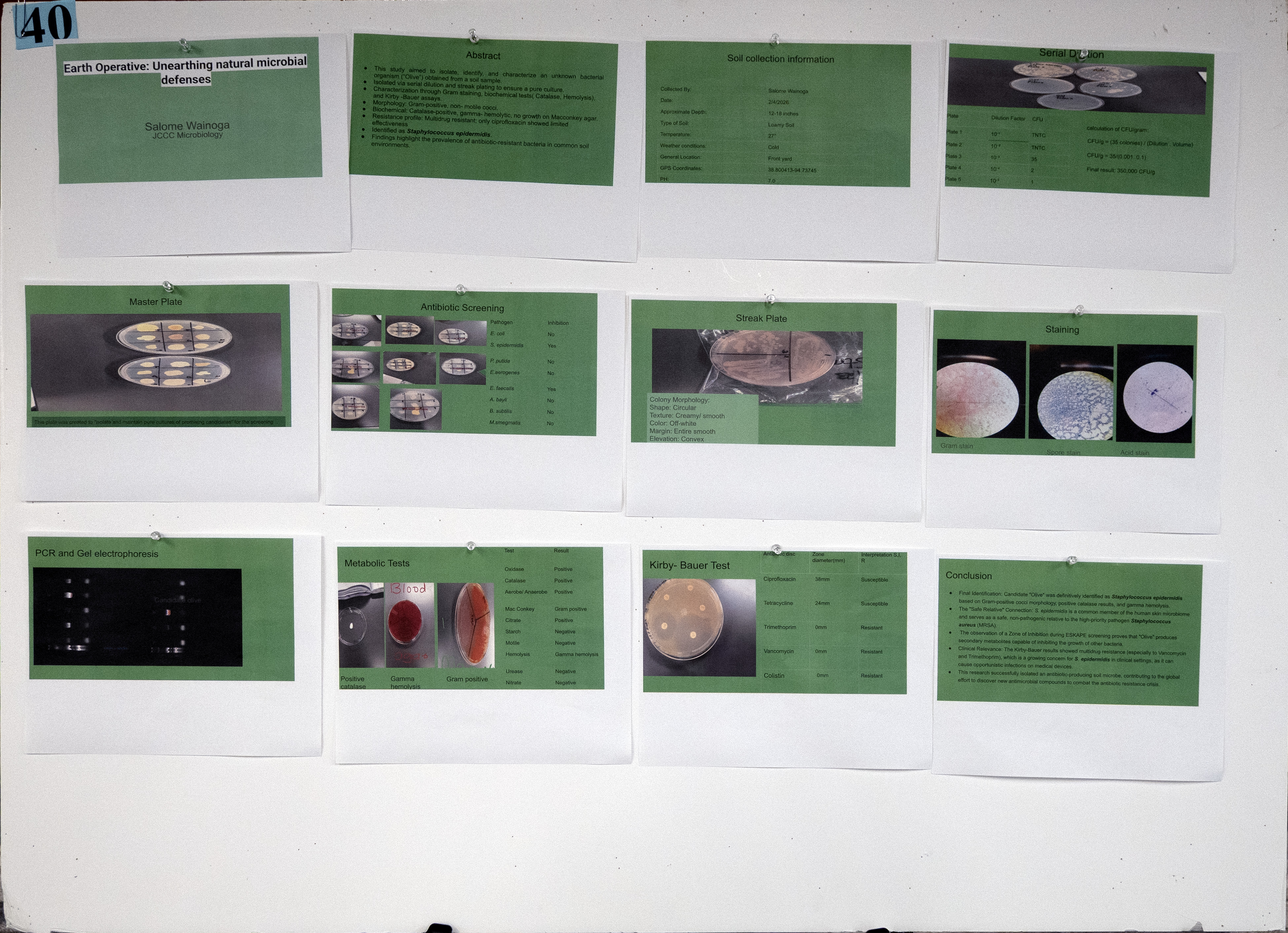
Beneath our feet lies a hidden world filled with microbes. Some are harmless, while others possess chemical weapons against their neighbors. This project aims to identify such microbial 'champions' from soil collected at Johnson County Community College and from a personal sample from my front yard. The soil samples were serially diluted and plated to isolate individual colonies, which were then tested against safe relatives of ESKAPE pathogens. Early results showed intriguing activity: Acinetobacter baylyi and Enterococcus faecalis from JCCC soil, and Staphylococcus epidermidis from my personal soil, produced clear zones of inhibition. A promising candidate from my personal soil (Olive) was prepared to obtain a pure culture. 'Olive' was further examined using Gram, spore, and acid-fast staining. Although the search continues, these findings suggest that everyday soil contains untapped antimicrobial potential. By exploring these microbial interactions, this research takes its first step toward discovering beneficial natural agents in the fight against resistant bacteria.
Image
Earth Operative: Unearthing Natural Microbial Defenses
CoLab, COM 127
Beneath our feet lies a hidden world filled with microbes. Some are harmless, while others possess chemical weapons against their neighbors. This project aims to identify such microbial 'champions' from soil collected at Johnson County Community College and from a personal sample from my front yard. The soil samples were serially diluted and plated to isolate individual colonies, which were then tested against safe relatives of ESKAPE pathogens. Early results showed intriguing activity: Acinetobacter baylyi and Enterococcus faecalis from JCCC soil, and Staphylococcus epidermidis from my personal soil, produced clear zones of inhibition. A promising candidate from my personal soil (Olive) was prepared to obtain a pure culture. 'Olive' was further examined using Gram, spore, and acid-fast staining. Although the search continues, these findings suggest that everyday soil contains untapped antimicrobial potential. By exploring these microbial interactions, this research takes its first step toward discovering beneficial natural agents in the fight against resistant bacteria.
Comments
The faculty mentor for this project was Beverly Tanui.