

Antibiotic Revolution
Location
CoLab, COM 361
Start Date
30-4-2026 3:45 PM
Document Type
Poster
Description
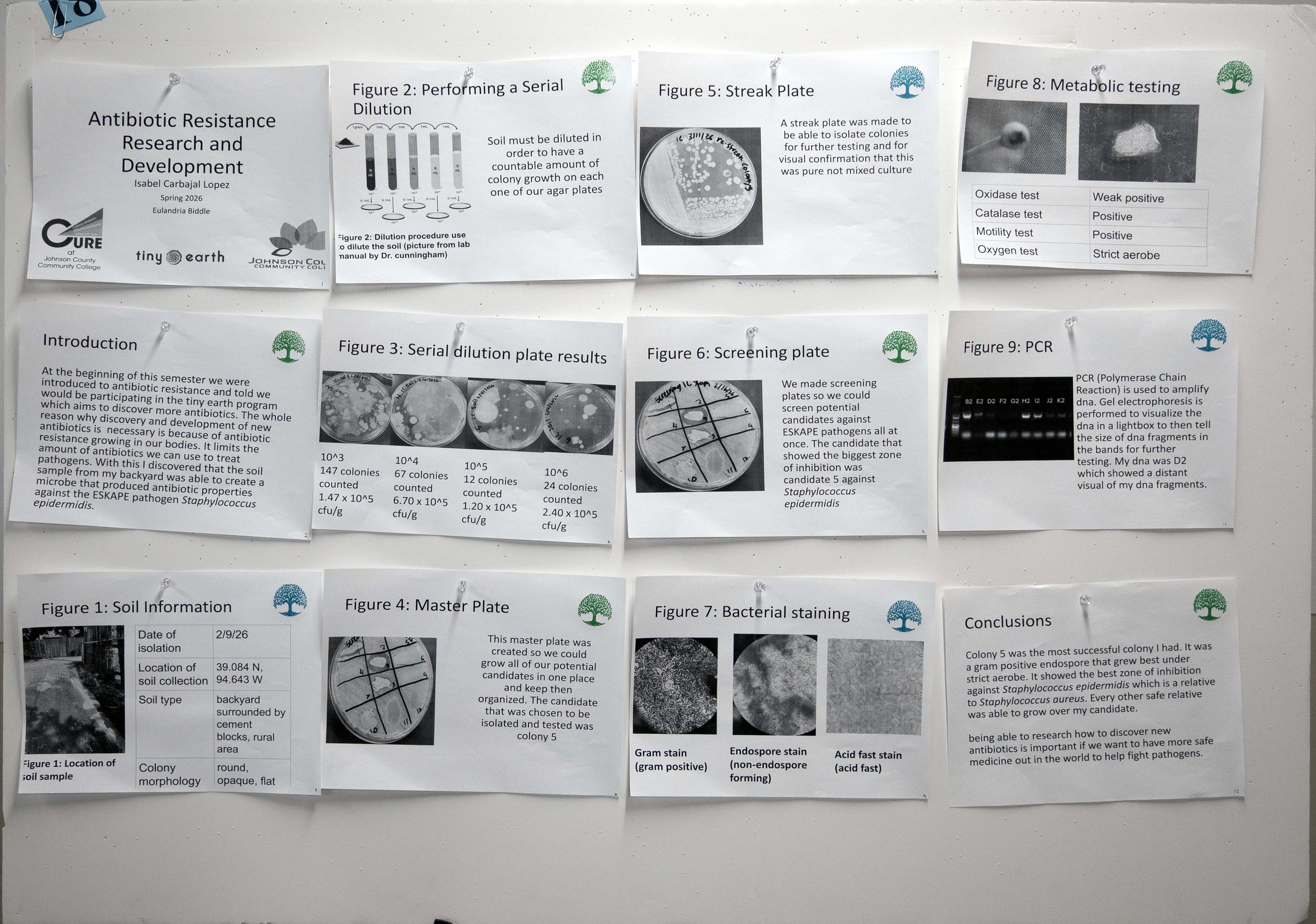
What if common infections that could easily be cured in the present one day become a death sentence. Developing new antibiotics is the key factor to treating things like disease but what happens when our bodies start adapting to resist these antibiotics therefore making them useless. We searched for new species of bacteria from common soil in hopes of finding the next antibiotic. First starting off by collecting soil from my garden and performing a serial dilution procedure in order to have a countable number of bacteria. After all the bacteria was incubated at room temperature on our TSA agar plates, I then chose twelve different potential candidates that showed zones of inhibition. We created a master plate in order to isolate bacterial colonies from our dilutions and organize them. After we incubated our master plates, we screened them against our safe relatives Enterococcus faecalis, Staphylococcus epidermidis, Escherichia coli, Acinetobacter baylyi, Pseudomonas putida, and Enterobacter aerogenes. I found three potential colonies that showed major zones of inhibition against bacteria’s S. epidermis and E. faecalis. I chose my fifth colony because it had the biggest and most clear zone of inhibition against both cultures. After finding the perfect colony I made a 3-streak plate for the purpose of separating individual cells. Lastly, we used that candidate and mixed in with our DNA sample and completed a PCR procedure to visualize the bands. Research like this is important for finding new antibiotics and discovering new medical opportunities for our future patients.
Image
Antibiotic Revolution
CoLab, COM 361
What if common infections that could easily be cured in the present one day become a death sentence. Developing new antibiotics is the key factor to treating things like disease but what happens when our bodies start adapting to resist these antibiotics therefore making them useless. We searched for new species of bacteria from common soil in hopes of finding the next antibiotic. First starting off by collecting soil from my garden and performing a serial dilution procedure in order to have a countable number of bacteria. After all the bacteria was incubated at room temperature on our TSA agar plates, I then chose twelve different potential candidates that showed zones of inhibition. We created a master plate in order to isolate bacterial colonies from our dilutions and organize them. After we incubated our master plates, we screened them against our safe relatives Enterococcus faecalis, Staphylococcus epidermidis, Escherichia coli, Acinetobacter baylyi, Pseudomonas putida, and Enterobacter aerogenes. I found three potential colonies that showed major zones of inhibition against bacteria’s S. epidermis and E. faecalis. I chose my fifth colony because it had the biggest and most clear zone of inhibition against both cultures. After finding the perfect colony I made a 3-streak plate for the purpose of separating individual cells. Lastly, we used that candidate and mixed in with our DNA sample and completed a PCR procedure to visualize the bands. Research like this is important for finding new antibiotics and discovering new medical opportunities for our future patients.
Comments
The faculty mentor for this project was Eulandria Biddle.