

Studying WTH - E Bacteria
Location
CoLab, COM 125
Start Date
30-4-2026 8:15 AM
Document Type
Poster
Description
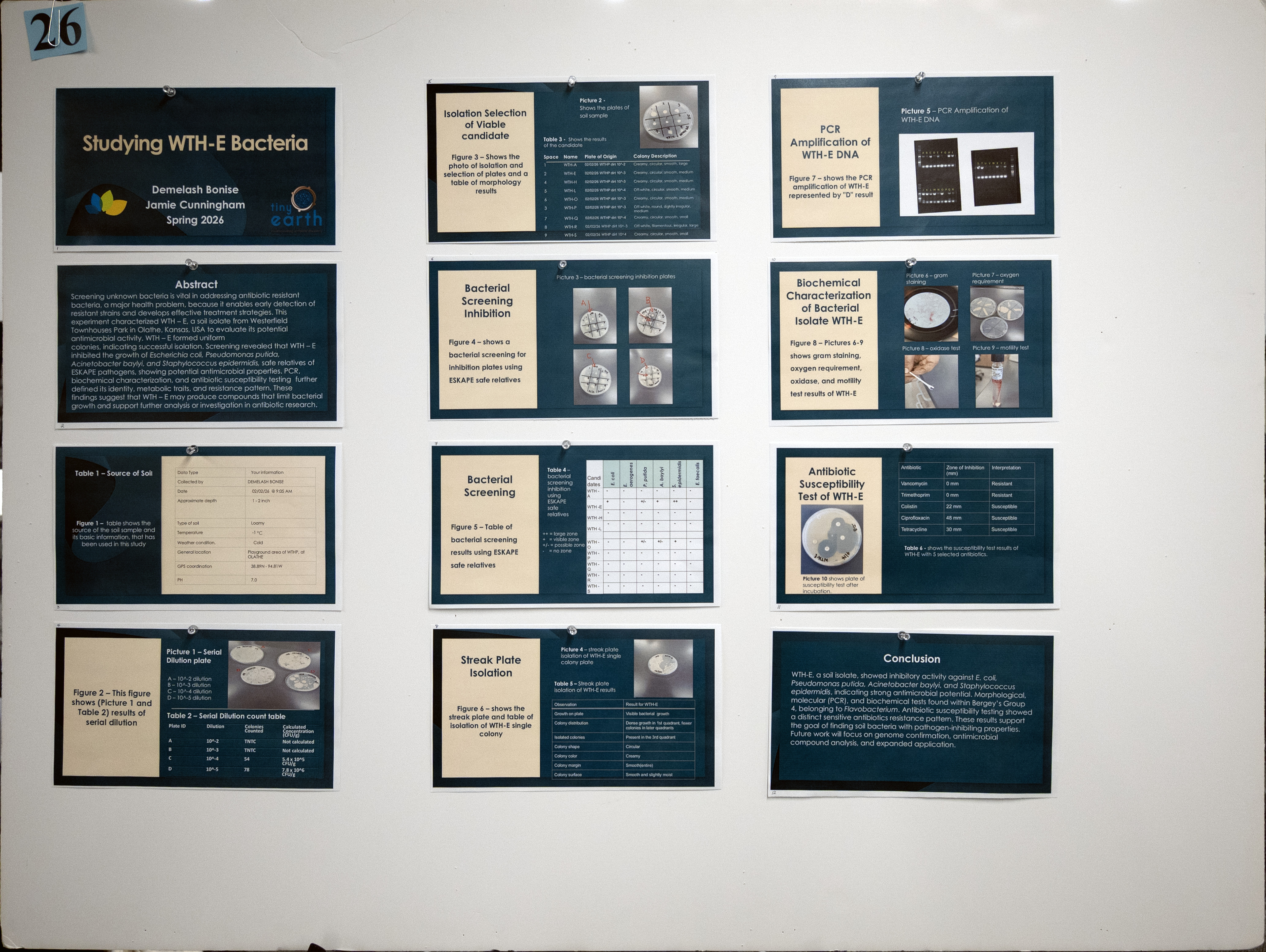
Screening unknown bacteria is vital in addressing antibiotic resistant bacteria, a major health problem, because it enables early detection of resistant strains and develops effective treatment strategies. This experiment characterized WTH – E, a soil isolate from Winterfield Townhouses Park in Olathe, Kansas, to evaluate its potential antimicrobial activity. WTH – E formed uniform colonies, indicating successful isolation. Screening revealed that WTH – E inhibited the growth of Escherichia coli, Pseudomonas putida, Acinetobacter baylyi, and Staphylococcus epidermidis, safe relatives of ESKAPE pathogens, indicating potential antimicrobial properties. These findings suggest that WTH – E may produce compounds that limit bacterial growth and support further analysis or investigation in antibiotic research.
Image
Studying WTH - E Bacteria
CoLab, COM 125
Screening unknown bacteria is vital in addressing antibiotic resistant bacteria, a major health problem, because it enables early detection of resistant strains and develops effective treatment strategies. This experiment characterized WTH – E, a soil isolate from Winterfield Townhouses Park in Olathe, Kansas, to evaluate its potential antimicrobial activity. WTH – E formed uniform colonies, indicating successful isolation. Screening revealed that WTH – E inhibited the growth of Escherichia coli, Pseudomonas putida, Acinetobacter baylyi, and Staphylococcus epidermidis, safe relatives of ESKAPE pathogens, indicating potential antimicrobial properties. These findings suggest that WTH – E may produce compounds that limit bacterial growth and support further analysis or investigation in antibiotic research.
Comments
The faculty mentor for this project was Jamie Cunningham.