

The Dirt on Antibiotics: The Search for a Potential Novel Antibiotic
Location
CoLab, COM 128
Start Date
30-4-2026 8:15 AM
Document Type
Poster
Description
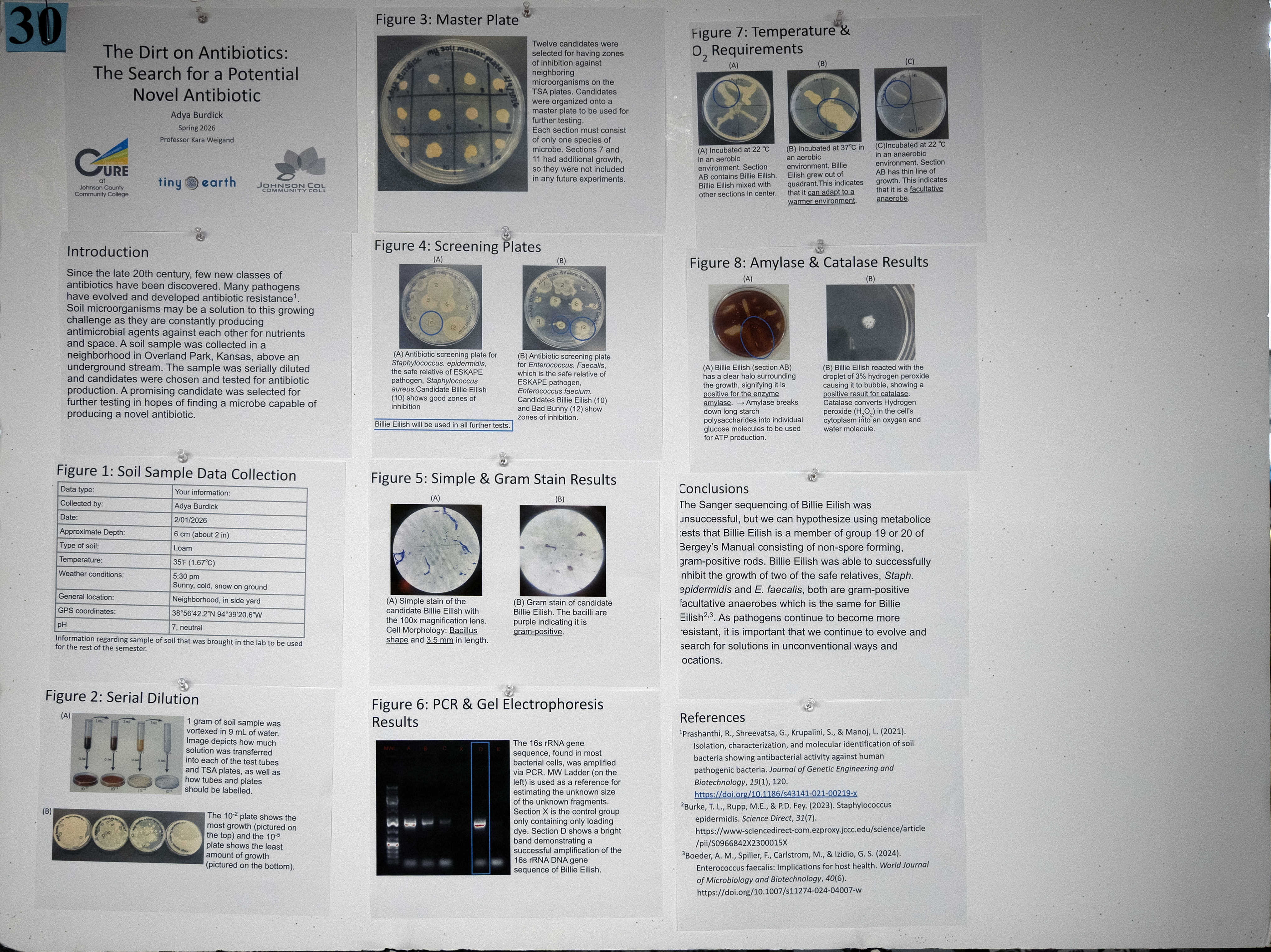
Since the late 20th century, very few new classes of antibiotics have been discovered. Pathogens have evolved to become more resistant to currently available antibiotics, limiting the number of effective treatments for infections. The Tiny Earth Network is a global organization made up of college students and professors, all searching for novel antibiotics from soil samples to be potential solutions to a global health crisis. Soil microorganisms are in a constant battle with each other for nutrients and space. They will often produce antibiotics to compete with other microbes in their environment. A soil sample was collected in a neighborhood in Overland Park, Kansas, located above an underground stream. One gram was serially diluted and candidates were selected from dilution plates. Candidates were chosen if they produced zones of inhibition against neighboring colonies. Those selected were tested for antibiotic production. A single promising candidate was then chosen for further testing in hopes of finding an unknown microbe from the original soil sample that produced a novel antibiotic.
Image
The Dirt on Antibiotics: The Search for a Potential Novel Antibiotic
CoLab, COM 128
Since the late 20th century, very few new classes of antibiotics have been discovered. Pathogens have evolved to become more resistant to currently available antibiotics, limiting the number of effective treatments for infections. The Tiny Earth Network is a global organization made up of college students and professors, all searching for novel antibiotics from soil samples to be potential solutions to a global health crisis. Soil microorganisms are in a constant battle with each other for nutrients and space. They will often produce antibiotics to compete with other microbes in their environment. A soil sample was collected in a neighborhood in Overland Park, Kansas, located above an underground stream. One gram was serially diluted and candidates were selected from dilution plates. Candidates were chosen if they produced zones of inhibition against neighboring colonies. Those selected were tested for antibiotic production. A single promising candidate was then chosen for further testing in hopes of finding an unknown microbe from the original soil sample that produced a novel antibiotic.
Comments
The faculty mentor for this project was Kara Weigand.