

Why Checking Your Water Quality Matters
Location
CoLab, COM 337
Start Date
30-4-2026 2:30 PM
Document Type
Poster
Description
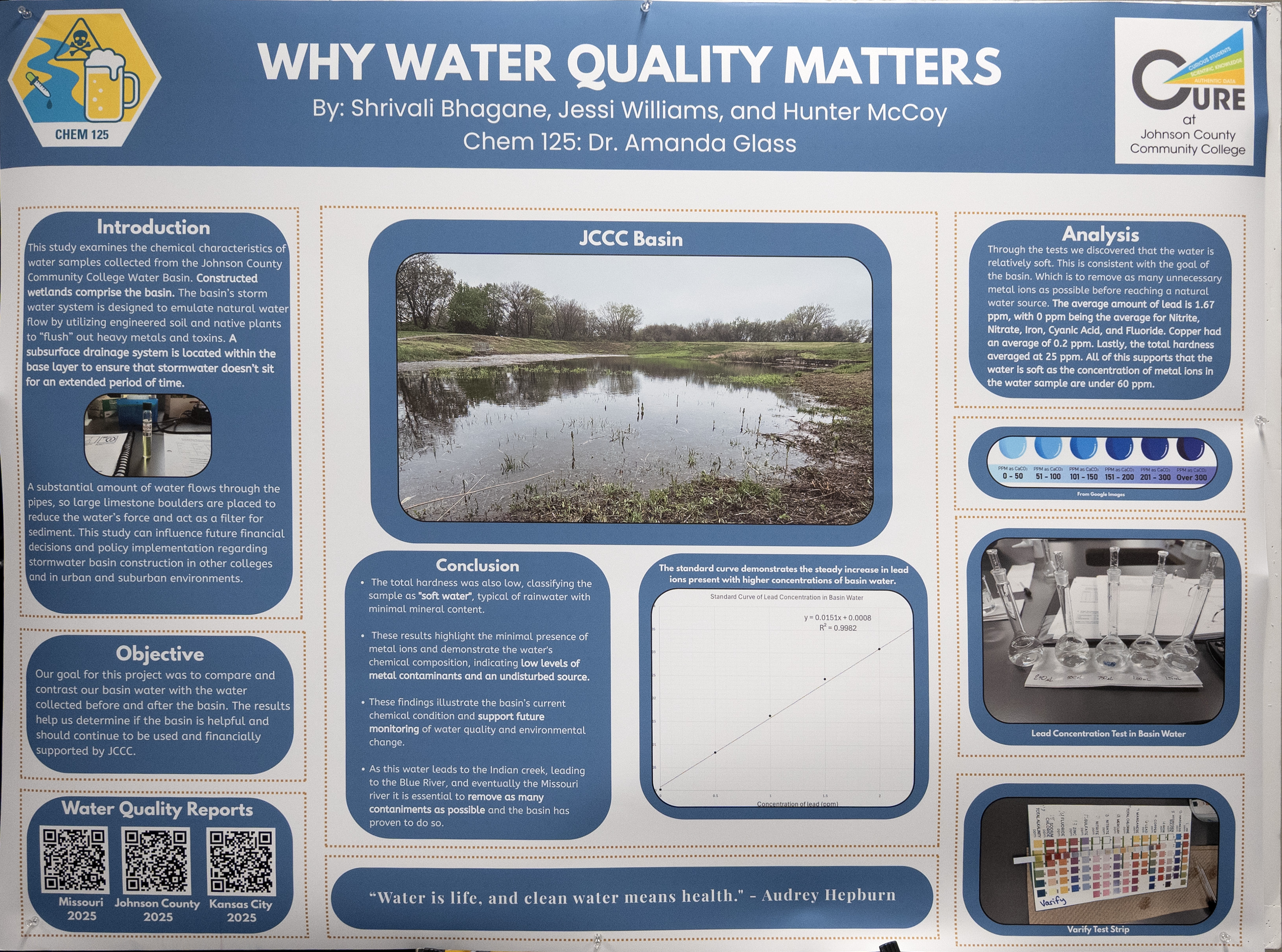
This study examines the chemical characteristics of water samples collected from the Johnson County Community College Water Basin. Constructed wetlands comprise the basin. The basin’s storm water system is designed to emulate natural water flow by utilizing engineered soil and native plants to “flush” out heavy metals and toxins. A subsurface drainage system is located within the base layer to ensure that stormwater doesn’t sit for an extended period of time. A substantial amount of water flows through the pipes, so large limestone boulders are placed to reduce the water’s force and act as a filter for sediment. This study can influence future financial decisions and policy implementation regarding stormwater basin construction in other colleges. Water samples collected earlier this year underwent various tests, including pH, alkalinity, metal ion detection, and conductivity, to evaluate water quality. The conductivity test and water strip data indicate the water is a non-electrolyte with a significant lack of metal ions, resulting in low conductivity. The total hardness was also low, classifying the sample as "soft water," typical of rainwater with minimal mineral content. These results highlight the minimal presence of metal ions and demonstrate the water's chemical composition, indicating low levels of metal contaminants and an undisturbed source. Together, these findings establish a clear baseline for the basin’s current chemical condition and support future monitoring of water quality and environmental change.
Image
Why Checking Your Water Quality Matters
CoLab, COM 337
This study examines the chemical characteristics of water samples collected from the Johnson County Community College Water Basin. Constructed wetlands comprise the basin. The basin’s storm water system is designed to emulate natural water flow by utilizing engineered soil and native plants to “flush” out heavy metals and toxins. A subsurface drainage system is located within the base layer to ensure that stormwater doesn’t sit for an extended period of time. A substantial amount of water flows through the pipes, so large limestone boulders are placed to reduce the water’s force and act as a filter for sediment. This study can influence future financial decisions and policy implementation regarding stormwater basin construction in other colleges. Water samples collected earlier this year underwent various tests, including pH, alkalinity, metal ion detection, and conductivity, to evaluate water quality. The conductivity test and water strip data indicate the water is a non-electrolyte with a significant lack of metal ions, resulting in low conductivity. The total hardness was also low, classifying the sample as "soft water," typical of rainwater with minimal mineral content. These results highlight the minimal presence of metal ions and demonstrate the water's chemical composition, indicating low levels of metal contaminants and an undisturbed source. Together, these findings establish a clear baseline for the basin’s current chemical condition and support future monitoring of water quality and environmental change.
Comments
The faculty mentor for this project was Amanda Glass.