

Nine Tried, Three Times, only One Survived
Location
CoLab, COM 315
Start Date
30-4-2026 2:30 PM
Document Type
Poster
Description
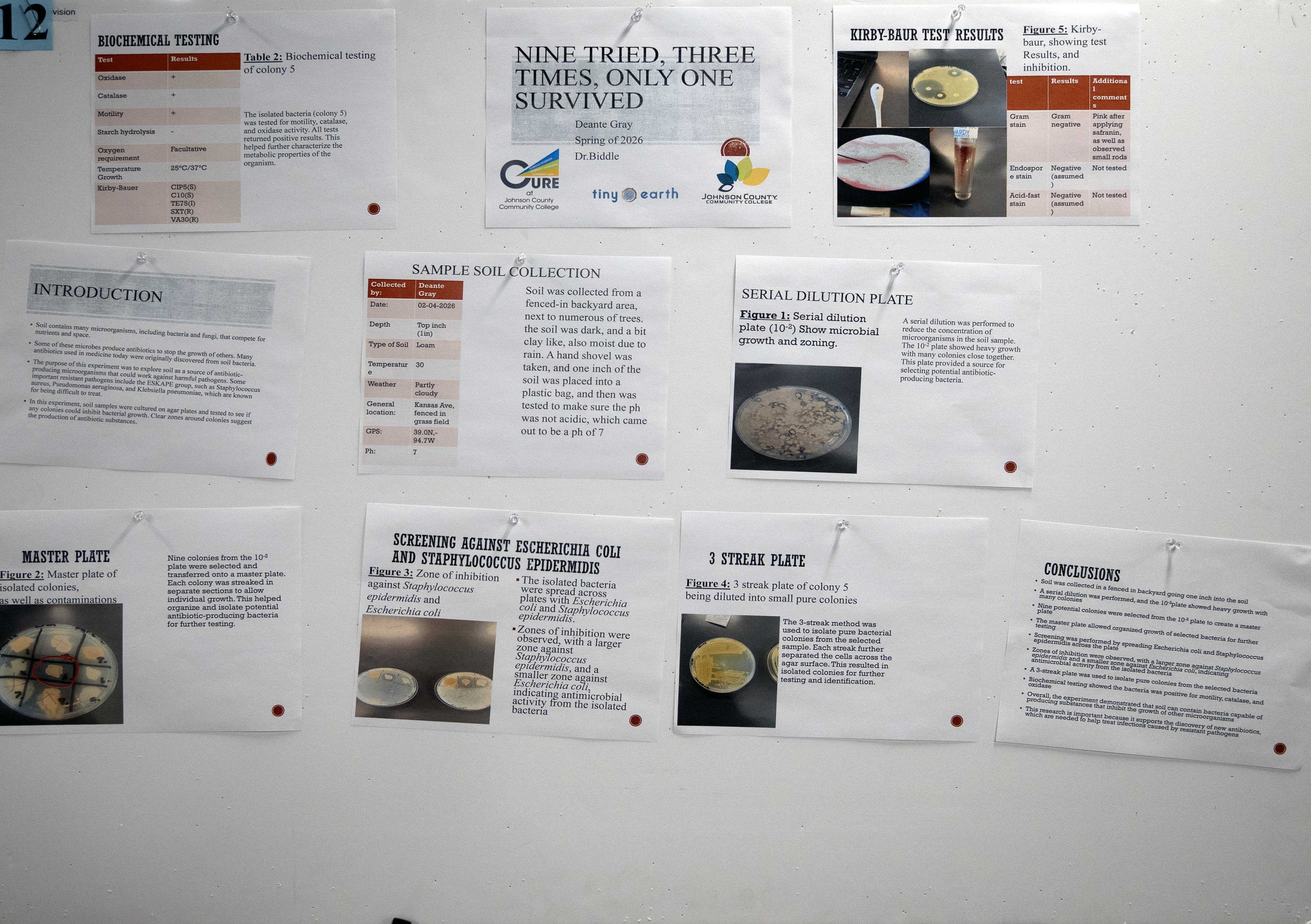
Antibiotic resistance is an increasing concern in modern medicine, as many bacteria are becoming less responsive to commonly used treatments. While ESKAPE pathogens are widely known for their resistance, other bacteria such as Escherichia coli and Staphylococcus epidermidis are also important in laboratory studies. These organisms are commonly used to test the effectiveness of potential antimicrobial agents. Due to the rise in resistance, it is important to identify new isolates that can inhibit bacterial growth effectively. In this study, serial dilution was performed first to prepare a range of concentrations for testing antimicrobial activity. This process allowed for accurate evaluation of each microorganism by reducing the number of cells to a countable level, making it possible to compare growth and identify the most effective isolate. After dilution, master plating was used to isolate and maintain pure colonies for consistent testing. A total of nine isolates were examined for their antimicrobial potential. The results showed that one isolate demonstrated the strongest antimicrobial activity against both Escherichia coli and Staphylococcus epidermidis. This isolate remained effective even at lower concentrations, indicating a high level of potency. The remaining isolates showed weaker or less consistent effects across the tested concentrations. Overall, the combination of serial dilution and master plating was effective in identifying a promising antimicrobial candidate. The selected isolate shows potential as an antimicrobial agent, and further research is needed to explore its properties and its possible use in treating resistant bacterial infections.
Image
Nine Tried, Three Times, only One Survived
CoLab, COM 315
Antibiotic resistance is an increasing concern in modern medicine, as many bacteria are becoming less responsive to commonly used treatments. While ESKAPE pathogens are widely known for their resistance, other bacteria such as Escherichia coli and Staphylococcus epidermidis are also important in laboratory studies. These organisms are commonly used to test the effectiveness of potential antimicrobial agents. Due to the rise in resistance, it is important to identify new isolates that can inhibit bacterial growth effectively. In this study, serial dilution was performed first to prepare a range of concentrations for testing antimicrobial activity. This process allowed for accurate evaluation of each microorganism by reducing the number of cells to a countable level, making it possible to compare growth and identify the most effective isolate. After dilution, master plating was used to isolate and maintain pure colonies for consistent testing. A total of nine isolates were examined for their antimicrobial potential. The results showed that one isolate demonstrated the strongest antimicrobial activity against both Escherichia coli and Staphylococcus epidermidis. This isolate remained effective even at lower concentrations, indicating a high level of potency. The remaining isolates showed weaker or less consistent effects across the tested concentrations. Overall, the combination of serial dilution and master plating was effective in identifying a promising antimicrobial candidate. The selected isolate shows potential as an antimicrobial agent, and further research is needed to explore its properties and its possible use in treating resistant bacterial infections.
Comments
The faculty mentor for this project was Eulandria Biddle.