

Finding a Gem in the Soil - Antibiotic Production by "Bejeweled 3"
Location
CoLab, COM 293
Start Date
30-4-2026 1:15 PM
Document Type
Poster
Description
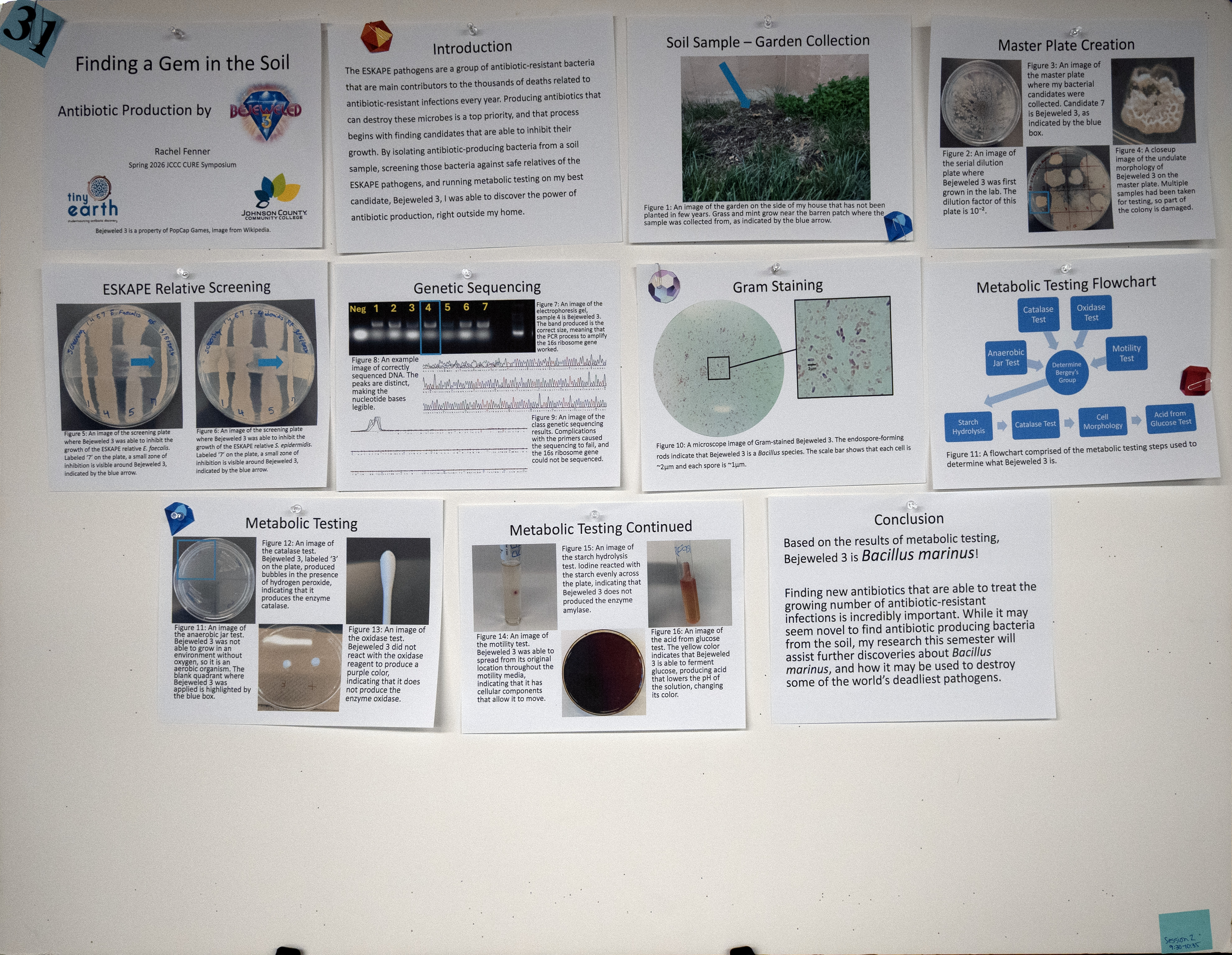
The ESKAPE pathogens are a group of antibiotic resistant bacteria that are incredibly dangerous because there is currently no medication that destroys these microbes. The deadly infections they cause are incurable, making the discovery of new antibiotics imperative. Soil has an incredible diversity of bacteria, some of which are able to produce antibiotics which help them thrive in their environment. By collecting fertile soil from a creek bed, an abandoned garden, and a marsh, I had a good chance of getting a diverse collection of bacteria without much chemical contamination. By diluting my soil samples in a series, I was able to grow bacterial colonies on agar plates and identify ones that created a zone of inhibition - an open area around the colony caused by antibiotic production that helps to push away its competitors. I then collected these antibiotic-producing candidates and stored them on a master plate where I could take bacterial samples of each specific colony. Using laboratory-safe relatives of the ESKAPE pathogens, I pit each of my candidates against each ESKAPE relative to find out if my bacteria could inhibit their growth. Out of the seven candidates I screened, two were antibiotic producers. My best candidate, Bejeweled 3, was able to inhibit both Enterococcus faecalis and Staphylococcus epidermidis. Moving forward, I will be determining the type of bacteria that Bejeweled 3 is through metabolic and genomic testing, helping to pave the way for its antibiotic-producing power to be harnessed against E. faecalis or S. epidermidis.
Image
Finding a Gem in the Soil - Antibiotic Production by "Bejeweled 3"
CoLab, COM 293
The ESKAPE pathogens are a group of antibiotic resistant bacteria that are incredibly dangerous because there is currently no medication that destroys these microbes. The deadly infections they cause are incurable, making the discovery of new antibiotics imperative. Soil has an incredible diversity of bacteria, some of which are able to produce antibiotics which help them thrive in their environment. By collecting fertile soil from a creek bed, an abandoned garden, and a marsh, I had a good chance of getting a diverse collection of bacteria without much chemical contamination. By diluting my soil samples in a series, I was able to grow bacterial colonies on agar plates and identify ones that created a zone of inhibition - an open area around the colony caused by antibiotic production that helps to push away its competitors. I then collected these antibiotic-producing candidates and stored them on a master plate where I could take bacterial samples of each specific colony. Using laboratory-safe relatives of the ESKAPE pathogens, I pit each of my candidates against each ESKAPE relative to find out if my bacteria could inhibit their growth. Out of the seven candidates I screened, two were antibiotic producers. My best candidate, Bejeweled 3, was able to inhibit both Enterococcus faecalis and Staphylococcus epidermidis. Moving forward, I will be determining the type of bacteria that Bejeweled 3 is through metabolic and genomic testing, helping to pave the way for its antibiotic-producing power to be harnessed against E. faecalis or S. epidermidis.
Comments
The faculty mentor for this project was Heather Seitz.