

Making a Solution out of a Molehill
Location
CoLab, COM 292
Start Date
30-4-2026 1:15 PM
Document Type
Poster
Description
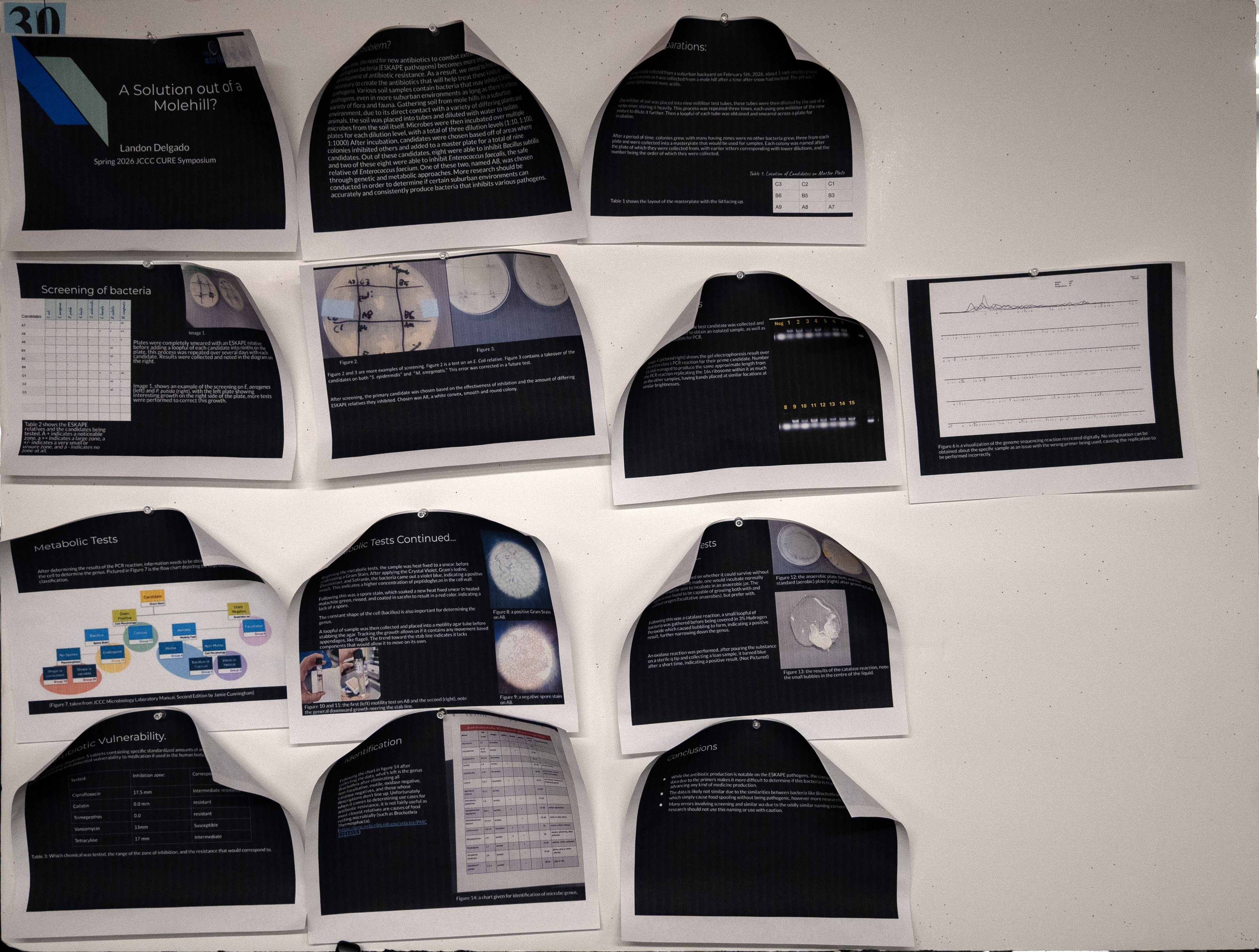
Over time, the need for new antibiotics to combat extremely harmful and contagious bacteria (ESKAPE pathogens) becomes more important due to the development of antibiotic resistance. As a result, we need to find any means necessary to create the antibiotics that will help treat these kinds of pathogens. Various soil samples contain bacteria that may inhibit ESKAPE pathogens, even in more suburban environments as long as there is a decent variety of flora and fauna. Gathering soil from mole hills in a suburban environment, due to its direct contact with a variety of differing plants and animals, the soil was placed into tubes and diluted with water to isolate microbes from the soil itself. Microbes were then incubated over multiple plates for each dilution level, with a total of three dilution levels (1:10, 1:100, 1:1000) After incubation, candidates were chosen based off of areas where colonies inhibited others and added to a master plate for a total of nine candidates. Out of these candidates, eight were able to inhibit Bacillus subtilis and two of these eight were able to inhibit Enterococcus faecalis, the safe relative of Enterococcus faecium. One of these two, named A8, was chosen through genetic and metabolic approaches. More research should be conducted in order to determine if certain suburban environments can accurately and consistently produce bacteria that inhibit various pathogens.
Image
Making a Solution out of a Molehill
CoLab, COM 292
Over time, the need for new antibiotics to combat extremely harmful and contagious bacteria (ESKAPE pathogens) becomes more important due to the development of antibiotic resistance. As a result, we need to find any means necessary to create the antibiotics that will help treat these kinds of pathogens. Various soil samples contain bacteria that may inhibit ESKAPE pathogens, even in more suburban environments as long as there is a decent variety of flora and fauna. Gathering soil from mole hills in a suburban environment, due to its direct contact with a variety of differing plants and animals, the soil was placed into tubes and diluted with water to isolate microbes from the soil itself. Microbes were then incubated over multiple plates for each dilution level, with a total of three dilution levels (1:10, 1:100, 1:1000) After incubation, candidates were chosen based off of areas where colonies inhibited others and added to a master plate for a total of nine candidates. Out of these candidates, eight were able to inhibit Bacillus subtilis and two of these eight were able to inhibit Enterococcus faecalis, the safe relative of Enterococcus faecium. One of these two, named A8, was chosen through genetic and metabolic approaches. More research should be conducted in order to determine if certain suburban environments can accurately and consistently produce bacteria that inhibit various pathogens.
Comments
The faculty mentor for this project was Heather Seitz.