

Discovery of an Antibiotic-Producing Bacterium from Soil Samples
Location
CoLab, COM 284
Start Date
30-4-2026 1:15 PM
Document Type
Poster
Description
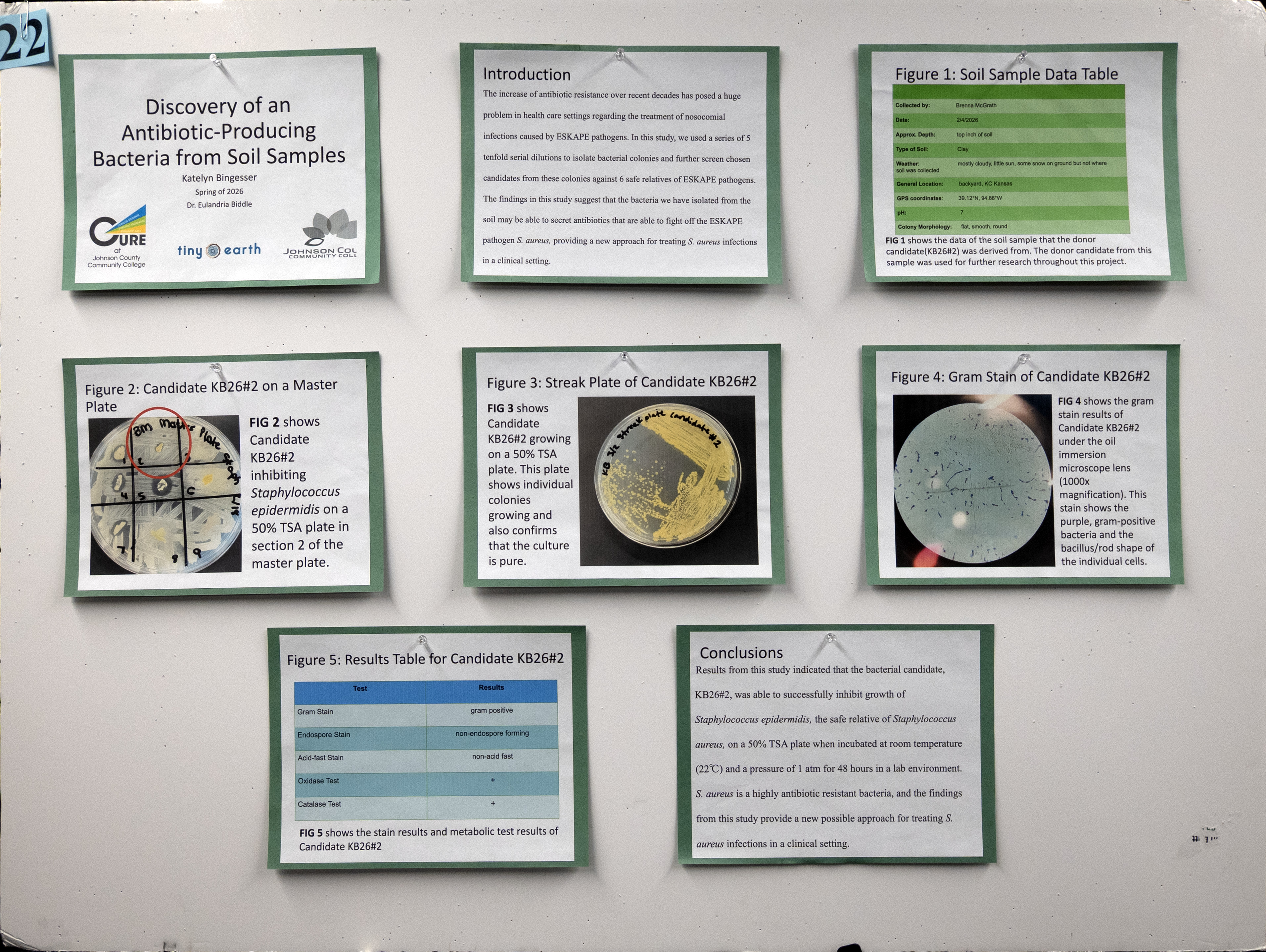
The increase of antibiotic resistance over recent decades has posed a huge problem in health care settings regarding the treatment of nosocomial infections caused by ESKAPE pathogens. In this study, we used a series of 5 tenfold serial dilutions to isolate bacterial colonies and further screen chosen candidates from these colonies against 6 safe relatives of ESKAPE pathogens. A total of six candidates that showed clear zones of inhibition around them on the serial dilution plates were chosen and used for screening. Our results indicated that the bacterial candidate, KB262, was able to successfully inhibit growth of Staphylococcus epidermidis, the safe relative of Staphylococcus aureus, on a 50% TSA plate when incubated at room temperature (22 degrees C) and a pressure of 1 atm for 48 hours in a lab setting. These findings suggest that the bacteria we have isolated from the soil may be able to secret antibiotics that are able to fight off the ESKAPE pathogen S. aureus, providing a new approach for treating S. aureus infections in a clinical setting. S. aureus is a highly antibiotic-resistant bacteria and the findings from this study may be the next step in discovering a new way to treat this infectious pathogen.
Image
Discovery of an Antibiotic-Producing Bacterium from Soil Samples
CoLab, COM 284
The increase of antibiotic resistance over recent decades has posed a huge problem in health care settings regarding the treatment of nosocomial infections caused by ESKAPE pathogens. In this study, we used a series of 5 tenfold serial dilutions to isolate bacterial colonies and further screen chosen candidates from these colonies against 6 safe relatives of ESKAPE pathogens. A total of six candidates that showed clear zones of inhibition around them on the serial dilution plates were chosen and used for screening. Our results indicated that the bacterial candidate, KB262, was able to successfully inhibit growth of Staphylococcus epidermidis, the safe relative of Staphylococcus aureus, on a 50% TSA plate when incubated at room temperature (22 degrees C) and a pressure of 1 atm for 48 hours in a lab setting. These findings suggest that the bacteria we have isolated from the soil may be able to secret antibiotics that are able to fight off the ESKAPE pathogen S. aureus, providing a new approach for treating S. aureus infections in a clinical setting. S. aureus is a highly antibiotic-resistant bacteria and the findings from this study may be the next step in discovering a new way to treat this infectious pathogen.
Comments
The faculty mentor for this project was Eulandria Biddle.