

Dirty Discoveries
Location
CoLab, COM 291
Start Date
30-4-2026 1:15 PM
Document Type
Poster
Description
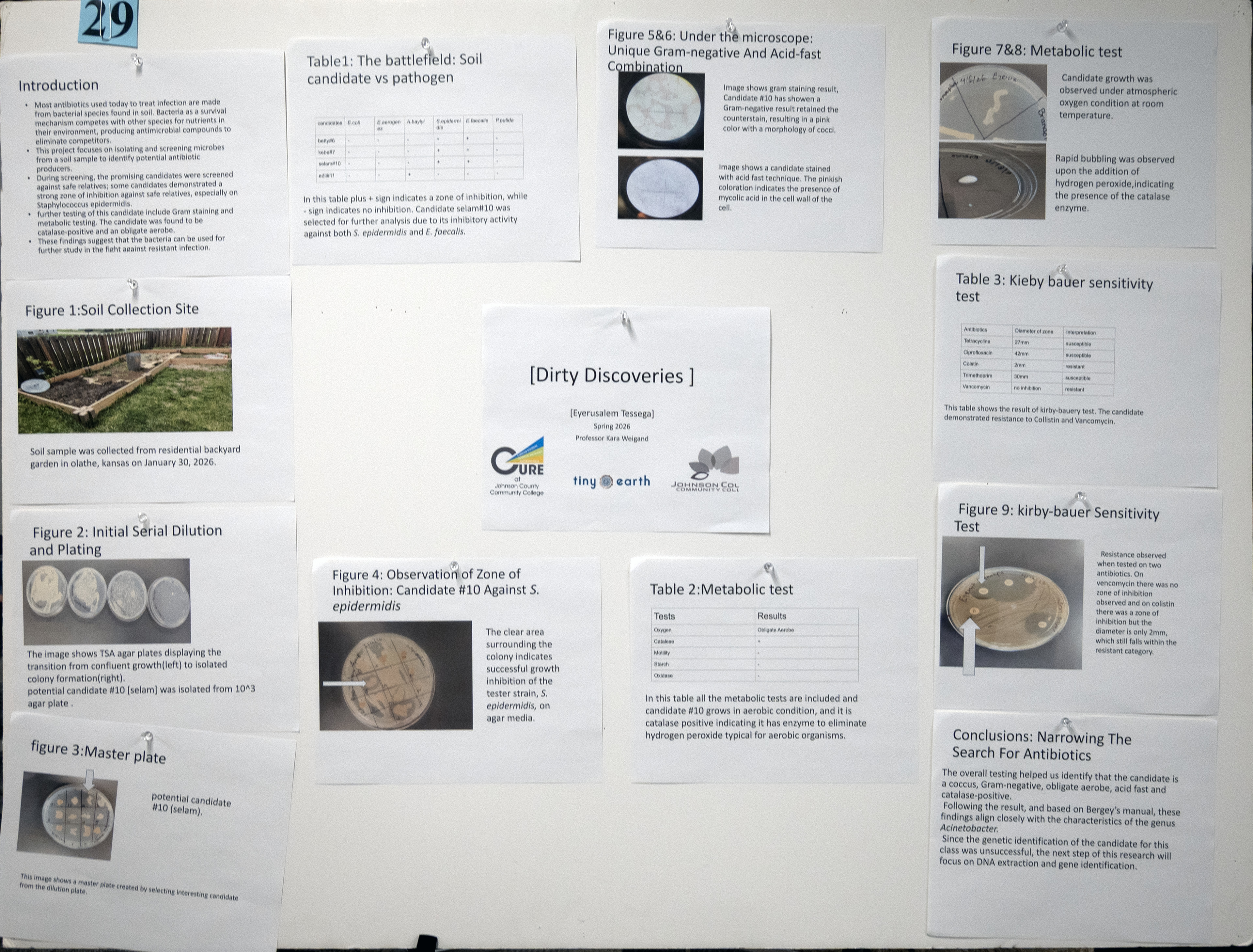
Most antibiotics used today to treat infection are made from bacterial species found in soil. Bacteria as a survival mechanism competes with other species for nutrients in their environment, producing antimicrobial compounds to eliminate competitors. One of the most competitive environments with limited amounts of nutrients and space is soil. This project focuses on isolating and screening microbes from a soil sample to identify potential antibiotic producers. The experiment process involved performing a serial dilution of a soil sample, identifying promising candidates, conducting antibiotic screening against safe relatives, and identifying type bacteria by staining. During screening, the promising candidates were screened against safe relatives; some candidates demonstrated a strong zone of inhibition-a clear area where growth was stopped- against safe relatives, especially on Staphylococcus epidermidis. While identifying the candidates with Gram-staining, the most effective candidate was a Gram-negative bacterium with a cocci morphology. These findings suggest that the bacteria can be used for further study in the fight against resistant infection.
Image
Dirty Discoveries
CoLab, COM 291
Most antibiotics used today to treat infection are made from bacterial species found in soil. Bacteria as a survival mechanism competes with other species for nutrients in their environment, producing antimicrobial compounds to eliminate competitors. One of the most competitive environments with limited amounts of nutrients and space is soil. This project focuses on isolating and screening microbes from a soil sample to identify potential antibiotic producers. The experiment process involved performing a serial dilution of a soil sample, identifying promising candidates, conducting antibiotic screening against safe relatives, and identifying type bacteria by staining. During screening, the promising candidates were screened against safe relatives; some candidates demonstrated a strong zone of inhibition-a clear area where growth was stopped- against safe relatives, especially on Staphylococcus epidermidis. While identifying the candidates with Gram-staining, the most effective candidate was a Gram-negative bacterium with a cocci morphology. These findings suggest that the bacteria can be used for further study in the fight against resistant infection.
Comments
The faculty mentor for this project was Kara Weigand.