

Evaluating Drought Resilience and Root Architecture of Canna spp in "Charged" Biochar Wood vs Peat Substrates
Location
CoLab, COM 264
Start Date
30-4-2026 1:15 PM
Document Type
Poster
Description
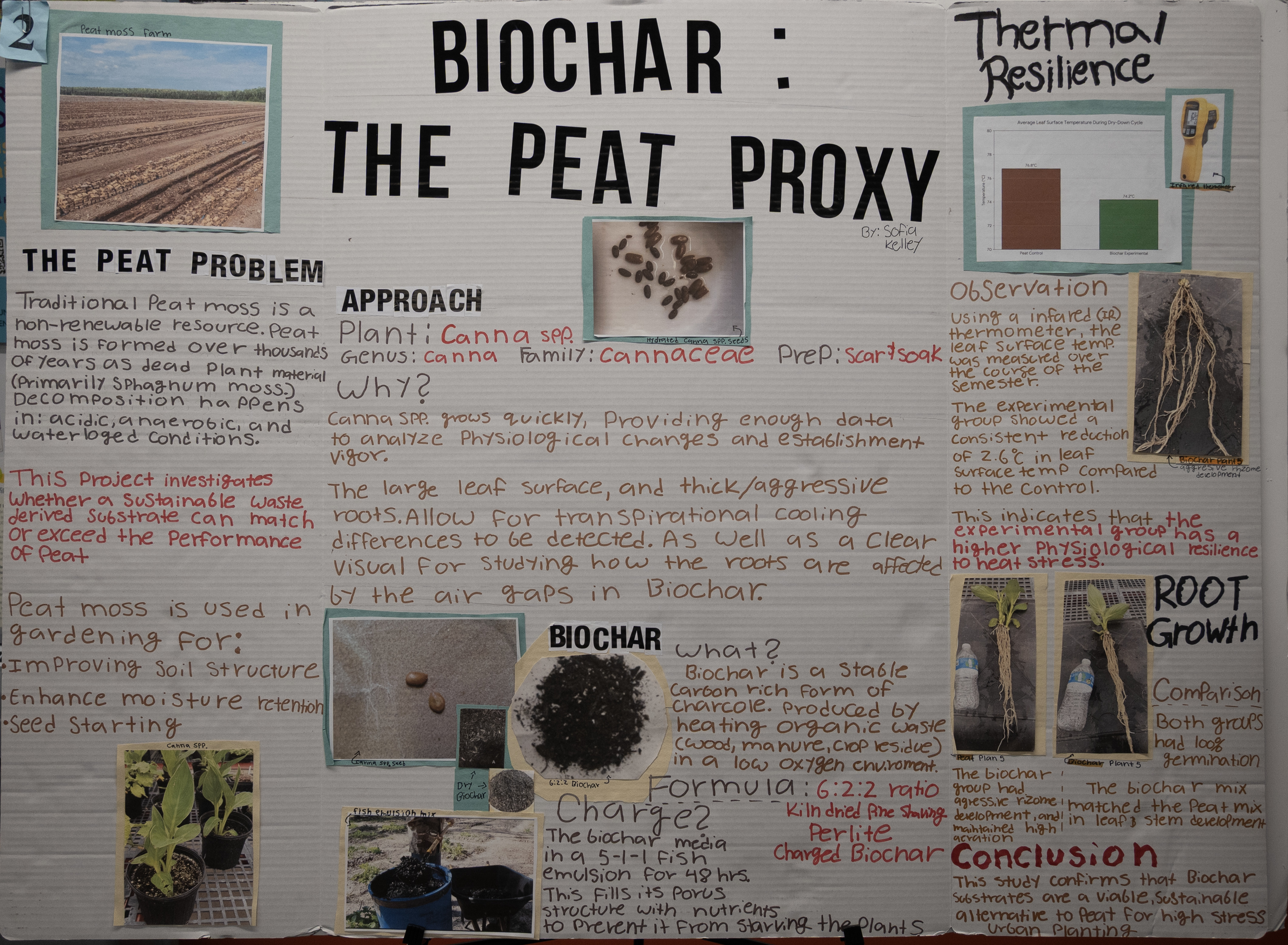
As urban areas face intensifying heat and unpredictable cold, there is a growing need for "living infrastructure." Traditional horticulture relies heavily on peat moss, a non-renewable resource. This study investigates the viability of a peat-free substrate composed of kiln-dried pine shavings and "charged" biochar, compared to a standard peat-based control. To facilitate rapid data collection, Canna spp. was selected as a physiological model due to its aggressive growth rate and resilience. The experimental design included 10 specimens: five established in a standard peat-based medium and five in the sustainable "charged" biochar. To prevent nutrient immobilization, the biochar was "charged" with a nitrogen-rich 5-1-1 fish emulsion prior to incorporation. Two primary metrics were used to assess drought resilience and root establishment: leaf surface temperature, monitored via a handheld infrared (IR) thermometer during induced "dry-down" cycles, and transpirational cooling under moisture stress. Following the growth period, root systems were analyzed to quantify branching patterns and rhizomatous development. This research determines if waste-stream-derived substances can provide a viable, sustainable framework for urban planting that matches or exceeds the performance of traditional peat media in high-heat scenarios.
Image
Evaluating Drought Resilience and Root Architecture of Canna spp in "Charged" Biochar Wood vs Peat Substrates
CoLab, COM 264
As urban areas face intensifying heat and unpredictable cold, there is a growing need for "living infrastructure." Traditional horticulture relies heavily on peat moss, a non-renewable resource. This study investigates the viability of a peat-free substrate composed of kiln-dried pine shavings and "charged" biochar, compared to a standard peat-based control. To facilitate rapid data collection, Canna spp. was selected as a physiological model due to its aggressive growth rate and resilience. The experimental design included 10 specimens: five established in a standard peat-based medium and five in the sustainable "charged" biochar. To prevent nutrient immobilization, the biochar was "charged" with a nitrogen-rich 5-1-1 fish emulsion prior to incorporation. Two primary metrics were used to assess drought resilience and root establishment: leaf surface temperature, monitored via a handheld infrared (IR) thermometer during induced "dry-down" cycles, and transpirational cooling under moisture stress. Following the growth period, root systems were analyzed to quantify branching patterns and rhizomatous development. This research determines if waste-stream-derived substances can provide a viable, sustainable framework for urban planting that matches or exceeds the performance of traditional peat media in high-heat scenarios.
Comments
The faculty mentor for this project was Brian Mitchell.