

Hunting for Antibiotics
Location
CoLab, COM 118
Start Date
30-4-2026 8:15 AM
Document Type
Poster
Description
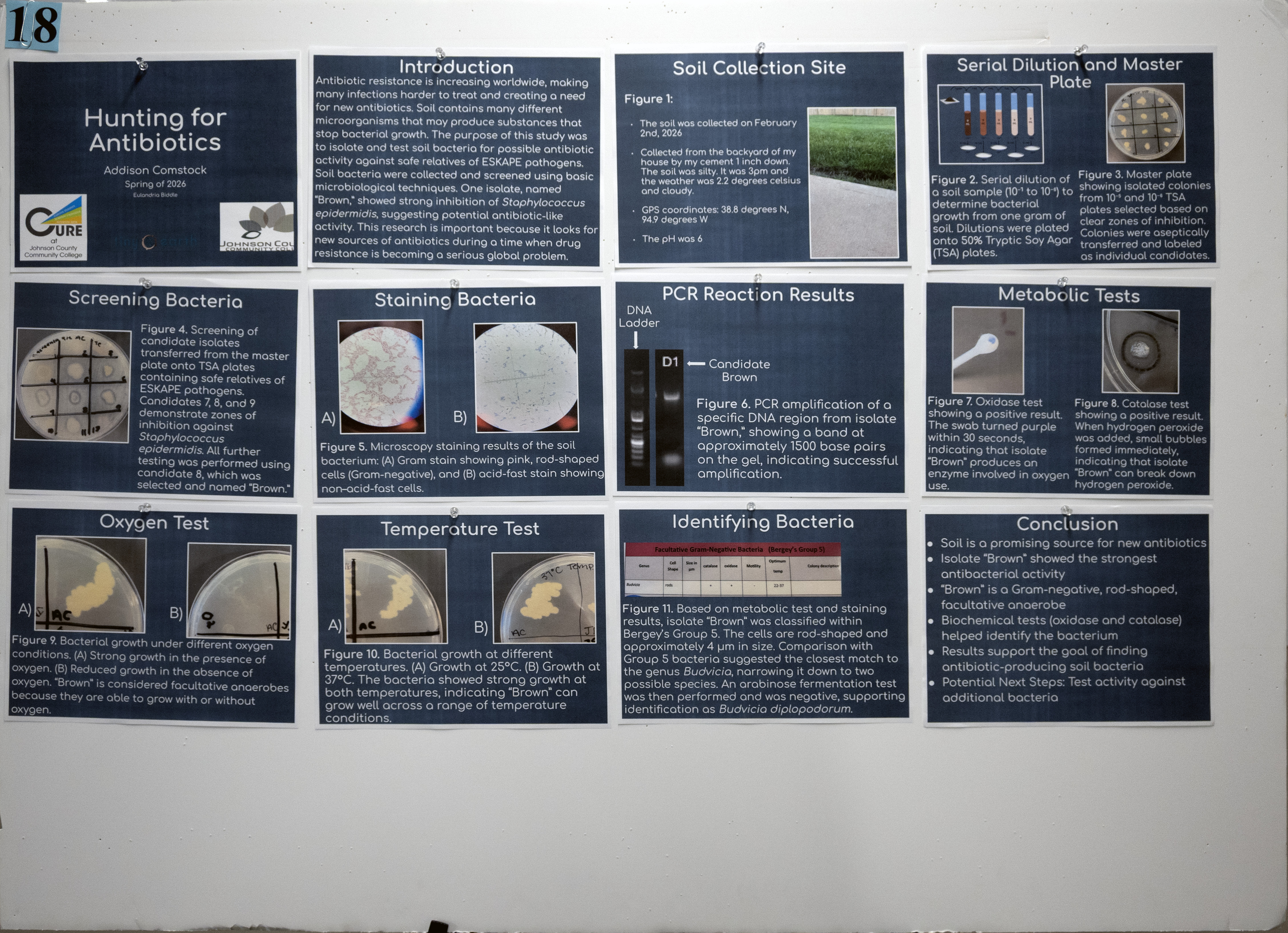
Antibiotics resistance has been an ongoing problem in the medical field so finding new bacteria that produce antibiotics is essential. Bacteria are constantly evolving and adapting to the drugs we already have therefore, antibiotic resistance The goal of this study was to isolate bacteria from soil and identify isolates that show antibiotic activity against the safe relatives of ESKAPE pathogens. One isolate, named Brown, produced a clear zone of inhibition against Staphylococcus epidermidis. This candidate was further isolated using a three-streak technique to produce pure, individual colonies. Several staining methods were also used to learn more about Brown. Through Gram staining techniques I learned Brown is Bacillus-shaped and Gram negative, this means it as a double layer membrane making Brown highly resistant to antibiotics. I also performed endospore staining, which appeared positive and indicated they can survive in extremely intense conditions, while the acid-fast staining appeared negative. More testing needs to be done to identify what type of bacteria Brown is.
Image
Hunting for Antibiotics
CoLab, COM 118
Antibiotics resistance has been an ongoing problem in the medical field so finding new bacteria that produce antibiotics is essential. Bacteria are constantly evolving and adapting to the drugs we already have therefore, antibiotic resistance The goal of this study was to isolate bacteria from soil and identify isolates that show antibiotic activity against the safe relatives of ESKAPE pathogens. One isolate, named Brown, produced a clear zone of inhibition against Staphylococcus epidermidis. This candidate was further isolated using a three-streak technique to produce pure, individual colonies. Several staining methods were also used to learn more about Brown. Through Gram staining techniques I learned Brown is Bacillus-shaped and Gram negative, this means it as a double layer membrane making Brown highly resistant to antibiotics. I also performed endospore staining, which appeared positive and indicated they can survive in extremely intense conditions, while the acid-fast staining appeared negative. More testing needs to be done to identify what type of bacteria Brown is.
Comments
The faculty mentor for this project was Eulandria Biddle.