

Hidden in the Dirt: Discovering Bacteria That Fight Infection
Location
CoLab, COM 119
Start Date
30-4-2026 8:15 AM
Document Type
Poster
Description
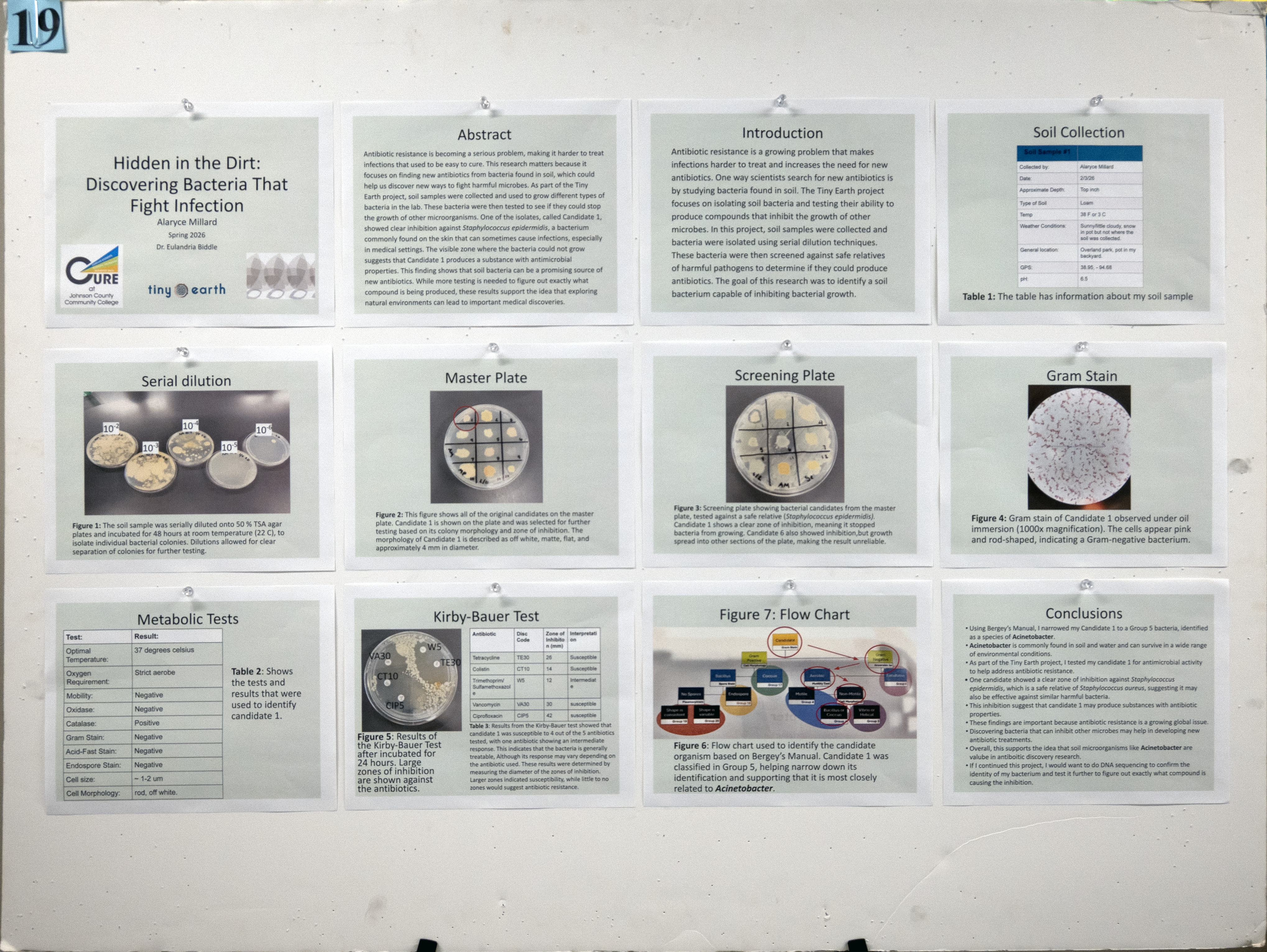
Antibiotic resistance is becoming a serious problem, making it harder to treat infections that used to be easy to cure. This research matters because it focuses on finding new antibiotics from bacteria found in soil, which could help us discover new ways to fight harmful microbes. As part of the Tiny Earth project, soil samples were collected and used to grow different types of bacteria in the lab. These bacteria were then tested to see if they could stop the growth of other microorganisms. One of the isolates, called Candidate 1, showed clear inhibition against Staphylococcus epidermidis, a bacterium commonly found on the skin that can sometimes cause infections, especially in medical settings. The visible zone where the bacteria could not grow suggests that Candidate 1 produces a substance with antimicrobial properties. This finding shows that soil bacteria can be a promising source of new antibiotics. While more testing is needed to figure out exactly what compound is being produced, these results support the idea that exploring natural environments can lead to important medical discoveries.
Image
Hidden in the Dirt: Discovering Bacteria That Fight Infection
CoLab, COM 119
Antibiotic resistance is becoming a serious problem, making it harder to treat infections that used to be easy to cure. This research matters because it focuses on finding new antibiotics from bacteria found in soil, which could help us discover new ways to fight harmful microbes. As part of the Tiny Earth project, soil samples were collected and used to grow different types of bacteria in the lab. These bacteria were then tested to see if they could stop the growth of other microorganisms. One of the isolates, called Candidate 1, showed clear inhibition against Staphylococcus epidermidis, a bacterium commonly found on the skin that can sometimes cause infections, especially in medical settings. The visible zone where the bacteria could not grow suggests that Candidate 1 produces a substance with antimicrobial properties. This finding shows that soil bacteria can be a promising source of new antibiotics. While more testing is needed to figure out exactly what compound is being produced, these results support the idea that exploring natural environments can lead to important medical discoveries.
Comments
The faculty mentor for this project was Eulandria Biddle.