

How Metal Concentrations Change as Water Moves through the JCCC Stormwater Basin
Location
CoLab, COM 275
Start Date
30-4-2026 1:15 PM
Document Type
Poster
Description
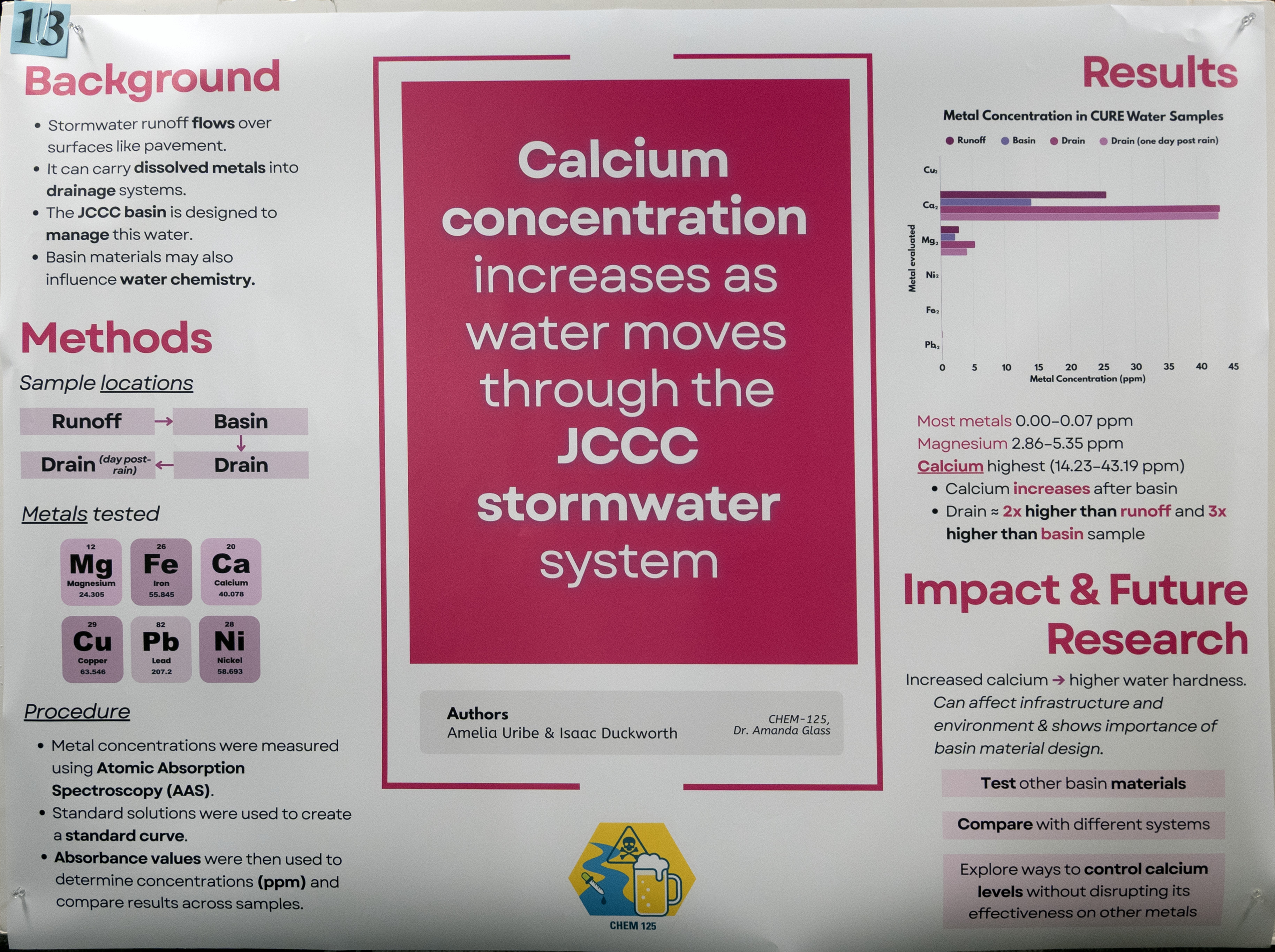
This study investigates how metal concentrations change as water moves through the JCCC stormwater basin, with a focus on identifying which metal shows the greatest variation. Stormwater basins are designed to reduce excess materials and pollutants before water enters natural waterways. However, the materials used in these systems or surrounding conditions may also influence water chemistry. This raises the question of whether all metals behave similarly as water flows through different stages of the system. To address this, water samples were collected at different points, including runoff, the basin, the drain, and the drain one day after rainfall. Concentrations of metals such as copper, calcium, nickel, iron, magnesium, and lead were measured and compared across these stages. Results showed consistently low levels for most metals, ranging from 0.00–0.07 ppm, indicating that their concentrations remained low throughout the system. Magnesium concentrations were slightly higher, ranging from 2.86–5.35 ppm. In contrast, calcium showed the highest concentrations overall (14.23–43.42 ppm) and increased significantly after passing through the basin, with values in the drain samples tripling compared to earlier stages. These results suggest that, unlike other metals, calcium concentration increases as water moves through the basin. This is likely due to the presence of limestone, which can react with water and release calcium into it. These findings highlight how stormwater systems can influence water chemistry and suggest the need for further research into how basin materials affect water composition and how system design could be adjusted to better manage calcium levels while maintaining effectiveness for other metals.
Image
How Metal Concentrations Change as Water Moves through the JCCC Stormwater Basin
CoLab, COM 275
This study investigates how metal concentrations change as water moves through the JCCC stormwater basin, with a focus on identifying which metal shows the greatest variation. Stormwater basins are designed to reduce excess materials and pollutants before water enters natural waterways. However, the materials used in these systems or surrounding conditions may also influence water chemistry. This raises the question of whether all metals behave similarly as water flows through different stages of the system. To address this, water samples were collected at different points, including runoff, the basin, the drain, and the drain one day after rainfall. Concentrations of metals such as copper, calcium, nickel, iron, magnesium, and lead were measured and compared across these stages. Results showed consistently low levels for most metals, ranging from 0.00–0.07 ppm, indicating that their concentrations remained low throughout the system. Magnesium concentrations were slightly higher, ranging from 2.86–5.35 ppm. In contrast, calcium showed the highest concentrations overall (14.23–43.42 ppm) and increased significantly after passing through the basin, with values in the drain samples tripling compared to earlier stages. These results suggest that, unlike other metals, calcium concentration increases as water moves through the basin. This is likely due to the presence of limestone, which can react with water and release calcium into it. These findings highlight how stormwater systems can influence water chemistry and suggest the need for further research into how basin materials affect water composition and how system design could be adjusted to better manage calcium levels while maintaining effectiveness for other metals.
Comments
The faculty mentor for this project was Amanda Glass.