

Clarifying Expectations for Student Work Hours Based on Enrollment Status
Location
CoLab, COM 265
Start Date
30-4-2026 1:15 PM
Document Type
Poster
Description
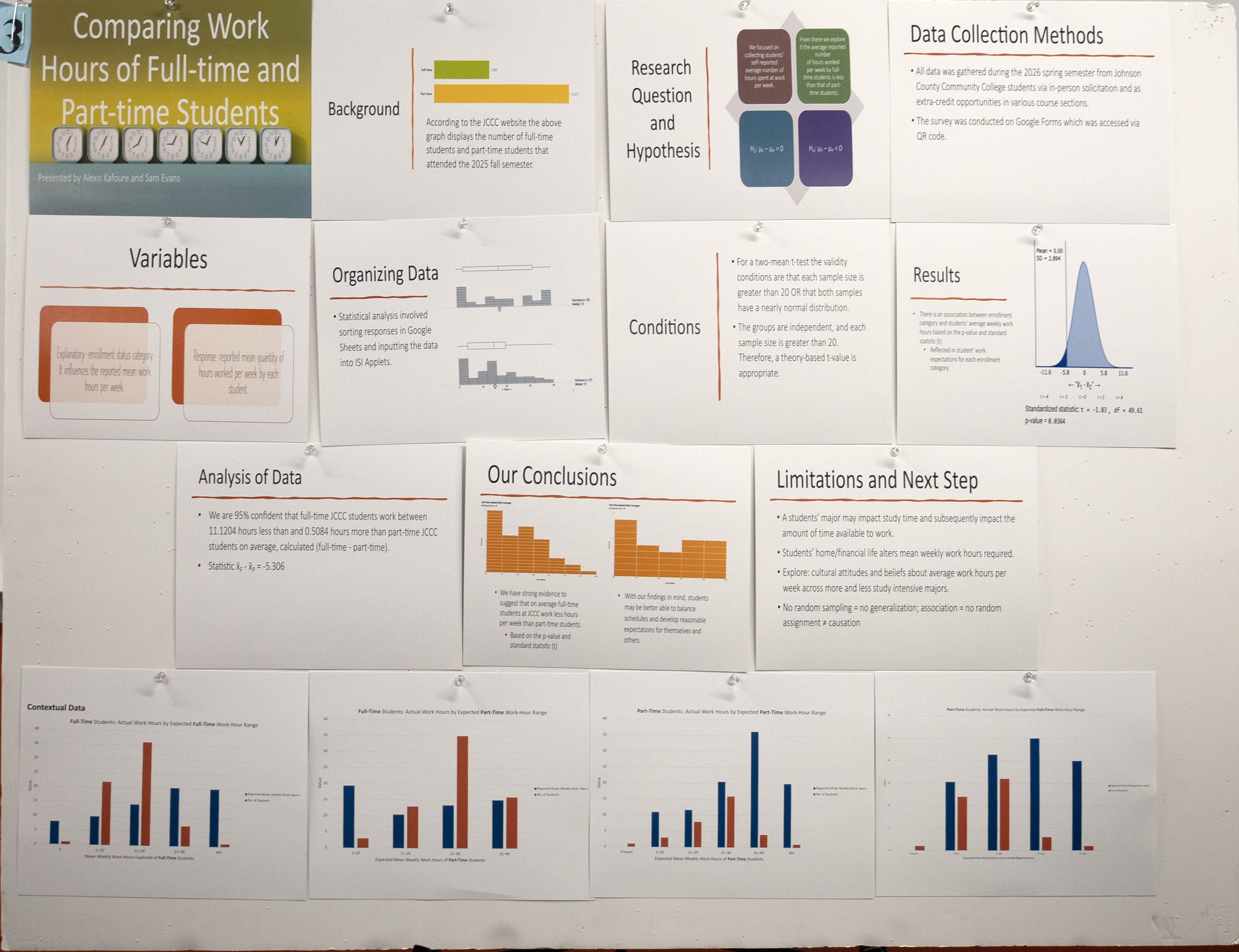
This student research focuses on average number of hours worked per week as a response variable to full-time or part-time student categorization. Centrally, we explore whether average hours worked per week differs between these two populations. All data was gathered from Johnson County Community College students from the full email list of enrolled students, as well as in-person solicitation, and as an extra-credit opportunity in various course sections. This data was then sorted into a data set for each population. For the purposes of data analysis, the number of hours worked are considered quantitatively and using a theory-based approach to calculate a sample mean for each group. We then compare these means to evaluate whether a difference in weekly work hours exists. The salience of this research is in making realistic expectations for students’ academic and professional workload readily apparent in the junior college context. With this information in hand, students are better able to set realistically achievable goals at school and work.
Image
Clarifying Expectations for Student Work Hours Based on Enrollment Status
CoLab, COM 265
This student research focuses on average number of hours worked per week as a response variable to full-time or part-time student categorization. Centrally, we explore whether average hours worked per week differs between these two populations. All data was gathered from Johnson County Community College students from the full email list of enrolled students, as well as in-person solicitation, and as an extra-credit opportunity in various course sections. This data was then sorted into a data set for each population. For the purposes of data analysis, the number of hours worked are considered quantitatively and using a theory-based approach to calculate a sample mean for each group. We then compare these means to evaluate whether a difference in weekly work hours exists. The salience of this research is in making realistic expectations for students’ academic and professional workload readily apparent in the junior college context. With this information in hand, students are better able to set realistically achievable goals at school and work.
Comments
The faculty mentor for this project was Elaine Hembree.