

Amino acid
Location
CoLab, COM 261
Start Date
30-4-2026 12:00 PM
Document Type
Poster
Description
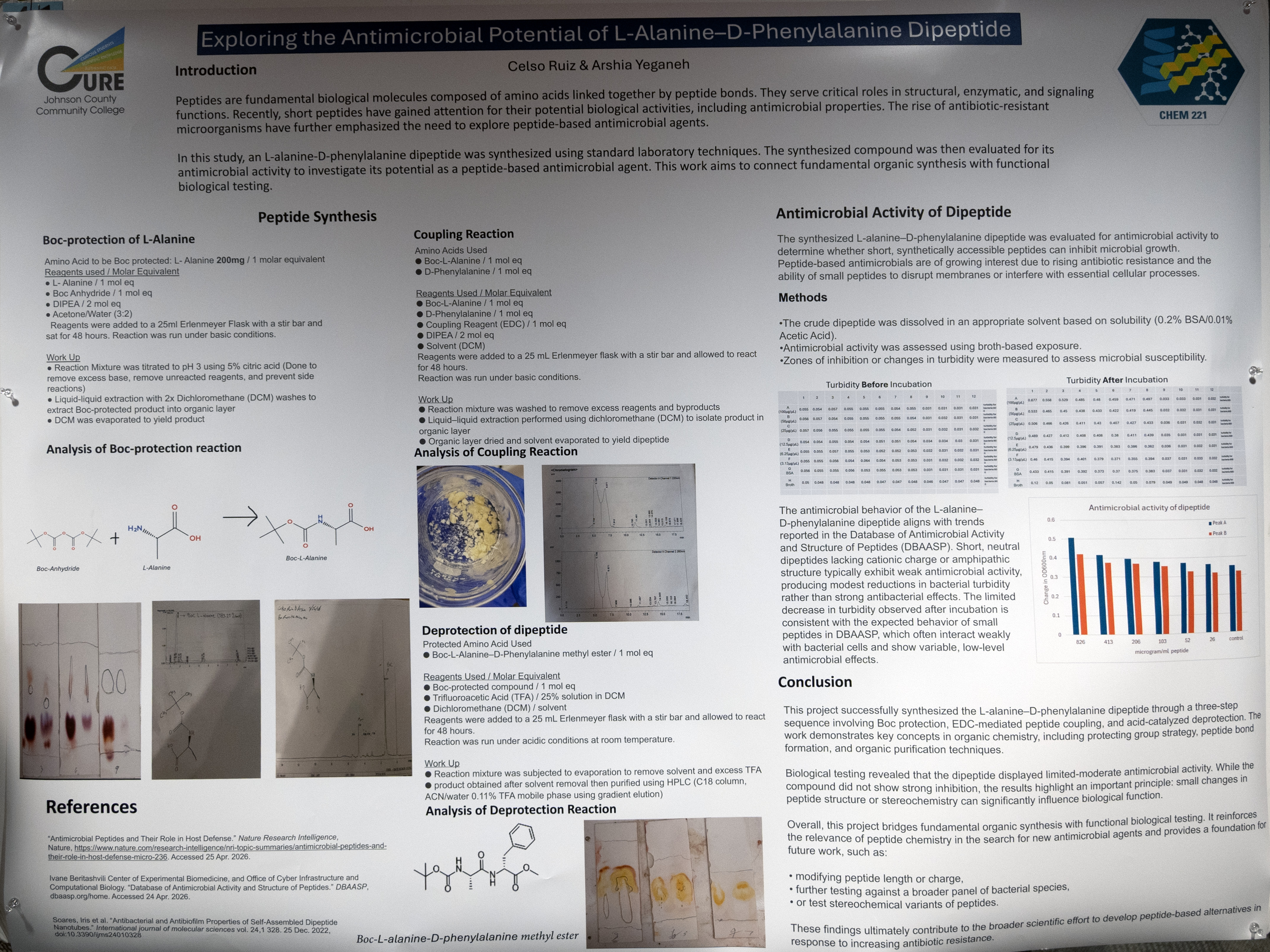
In this amino acid project, the goal is to protect the amino group of an amino acid so that it will not react during later steps of a synthesis. Amino acids contain both an amino group and a carboxylic acid group, so without protection several unwanted reactions could occur. To avoid this, the amino acid is reacted with di-tert-butyl dicarbonate (Boc₂O) under basic conditions to form a Boc-protected amino acid. The base, usually sodium carbonate or sodium hydroxide, deprotonates the amino group and allows it to attack the Boc reagent. This produces a more stable derivative that can be used in later reactions while keeping the amino group temporarily blocked. During the experiment, the starting amino acid is dissolved in water and mixed with the base. The Boc reagent is then added slowly while the reaction mixture is stirred. After the reaction is complete, the solution is acidified to precipitate the protected amino acid, which is collected by vacuum filtration. The product is then dried and characterized using melting point and IR spectroscopy. In the IR spectrum, the disappearance of the broad N–H stretch of the free amino group and the appearance of a new carbonyl absorption from the Boc group confirm that protection occurred. This experiment demonstrates an important technique used in peptide synthesis and pharmaceutical chemistry.
Image
Amino acid
CoLab, COM 261
In this amino acid project, the goal is to protect the amino group of an amino acid so that it will not react during later steps of a synthesis. Amino acids contain both an amino group and a carboxylic acid group, so without protection several unwanted reactions could occur. To avoid this, the amino acid is reacted with di-tert-butyl dicarbonate (Boc₂O) under basic conditions to form a Boc-protected amino acid. The base, usually sodium carbonate or sodium hydroxide, deprotonates the amino group and allows it to attack the Boc reagent. This produces a more stable derivative that can be used in later reactions while keeping the amino group temporarily blocked. During the experiment, the starting amino acid is dissolved in water and mixed with the base. The Boc reagent is then added slowly while the reaction mixture is stirred. After the reaction is complete, the solution is acidified to precipitate the protected amino acid, which is collected by vacuum filtration. The product is then dried and characterized using melting point and IR spectroscopy. In the IR spectrum, the disappearance of the broad N–H stretch of the free amino group and the appearance of a new carbonyl absorption from the Boc group confirm that protection occurred. This experiment demonstrates an important technique used in peptide synthesis and pharmaceutical chemistry.
Comments
The faculty mentor for this project was Meagan Weldele.