

Reciprocal Relationship Between Calcium Ions and pH Level in JCCC Stormwater Basin
Location
CoLab, COM 254
Start Date
30-4-2026 12:00 PM
Document Type
Poster
Description
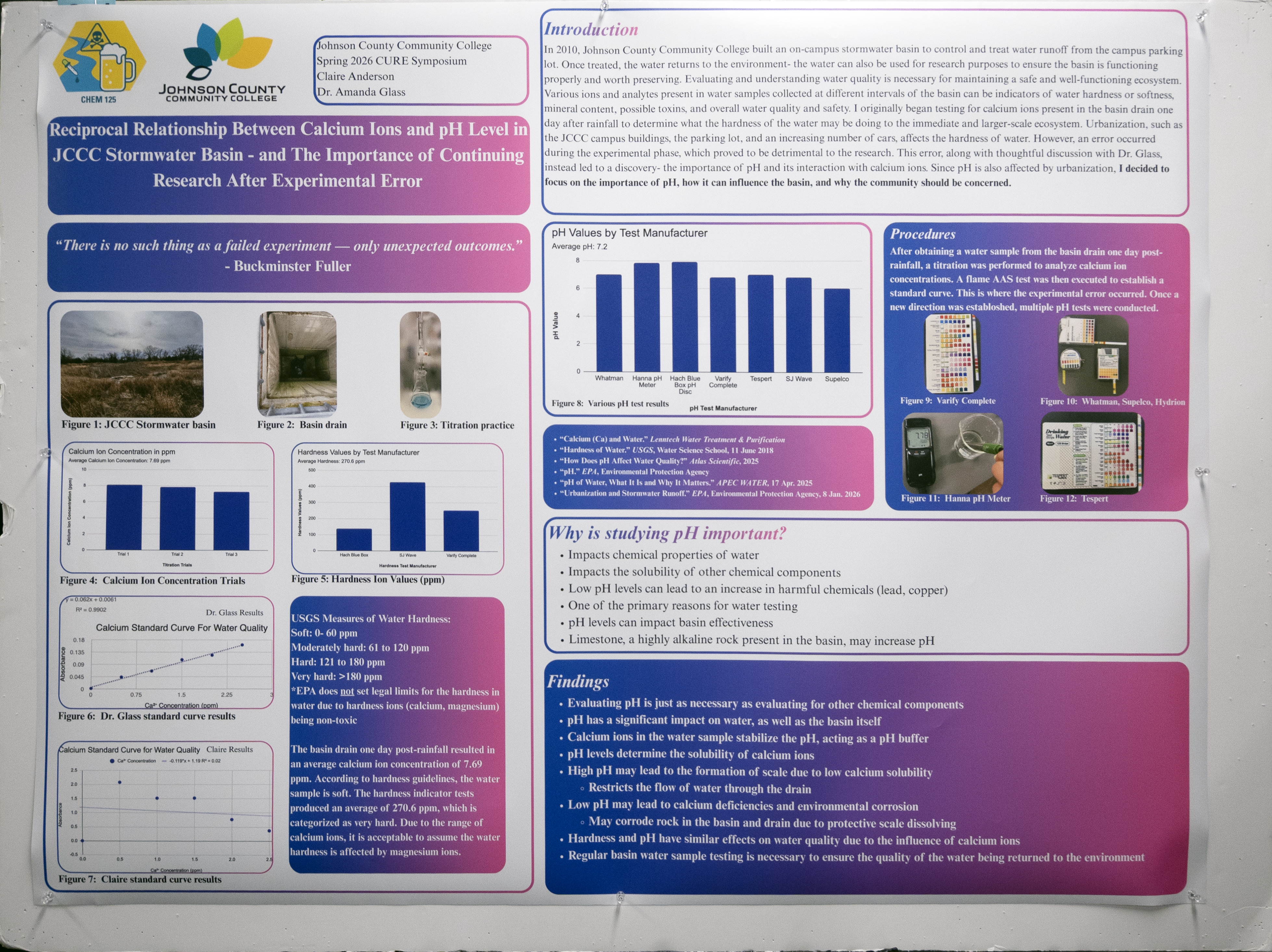
Testing and understanding water quality is essential for maintaining a safe and well-functioning ecosystem. In 2010, Johnson County Community College constructed an on-campus stormwater basin to control and treat water runoff from the campus parking lot. Students now have the ability to conduct thoughtful research which further allows more accurate data and results. Various ions present in the basin water samples can be indicators of water hardness or softness, mineral content, possible toxins, and overall water quality and safety. Testing for calcium ions present in the basin drain one day after rainfall brings to question what the hardness of the water may be doing to the immediate and larger-scale ecosystem. Our research focuses on how water hardness impacts pH and how, in turn, pH impacts water hardness. We ran a series of tests in order to determine the consistency of pH results and the average pH value. Through these tests, we found the range of the pH to be from 6 to 8 and the most commonly occurring pH values to be 6.8 and 7.0- leaving us with an overall average pH of 7.2. With this pH data, we are able to further examine the impact it has on water hardness, leading us to discover a reciprocal relationship between the two.
Image
Reciprocal Relationship Between Calcium Ions and pH Level in JCCC Stormwater Basin
CoLab, COM 254
Testing and understanding water quality is essential for maintaining a safe and well-functioning ecosystem. In 2010, Johnson County Community College constructed an on-campus stormwater basin to control and treat water runoff from the campus parking lot. Students now have the ability to conduct thoughtful research which further allows more accurate data and results. Various ions present in the basin water samples can be indicators of water hardness or softness, mineral content, possible toxins, and overall water quality and safety. Testing for calcium ions present in the basin drain one day after rainfall brings to question what the hardness of the water may be doing to the immediate and larger-scale ecosystem. Our research focuses on how water hardness impacts pH and how, in turn, pH impacts water hardness. We ran a series of tests in order to determine the consistency of pH results and the average pH value. Through these tests, we found the range of the pH to be from 6 to 8 and the most commonly occurring pH values to be 6.8 and 7.0- leaving us with an overall average pH of 7.2. With this pH data, we are able to further examine the impact it has on water hardness, leading us to discover a reciprocal relationship between the two.
Comments
The faculty mentor for this project was Amanda Glass.