
Plastic Eating Alage!
Location
CoLab, COM 230
Start Date
30-4-2026 12:00 PM
Document Type
Poster
Description
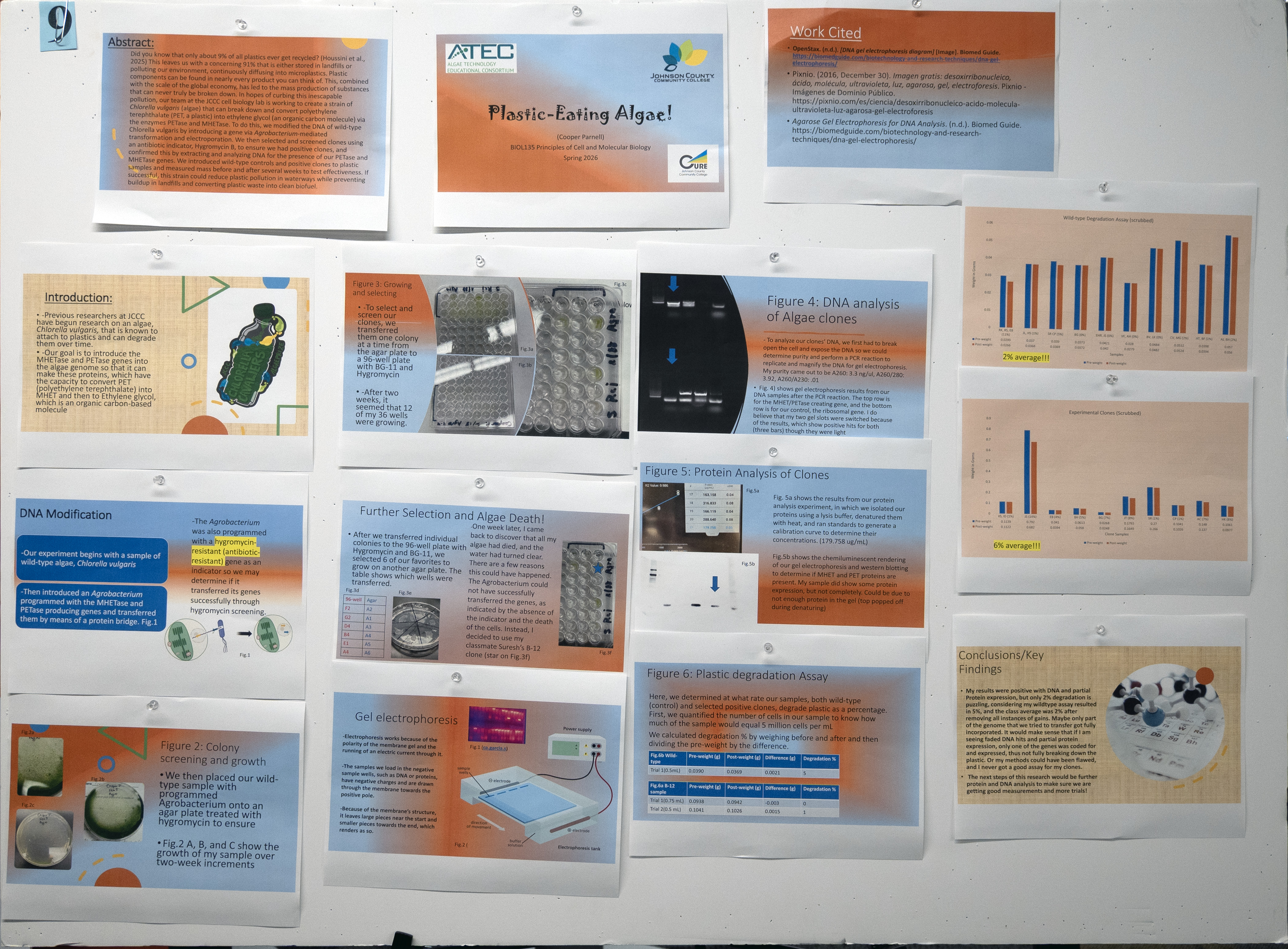
Did you know that only about 9% of all plastics ever get recycled? (Houssini et al., 2025) This leaves a concerning 91% that is stored in landfills or the environment as pollutants, continuously diffusing into microplastics. Plastic components can be found in nearly every product on our shelves. This, combined with the conditions of the global economy, has led to the mass production of substances that can never truly be broken down. To curb this inescapable pollution, our team at the JCCC cell biology lab is working to create a strain of Chlorella vulgaris (algae) that can break down and convert polyethylene terephthalate (plastic) into ethylene glycol (an organic carbon molecule) via PETase and MHETase enzymes. To do this, we altered the DNA of wild-type Chlorella vulgaris by adding a gene using Agrobacterium and electroporation. We then selected and screened clones using hygromycin B (antibiotic indicator) to ensure we had positive clones, confirmed by extracting and analyzing DNA for the presence of PETase and MHETase genes. We introduced wild-type controls and positive clones to plastic samples and measured mass before and after several weeks to test effectiveness. If successful, the implications of this research are incredibly profound. New strains could be introduced into waterways, which would naturally reduce plastic pollution in them while also preventing plastic from taking up space in landfills or inevitably diffusing into microplastics. Algae are also considered candidates for biofuels, so the possibility of "feeding" algae with our plastic waste to produce clean energy is incredible.
Image
Plastic Eating Alage!
CoLab, COM 230
Did you know that only about 9% of all plastics ever get recycled? (Houssini et al., 2025) This leaves a concerning 91% that is stored in landfills or the environment as pollutants, continuously diffusing into microplastics. Plastic components can be found in nearly every product on our shelves. This, combined with the conditions of the global economy, has led to the mass production of substances that can never truly be broken down. To curb this inescapable pollution, our team at the JCCC cell biology lab is working to create a strain of Chlorella vulgaris (algae) that can break down and convert polyethylene terephthalate (plastic) into ethylene glycol (an organic carbon molecule) via PETase and MHETase enzymes. To do this, we altered the DNA of wild-type Chlorella vulgaris by adding a gene using Agrobacterium and electroporation. We then selected and screened clones using hygromycin B (antibiotic indicator) to ensure we had positive clones, confirmed by extracting and analyzing DNA for the presence of PETase and MHETase genes. We introduced wild-type controls and positive clones to plastic samples and measured mass before and after several weeks to test effectiveness. If successful, the implications of this research are incredibly profound. New strains could be introduced into waterways, which would naturally reduce plastic pollution in them while also preventing plastic from taking up space in landfills or inevitably diffusing into microplastics. Algae are also considered candidates for biofuels, so the possibility of "feeding" algae with our plastic waste to produce clean energy is incredible.
Comments
The faculty mentor for this project was Heather Seitz.