

Battling Antibiotic Resistance
Location
CoLab, COM 243
Start Date
30-4-2026 12:00 PM
Document Type
Poster
Description
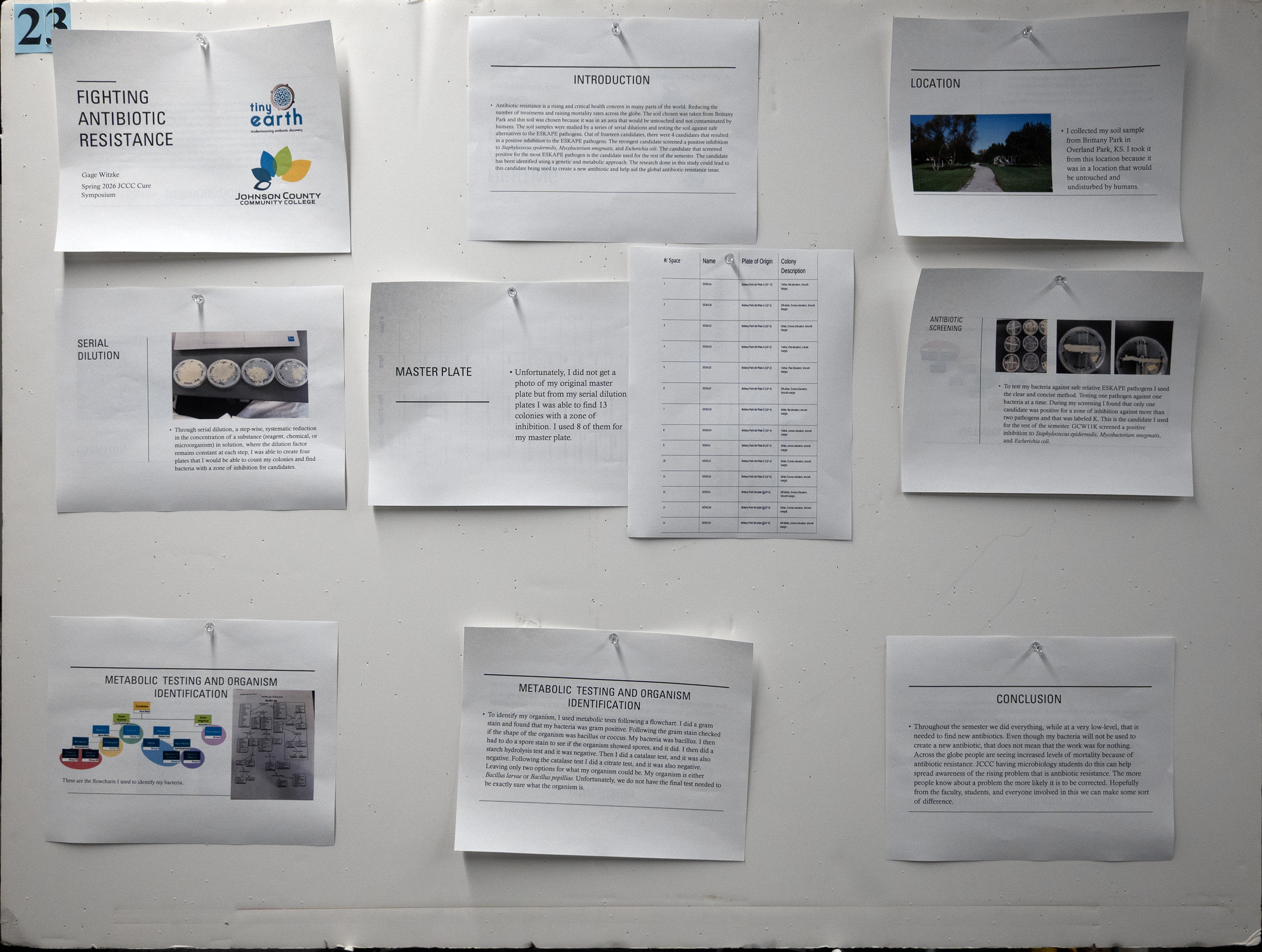
Antibiotic resistance is a rising and critical health concern in many parts of the world. Reducing the number of treatments and raising mortality rates across the globe. The soil chosen was taken from Brittany Park and this soil was chosen because it was in an area that would be untouched and not contaminated by humans. The soil samples were studied by a series of serial dilutions and testing the soil against safe alternatives to the ESKAPE pathogens. Out of fourteen candidates, there were 4 candidates that resulted in a positive inhibition to the ESKAPE pathogens. The strongest candidate screened a positive inhibition to Staphylococcus epidermidis, Mycobacterium smegmatis, and Escherichia coli. The candidate that screened positive for the most ESKAPE pathogen is the candidate used for the rest of the semester. The candidate has been identified using a genetic and metabolic approach. The research done in this study could lead to this candidate being used to create a new antibiotic and help aid the global antibiotic resistance issue.
Image
Battling Antibiotic Resistance
CoLab, COM 243
Antibiotic resistance is a rising and critical health concern in many parts of the world. Reducing the number of treatments and raising mortality rates across the globe. The soil chosen was taken from Brittany Park and this soil was chosen because it was in an area that would be untouched and not contaminated by humans. The soil samples were studied by a series of serial dilutions and testing the soil against safe alternatives to the ESKAPE pathogens. Out of fourteen candidates, there were 4 candidates that resulted in a positive inhibition to the ESKAPE pathogens. The strongest candidate screened a positive inhibition to Staphylococcus epidermidis, Mycobacterium smegmatis, and Escherichia coli. The candidate that screened positive for the most ESKAPE pathogen is the candidate used for the rest of the semester. The candidate has been identified using a genetic and metabolic approach. The research done in this study could lead to this candidate being used to create a new antibiotic and help aid the global antibiotic resistance issue.
Comments
The faculty mentor for this project was Heather Seitz.