

Keeping our Local Water Sources Clean
Location
CoLab, COM 212
Start Date
30-4-2026 10:45 AM
Document Type
Poster
Description
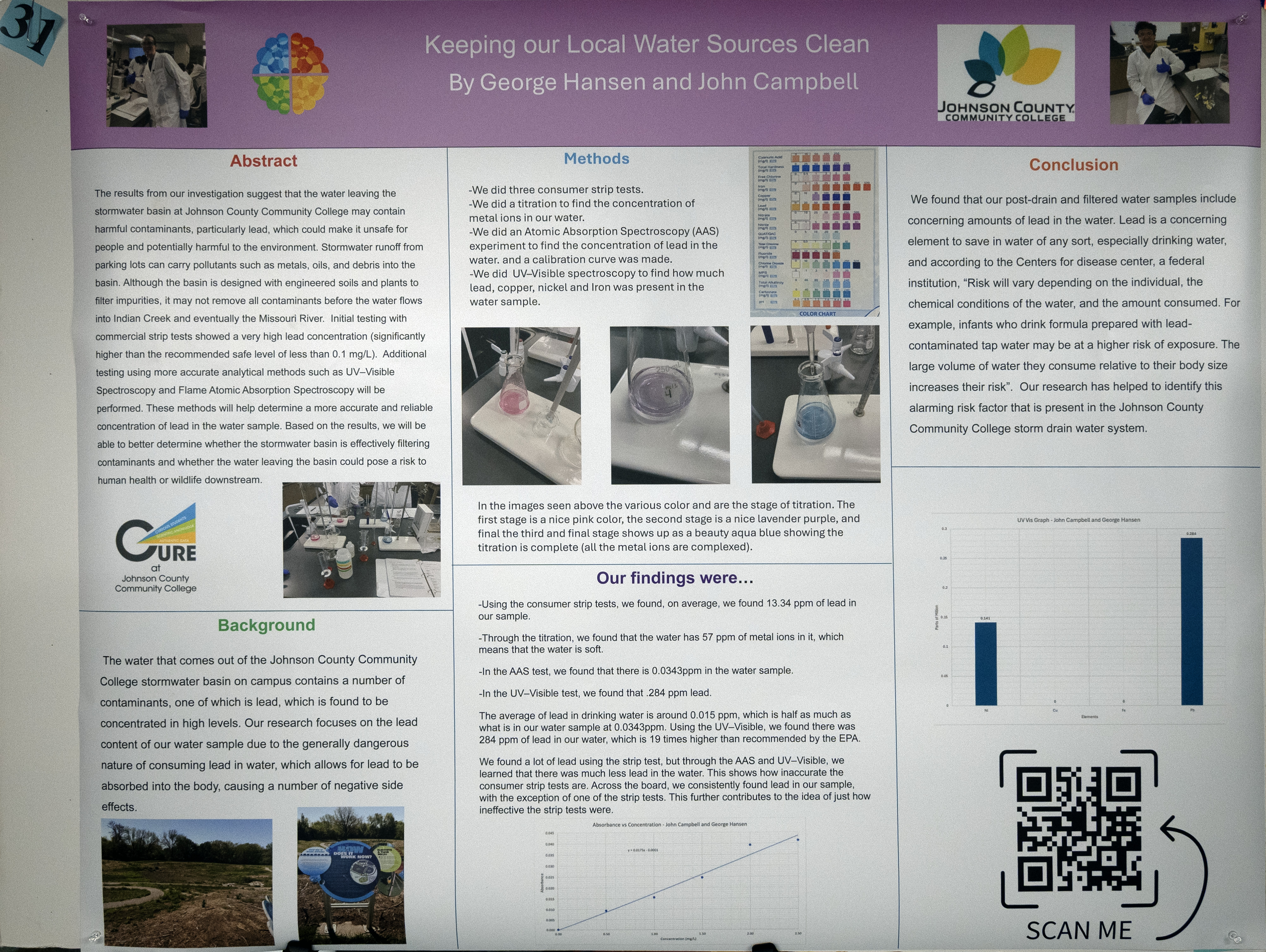
The results from our investigation suggest that the water leaving the stormwater basin at Johnson County Community College may contain harmful contaminants, particularly lead, which could make it unsafe for people and potentially harmful to the environment. Stormwater runoff from parking lots can carry pollutants such as metals, oils, and debris into the basin. Although the basin is designed with engineered soils and plants to filter impurities, it may not remove all contaminants before the water flows into Indian Creek and eventually the Missouri River. Initial testing with commercial strip tests showed a very high lead concentration (significantly higher than the recommended safe level of less than 0.1 mg/L). Additional testing using more accurate analytical methods such as UV–Visible Spectroscopy and Flame Atomic Absorption Spectroscopy will be performed. These methods will help determine a more accurate and reliable concentration of lead in the water sample. Based on the results, we will be able to better determine whether the stormwater basin is effectively filtering contaminants and whether the water leaving the basin could pose a risk to human health or wildlife downstream.
Image
Keeping our Local Water Sources Clean
CoLab, COM 212
The results from our investigation suggest that the water leaving the stormwater basin at Johnson County Community College may contain harmful contaminants, particularly lead, which could make it unsafe for people and potentially harmful to the environment. Stormwater runoff from parking lots can carry pollutants such as metals, oils, and debris into the basin. Although the basin is designed with engineered soils and plants to filter impurities, it may not remove all contaminants before the water flows into Indian Creek and eventually the Missouri River. Initial testing with commercial strip tests showed a very high lead concentration (significantly higher than the recommended safe level of less than 0.1 mg/L). Additional testing using more accurate analytical methods such as UV–Visible Spectroscopy and Flame Atomic Absorption Spectroscopy will be performed. These methods will help determine a more accurate and reliable concentration of lead in the water sample. Based on the results, we will be able to better determine whether the stormwater basin is effectively filtering contaminants and whether the water leaving the basin could pose a risk to human health or wildlife downstream.
Comments
The faculty mentor for this project was Lori Slavin.