

Tiny Earth: Using Soil Microbes to ESKAPE Antibiotic Resistance
Location
CoLab, COM 201
Start Date
30-4-2026 10:45 AM
Document Type
Poster
Description
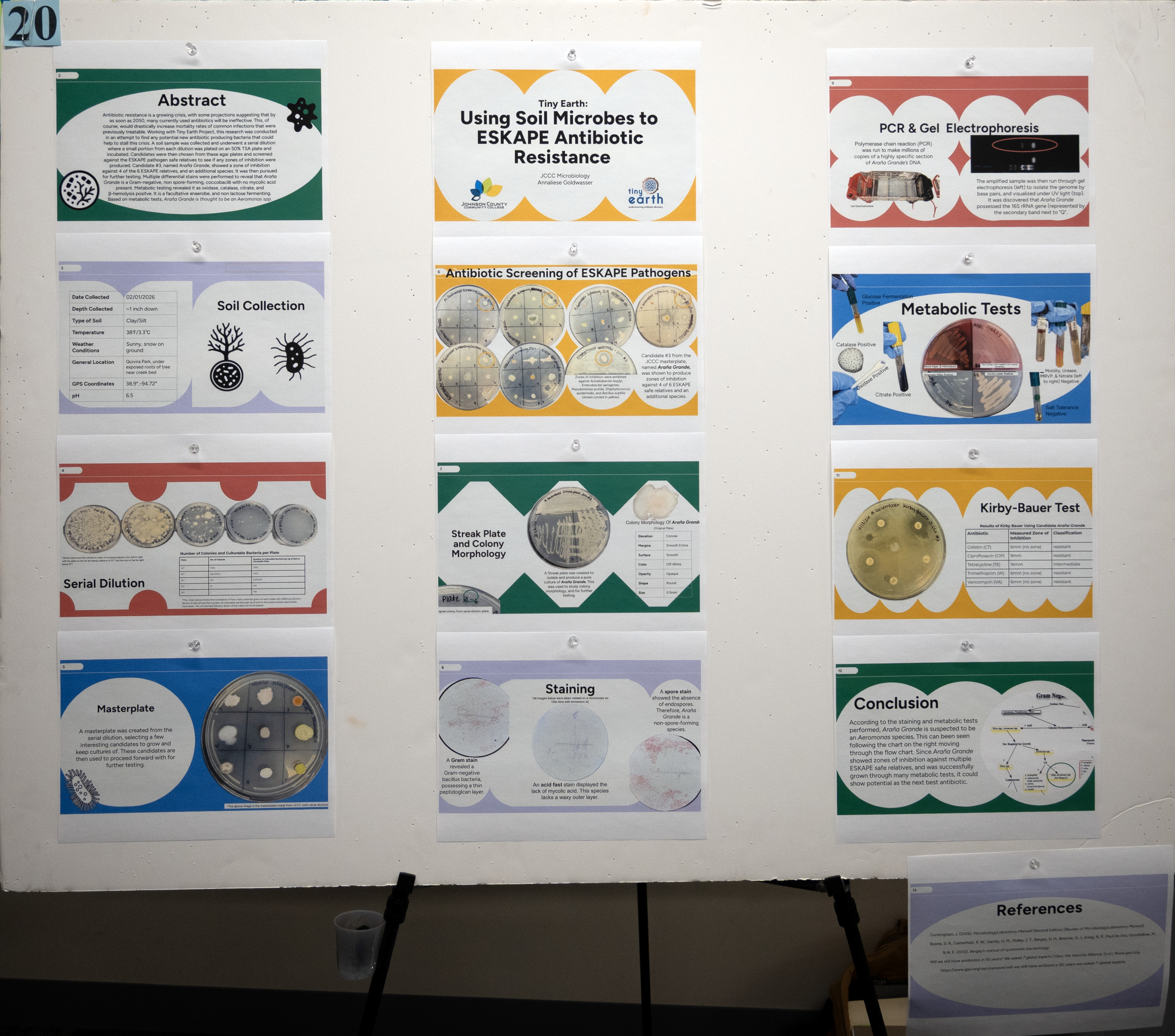
Antibiotic resistance is a growing crisis, with some projections suggesting that by as soon as 2050, many of our current antibiotics will be ineffective. This of course would drastically increase mortality rates of common infections that were previously treatable. Working with Tiny Earth Project, this research was conducted in an attempt to find any potential new antibiotic producing bacteria that could help to stall this crisis. A soil sample was collected and underwent a serial dilution where a small portion from each dilution was plated on an agar plate and incubated. Candidates were then chosen from these agar plates and screened against the ESKAPE pathogen safe relatives to see if any zones of inhibition were produced. Candidate #3 showed a zone of inhibition against 5 of the 8 ESKAPE relatives and was pursued for further testing. Multiple differential stains were performed to gather more information about this bacteria. Candidate #3 is a Gram-negative, non spore-forming, coccobacilli with no mycolic acid present. Additional testing is needed to learn more about this bacteria and its potential as the world's next antibiotic, but it has shown some promise thus far.
Image
Tiny Earth: Using Soil Microbes to ESKAPE Antibiotic Resistance
CoLab, COM 201
Antibiotic resistance is a growing crisis, with some projections suggesting that by as soon as 2050, many of our current antibiotics will be ineffective. This of course would drastically increase mortality rates of common infections that were previously treatable. Working with Tiny Earth Project, this research was conducted in an attempt to find any potential new antibiotic producing bacteria that could help to stall this crisis. A soil sample was collected and underwent a serial dilution where a small portion from each dilution was plated on an agar plate and incubated. Candidates were then chosen from these agar plates and screened against the ESKAPE pathogen safe relatives to see if any zones of inhibition were produced. Candidate #3 showed a zone of inhibition against 5 of the 8 ESKAPE relatives and was pursued for further testing. Multiple differential stains were performed to gather more information about this bacteria. Candidate #3 is a Gram-negative, non spore-forming, coccobacilli with no mycolic acid present. Additional testing is needed to learn more about this bacteria and its potential as the world's next antibiotic, but it has shown some promise thus far.
Comments
The faculty mentor for this project was Beverly Tanui.