

There’s No Place Like Home: Discovering New Antibiotics in Kansas Soil
Location
CoLab, COM 199
Start Date
30-4-2026 10:45 AM
Document Type
Poster
Description
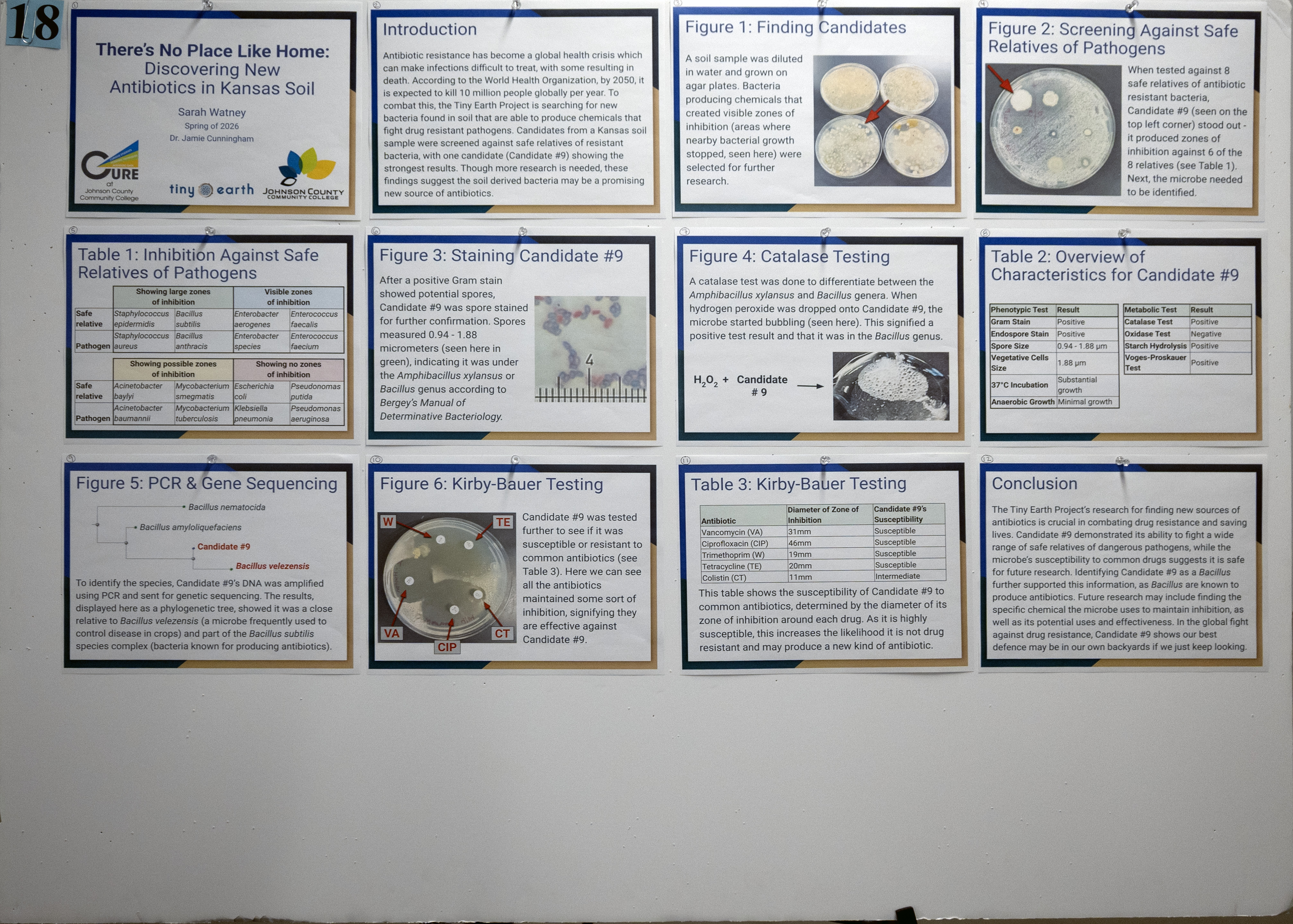
While many see antibiotics as a means to treat infection, bacteria are constantly evolving to survive these medications. Antibiotic resistance has become a global health crisis, leading to infections that are difficult to treat and able to spread more easily. For this reason, research needs to be done to search for new bacteria, frequently found in soil collections, secreting chemicals that inhibit other bacterial pathogens resistant to common antibiotics. Candidates maintaining zones of inhibition, or areas where other bacterial growth stopped, within the competitive environment of a Kansas soil sample were screened against safe relatives of pathogens resistant to common antibiotics. A candidate (Candidate #9) was found to inhibit safe relatives of Enterococcus faecium, Staphylococcus aureus, Acinetobacter baumannii, Enterobacter species, Bacillus anthracis, and Mycobacterium tuberculosis. Though more research needs to be done, these findings suggest the soil bacteria may be a promising new source of antibiotics able to fight against antibiotic resistant pathogens.
Image
There’s No Place Like Home: Discovering New Antibiotics in Kansas Soil
CoLab, COM 199
While many see antibiotics as a means to treat infection, bacteria are constantly evolving to survive these medications. Antibiotic resistance has become a global health crisis, leading to infections that are difficult to treat and able to spread more easily. For this reason, research needs to be done to search for new bacteria, frequently found in soil collections, secreting chemicals that inhibit other bacterial pathogens resistant to common antibiotics. Candidates maintaining zones of inhibition, or areas where other bacterial growth stopped, within the competitive environment of a Kansas soil sample were screened against safe relatives of pathogens resistant to common antibiotics. A candidate (Candidate #9) was found to inhibit safe relatives of Enterococcus faecium, Staphylococcus aureus, Acinetobacter baumannii, Enterobacter species, Bacillus anthracis, and Mycobacterium tuberculosis. Though more research needs to be done, these findings suggest the soil bacteria may be a promising new source of antibiotics able to fight against antibiotic resistant pathogens.
Comments
The faculty mentor for this project was Jamie Cunningham.