

Location
CoLab, COM 100
Start Date
1-5-2025 8:30 AM
Document Type
Poster
Description
Forensic anthropologists use skull and bone fragments to identify, study, and hypothesize when only partial findings are available. We are doing similar work as we examine one of 6 unknown skeletons in the JCCC Science lab to estimate each skeleton’s stature. The previous class has theorized each skeleton’s sex at birth, which has aided us in validating our height estimates. The future classes will analyze the skeletons to estimate each skeleton’s age and ancestry. The full skeletal method requires measuring the height of the skull, the height of the vertebrae, the lengths of the femur and tibia, and the height of the ankle. This sum is used within a formula that corrects for the absence of soft tissue and vertebral curvature that is present within living humans to aid in the accuracy of the estimation. The linear regression method uses the lengths of the longest appendicular bones with a standard error for the femur, the fibula, and the humerus. Our measurements and calculations using the full skeletal method have led us to the conclusion that our male skeleton’s stature was approximately 144.8cm. The linear regression model provides three ranges of Unknown 6’s height using each bone with a total range of 150.96cm - 171.1cm. This estimation excludes ancestry and age and all estimated statures have a margin of error, but all equations conclude that Unknown 6 was greater than 144cm, but no more than 172cm.
Image
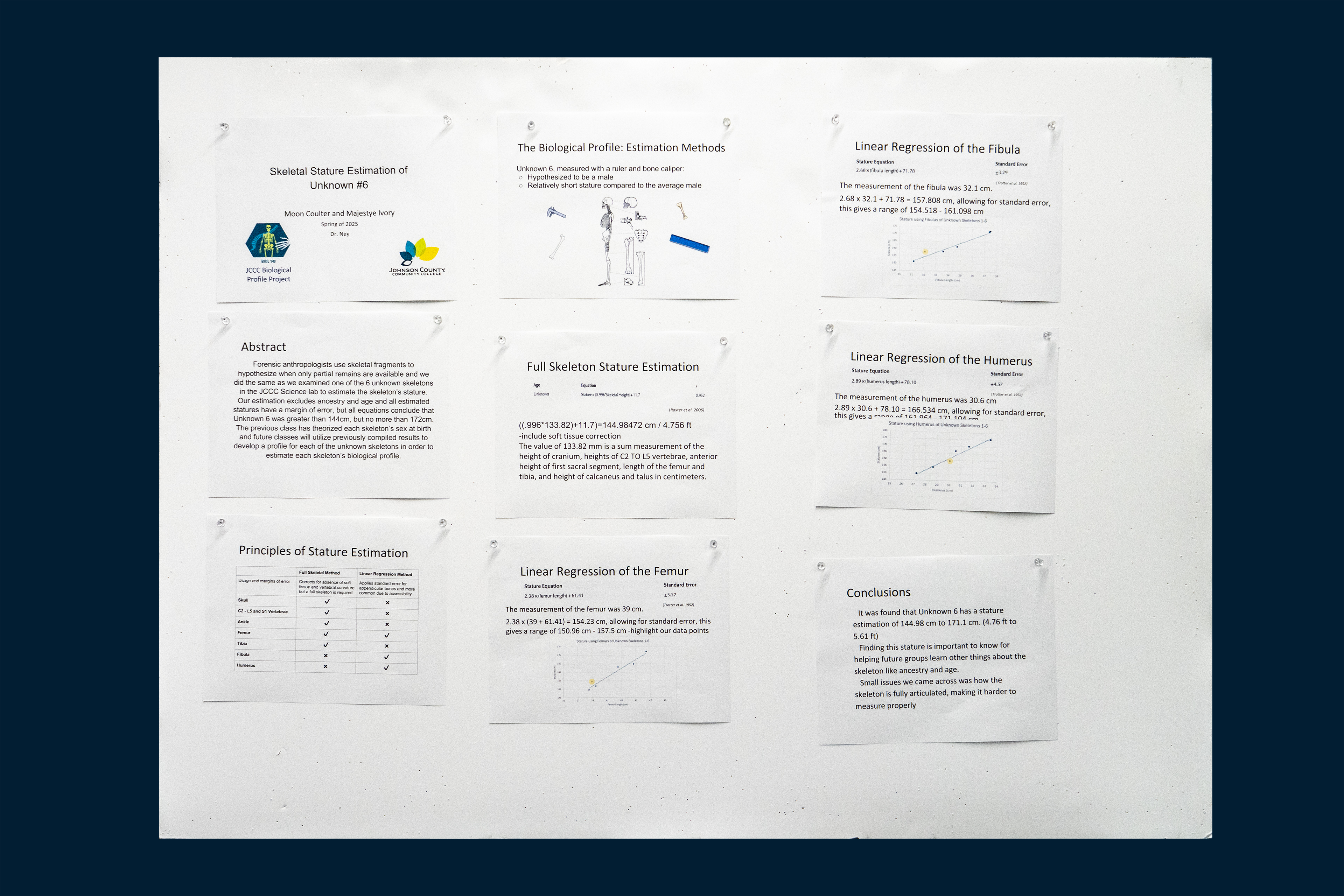
Skeletal Stature of Unknown 6
CoLab, COM 100
Forensic anthropologists use skull and bone fragments to identify, study, and hypothesize when only partial findings are available. We are doing similar work as we examine one of 6 unknown skeletons in the JCCC Science lab to estimate each skeleton’s stature. The previous class has theorized each skeleton’s sex at birth, which has aided us in validating our height estimates. The future classes will analyze the skeletons to estimate each skeleton’s age and ancestry. The full skeletal method requires measuring the height of the skull, the height of the vertebrae, the lengths of the femur and tibia, and the height of the ankle. This sum is used within a formula that corrects for the absence of soft tissue and vertebral curvature that is present within living humans to aid in the accuracy of the estimation. The linear regression method uses the lengths of the longest appendicular bones with a standard error for the femur, the fibula, and the humerus. Our measurements and calculations using the full skeletal method have led us to the conclusion that our male skeleton’s stature was approximately 144.8cm. The linear regression model provides three ranges of Unknown 6’s height using each bone with a total range of 150.96cm - 171.1cm. This estimation excludes ancestry and age and all estimated statures have a margin of error, but all equations conclude that Unknown 6 was greater than 144cm, but no more than 172cm.
Comments
The faculty mentor for this project was Gideon Ney, Biology.