

Location
CoLab, COM 100
Start Date
1-5-2025 8:30 AM
Document Type
Poster
Description
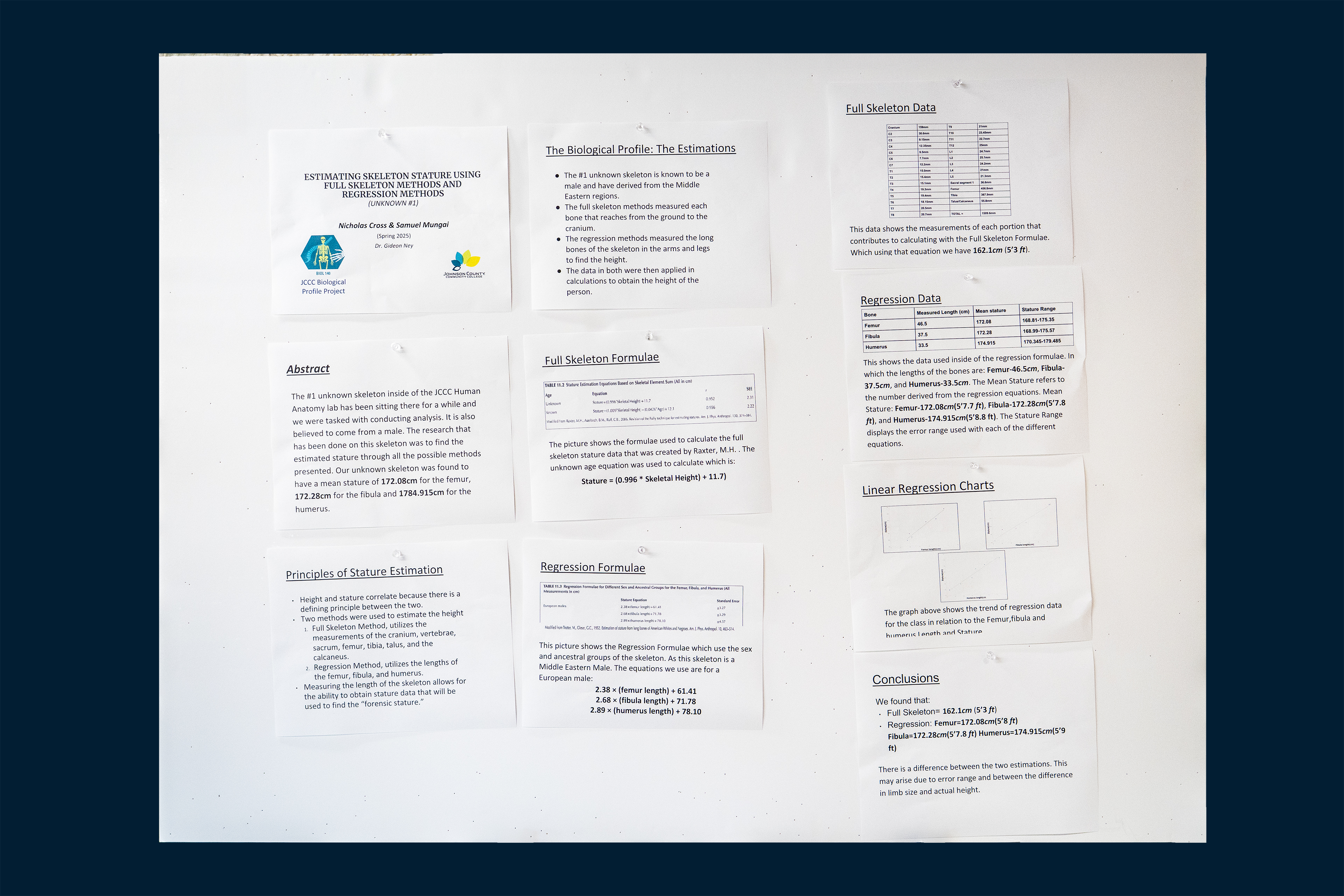
The #1 unknown skeleton inside of the JCCC Human Anatomy lab has been sitting there for a while and we were tasked with conducting analysis. It is also believed to come from a male. The research that has been done on this skeleton was to find the estimated stature through all the possible methods that will be presented. Using the first type of method, being full skeleton methods, the process involves estimating stature based on the sum of the vertical measurements of all bones that contribute to stature. Which includes the measurements of the heights of the skull, vertebrae, and ankle as well as the lengths of the femur and tibia. Our estimated stature was found to be 162.1cm (5’3) Then there is the second type of method that was used, regression methods, being based on the correlation between the person’s height and length of their body segments. This method uses one of these bones’ lengths: Femur, Tibia, or Humerus. Using the femur has the least amount of error, 士3.27, inside of the height estimate whereas the humerus has the greatest error out of the three with being 士4.57. These numbers are done using the stature equations for European Males. Our unknown skeleton was found to have a mean stature of 172.08cm for the femur, 172.28cm for the fibula and 1784.915cm for the humerus. These methods could involve errors such as the bone may have decayed or because of the lack of connective tissue in between the bones.
Image
Skeleton Stature Estimation
CoLab, COM 100
The #1 unknown skeleton inside of the JCCC Human Anatomy lab has been sitting there for a while and we were tasked with conducting analysis. It is also believed to come from a male. The research that has been done on this skeleton was to find the estimated stature through all the possible methods that will be presented. Using the first type of method, being full skeleton methods, the process involves estimating stature based on the sum of the vertical measurements of all bones that contribute to stature. Which includes the measurements of the heights of the skull, vertebrae, and ankle as well as the lengths of the femur and tibia. Our estimated stature was found to be 162.1cm (5’3) Then there is the second type of method that was used, regression methods, being based on the correlation between the person’s height and length of their body segments. This method uses one of these bones’ lengths: Femur, Tibia, or Humerus. Using the femur has the least amount of error, 士3.27, inside of the height estimate whereas the humerus has the greatest error out of the three with being 士4.57. These numbers are done using the stature equations for European Males. Our unknown skeleton was found to have a mean stature of 172.08cm for the femur, 172.28cm for the fibula and 1784.915cm for the humerus. These methods could involve errors such as the bone may have decayed or because of the lack of connective tissue in between the bones.
Comments
The faculty mentor for this project was Gideon Ney, Biology.