

Location
CoLab, COM 100
Start Date
1-5-2025 12:15 PM
Document Type
Poster
Description
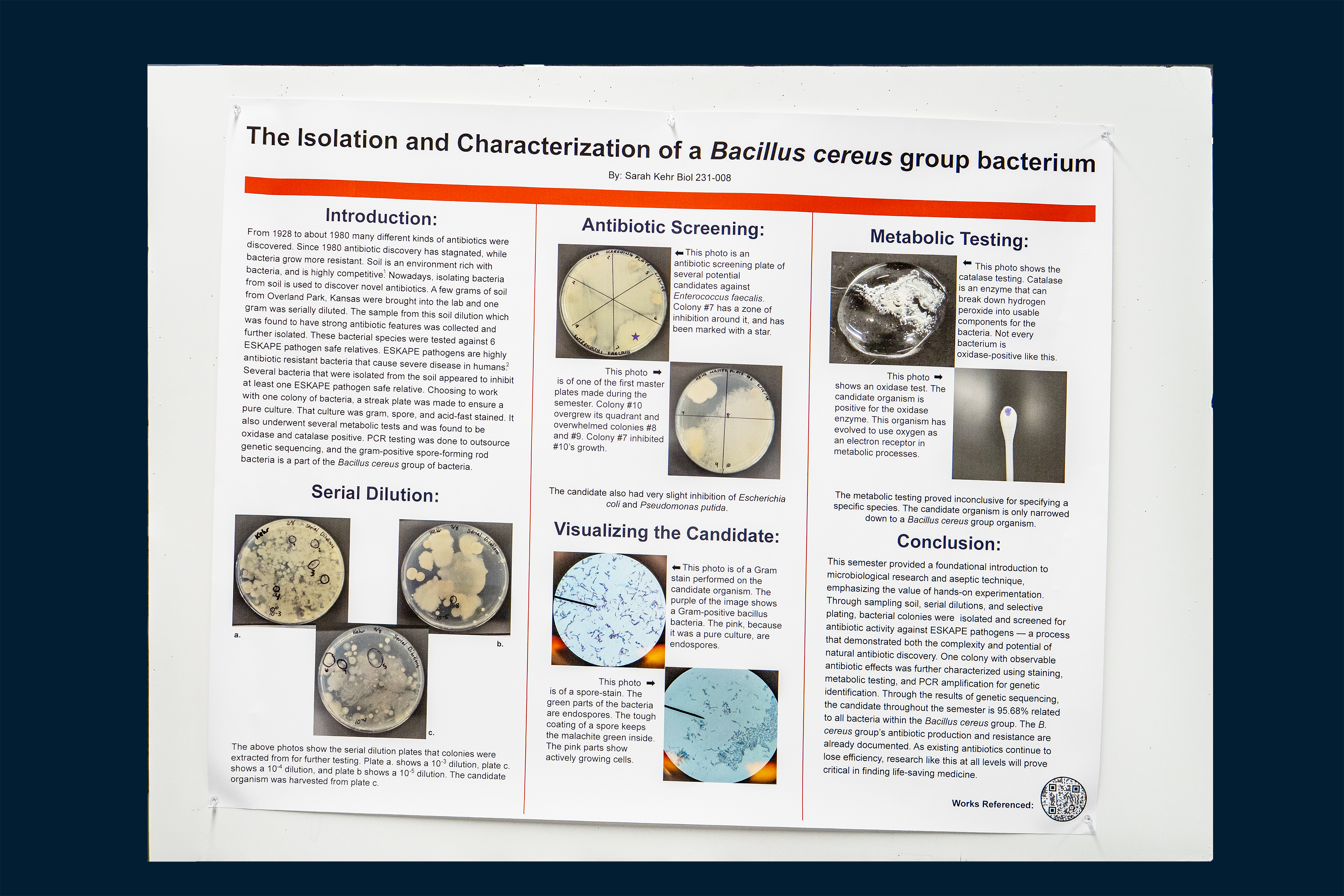
Antibiotic resistance is a plague upon the healthcare system. In 1928 Alexander Fleming discovered the first antibiotic, penicillin. From 1928 to about 1980 many different kinds of antibiotics were discovered. Since 1980 there has been a void of discovery, and bacteria are growing more resistant to available antibiotics. Soil is an environment rich with bacteria, and is highly competitive. Nowadays, isolating bacteria from soil is used to discover hopefully new antibiotics. A few grams of soil from Overland Park, Kansas were brought into the lab and one gram was serially diluted. The bacteria from this soil dilution found to have strong antibiotic features were collected and further isolated. These bacterial species were tested against ESKAPE pathogen safe relatives. ESKAPE pathogens are highly antibiotic resistant bacteria that cause severe disease in humans. Several bacteria that were isolated from the soil appeared to inhibit at least one ESKAPE pathogen safe relative. Choosing to work with one colony of bacteria, a streak plate was made to ensure a pure culture. That culture was gram stained, spore stained, and acid-fast stained. That culture of bacteria is a gram-positive bacillus (rod) that forms spores.
Image
Exploring Antibiotic Production of Soil Bacteria
CoLab, COM 100
Antibiotic resistance is a plague upon the healthcare system. In 1928 Alexander Fleming discovered the first antibiotic, penicillin. From 1928 to about 1980 many different kinds of antibiotics were discovered. Since 1980 there has been a void of discovery, and bacteria are growing more resistant to available antibiotics. Soil is an environment rich with bacteria, and is highly competitive. Nowadays, isolating bacteria from soil is used to discover hopefully new antibiotics. A few grams of soil from Overland Park, Kansas were brought into the lab and one gram was serially diluted. The bacteria from this soil dilution found to have strong antibiotic features were collected and further isolated. These bacterial species were tested against ESKAPE pathogen safe relatives. ESKAPE pathogens are highly antibiotic resistant bacteria that cause severe disease in humans. Several bacteria that were isolated from the soil appeared to inhibit at least one ESKAPE pathogen safe relative. Choosing to work with one colony of bacteria, a streak plate was made to ensure a pure culture. That culture was gram stained, spore stained, and acid-fast stained. That culture of bacteria is a gram-positive bacillus (rod) that forms spores.
Comments
The faculty mentor for this project was Matthew Ducote, Biology.