

Location
CoLab, COM 100
Start Date
1-5-2025 12:15 PM
Document Type
Poster
Description
In this study, I investigated the antimicrobial properties of bacteria isolated from a random soil sample, focusing on their ability to inhibit the growth of ESKAPE pathogens, a group of bacteria known for their multidrug resistance and clinical significance. A total of 8 candidate strains were tested against 8 safe relatives of ESKAPE pathogens, including Escherichia coli, Enterobacter aerogenes, Pseudomonas putida, Acinetobacter baylyi, Staphylococcus epidermidis, Enterococcus faecalis, Bacillus subtilis, and Mycobacterium smegmatis. Among the candidates, YA2.1 demonstrated consistent inhibition of 5 out of the 8 tested species, marking it as the most promising isolate for further investigation. YA2.1 showed large visible zones of inhibition against E. coli, S. epidermidis, B. subtilis, and M. smegmatis. With a visible zone of inhibition against E. faecalis, and a possible zone against A. baylyi indicating its potential as a source of antimicrobial compounds. This project discusses the methodology, results, and potential applications of YA2.1, emphasizing its significance in the search for new antimicrobial agents, particularly in the face of rising antibiotic resistance.
Image
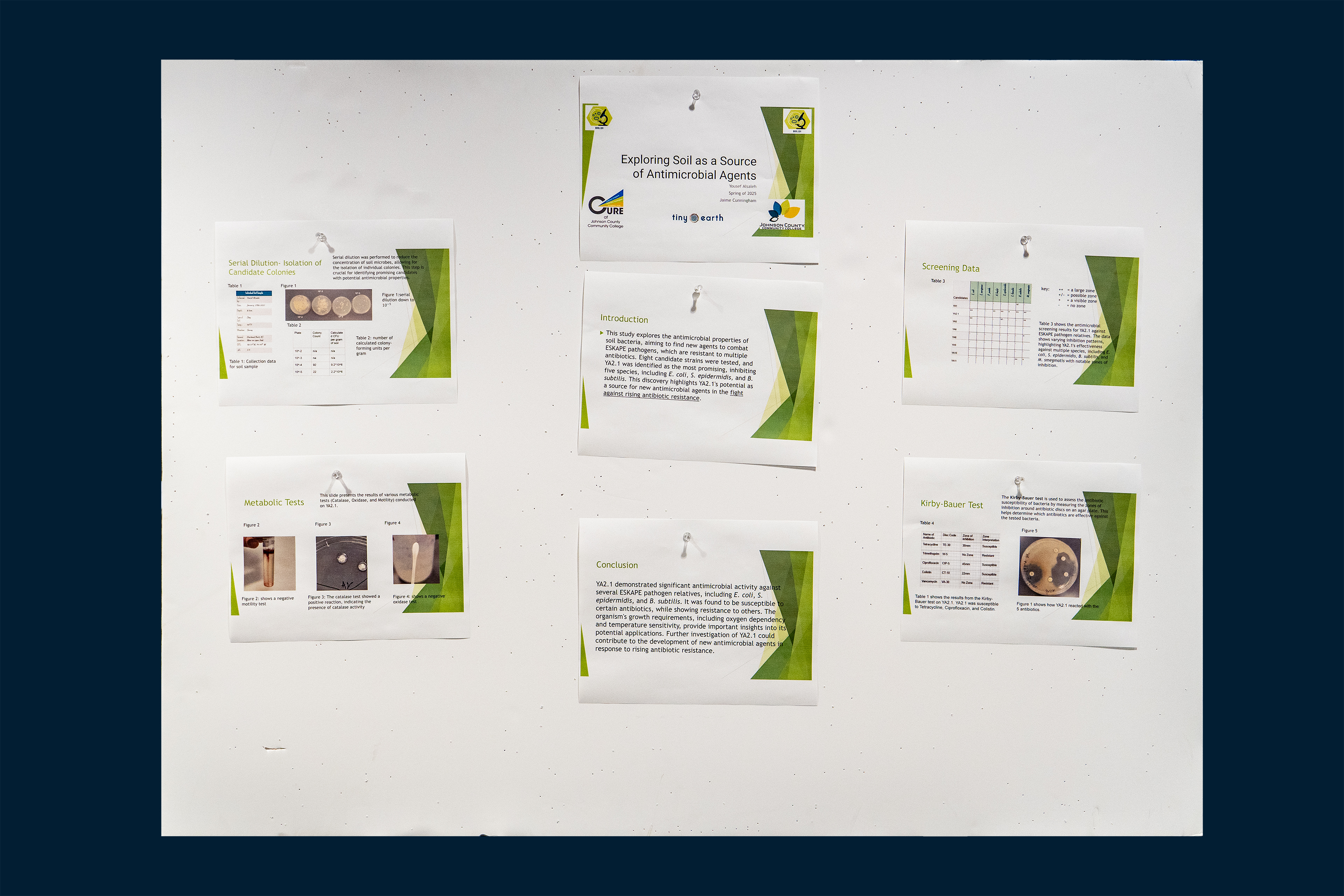
Exploring Soil as a Source of Antimicrobial Agents
CoLab, COM 100
In this study, I investigated the antimicrobial properties of bacteria isolated from a random soil sample, focusing on their ability to inhibit the growth of ESKAPE pathogens, a group of bacteria known for their multidrug resistance and clinical significance. A total of 8 candidate strains were tested against 8 safe relatives of ESKAPE pathogens, including Escherichia coli, Enterobacter aerogenes, Pseudomonas putida, Acinetobacter baylyi, Staphylococcus epidermidis, Enterococcus faecalis, Bacillus subtilis, and Mycobacterium smegmatis. Among the candidates, YA2.1 demonstrated consistent inhibition of 5 out of the 8 tested species, marking it as the most promising isolate for further investigation. YA2.1 showed large visible zones of inhibition against E. coli, S. epidermidis, B. subtilis, and M. smegmatis. With a visible zone of inhibition against E. faecalis, and a possible zone against A. baylyi indicating its potential as a source of antimicrobial compounds. This project discusses the methodology, results, and potential applications of YA2.1, emphasizing its significance in the search for new antimicrobial agents, particularly in the face of rising antibiotic resistance.
Comments
The faculty mentor for this project was Jamie Cunningham, Biology.