

Location
CoLab, COM 100
Start Date
1-5-2025 12:15 PM
Document Type
Poster
Description
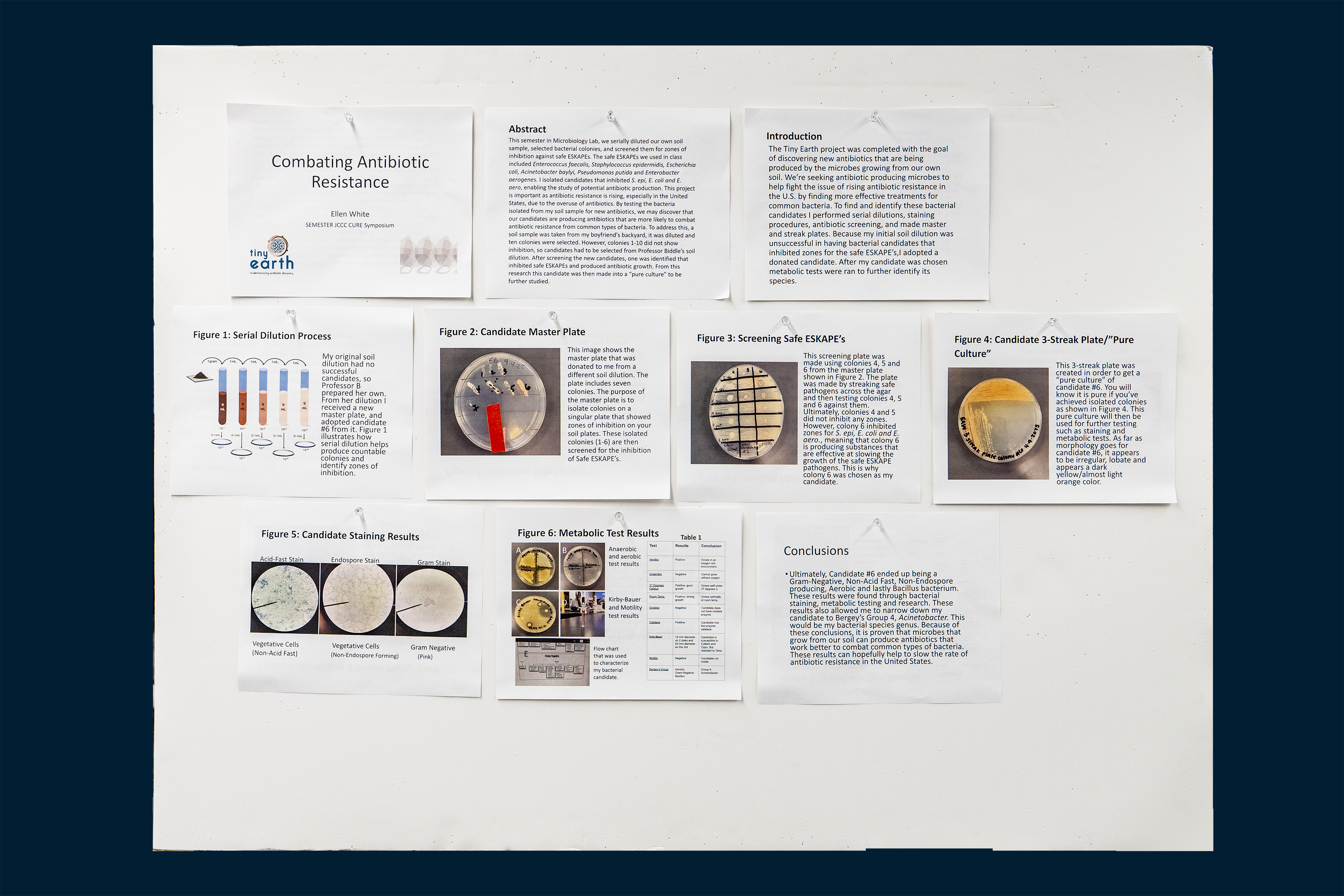
This semester in Microbiology Lab, we serially diluted our own soil sample, selected bacterial colonies, and screened them for zones of inhibition against safe ESKAPEs. The safe ESKAPEs we used in class included E. fae, S. epi, E. coli, A. bay, P. put and E. aero. I isolated candidates that inhibited these, enabling the study of potential antibiotic production. This project is important as antibiotic resistance is rising, especially in the United States, due to the overuse of antibiotics. By testing the bacteria isolated from my soil sample for new antibiotics, we may discover that our candidates are producing antibiotics that are more likely to combat antibiotic resistance from common types of bacteria. To address this, a soil sample was taken from my boyfriend's backyard, it was diluted and ten colonies were selected. However, colonies 1-10 did not show inhibition, so candidates had to be selected from a different dilution. After screening the new candidates, one was identified that inhibited safe ESKAPEs and produced antibiotic growth. From this research this candidate was then made into a “pure culture” to be further studied.
Image
Combating Antibiotic Resistance
CoLab, COM 100
This semester in Microbiology Lab, we serially diluted our own soil sample, selected bacterial colonies, and screened them for zones of inhibition against safe ESKAPEs. The safe ESKAPEs we used in class included E. fae, S. epi, E. coli, A. bay, P. put and E. aero. I isolated candidates that inhibited these, enabling the study of potential antibiotic production. This project is important as antibiotic resistance is rising, especially in the United States, due to the overuse of antibiotics. By testing the bacteria isolated from my soil sample for new antibiotics, we may discover that our candidates are producing antibiotics that are more likely to combat antibiotic resistance from common types of bacteria. To address this, a soil sample was taken from my boyfriend's backyard, it was diluted and ten colonies were selected. However, colonies 1-10 did not show inhibition, so candidates had to be selected from a different dilution. After screening the new candidates, one was identified that inhibited safe ESKAPEs and produced antibiotic growth. From this research this candidate was then made into a “pure culture” to be further studied.
Comments
The faculty mentor for this project was Eulandria Biddle, Biology.