

Location
CoLab, COM 100
Start Date
1-5-2025 12:15 PM
Document Type
Poster
Description
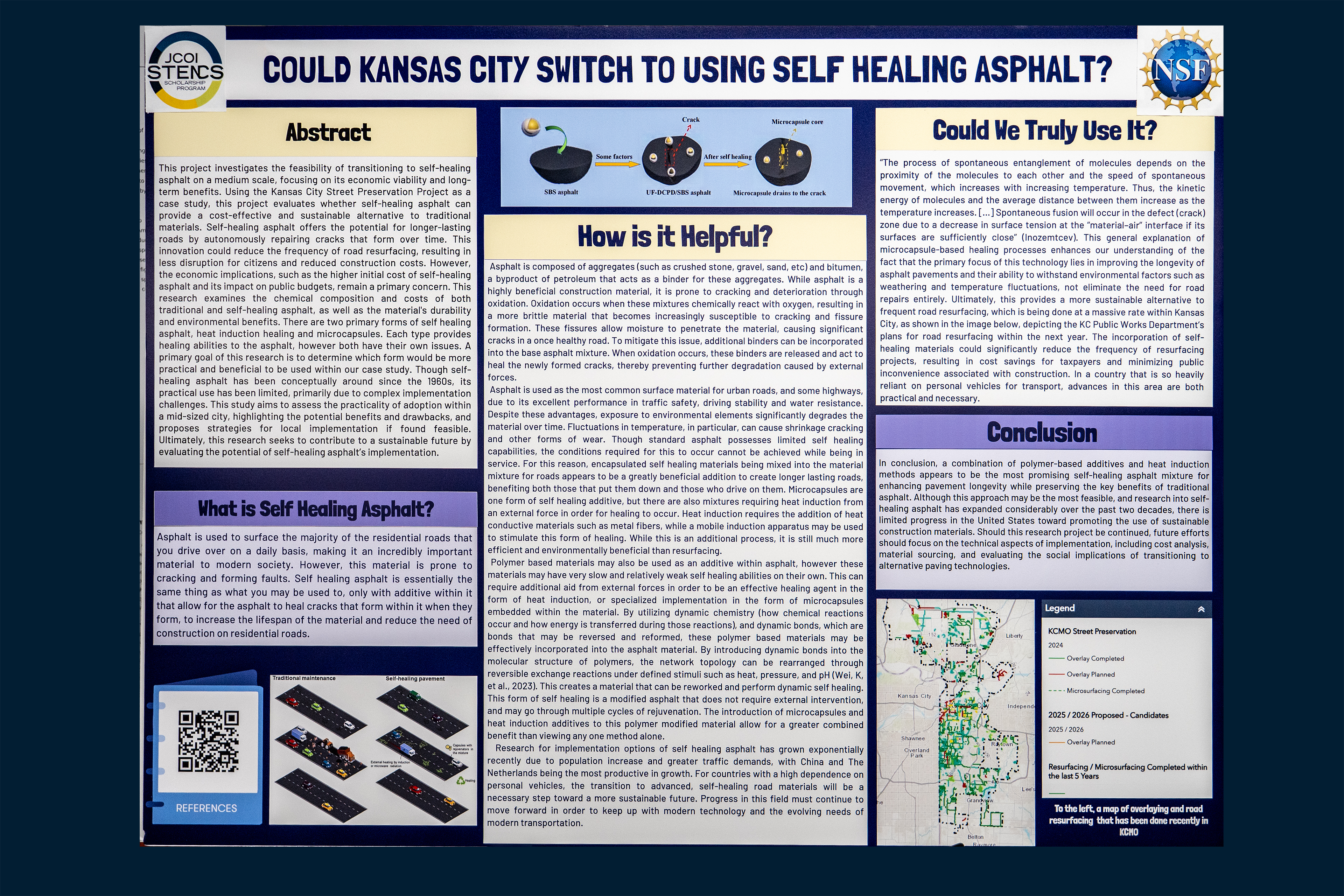
This project investigates the feasibility of transitioning to self-healing asphalt on a medium scale, focusing on its economic viability and long-term benefits. Using the Kansas City Street Preservation Project as a case study, this project evaluates whether self-healing asphalt can provide a cost-effective and sustainable alternative to traditional materials. Self-healing asphalt offers the potential for longer-lasting roads by autonomously repairing cracks that form over time. This innovation could reduce the frequency of road resurfacing, resulting in less disruption for citizens and reduced construction costs. However, the economic implications, such as the higher initial cost of self-healing asphalt and its impact on public budgets, remain a primary concern. This research examines the chemical composition and costs of both traditional and self-healing asphalt, as well as the material's durability and environmental benefits. There are two primary forms of self healing asphalt, heat induction healing and microcapsules. Each type provides healing abilities to the asphalt, however both have their own issues. A primary goal of this research is to determine which form would be more practical and beneficial to be used within our case study. Though self-healing asphalt has been conceptually around since the 1960s, its practical use has been limited, primarily due to complex implementation challenges. This study aims to assess the practicality of adoption within a mid-sized city, highlighting the potential benefits and drawbacks, and proposes strategies for local implementation if found feasible. Ultimately, this research seeks to contribute to a sustainable future by evaluating the potential of self-healing asphalt’s implementation.
Image
Could Kansas City Switch to Using Self-Healing Asphalt?
CoLab, COM 100
This project investigates the feasibility of transitioning to self-healing asphalt on a medium scale, focusing on its economic viability and long-term benefits. Using the Kansas City Street Preservation Project as a case study, this project evaluates whether self-healing asphalt can provide a cost-effective and sustainable alternative to traditional materials. Self-healing asphalt offers the potential for longer-lasting roads by autonomously repairing cracks that form over time. This innovation could reduce the frequency of road resurfacing, resulting in less disruption for citizens and reduced construction costs. However, the economic implications, such as the higher initial cost of self-healing asphalt and its impact on public budgets, remain a primary concern. This research examines the chemical composition and costs of both traditional and self-healing asphalt, as well as the material's durability and environmental benefits. There are two primary forms of self healing asphalt, heat induction healing and microcapsules. Each type provides healing abilities to the asphalt, however both have their own issues. A primary goal of this research is to determine which form would be more practical and beneficial to be used within our case study. Though self-healing asphalt has been conceptually around since the 1960s, its practical use has been limited, primarily due to complex implementation challenges. This study aims to assess the practicality of adoption within a mid-sized city, highlighting the potential benefits and drawbacks, and proposes strategies for local implementation if found feasible. Ultimately, this research seeks to contribute to a sustainable future by evaluating the potential of self-healing asphalt’s implementation.
Comments
The faculty mentor for this project was Beth Edmonds, STEM Scholars.