

Location
CoLab, COM 100
Start Date
1-5-2025 11:00 AM
Document Type
Poster
Description
The purpose of “Lysine’s the Limit - A Peptide Synthesis Project,” is to synthesize an antimicrobial peptide from the coupling of Lysine and BOC-FF-OMe. The goal of the synthesis is to form a peptide that is two to three amino acids long. Before the coupling reaction can begin, both amino acids need to have a protecting group to prevent unwanted reactions. The amine groups on lysine will need to be protected by BOC-anhydride; di-tert butyl-dicarbonate. The peptide, BOC-FF-OMe, with its carboxylic acid protected, will need to go through a deprotection reaction. This will free the amine group to react with the carboxylic acid on lysine. The peptide bond will then be formed using EDC as a coupling reagent. The final peptide will be analyzed using 1H NMR and IR spectra. The antimicrobial activity will also be evaluated to ensure its an antimicrobial peptide.
Image
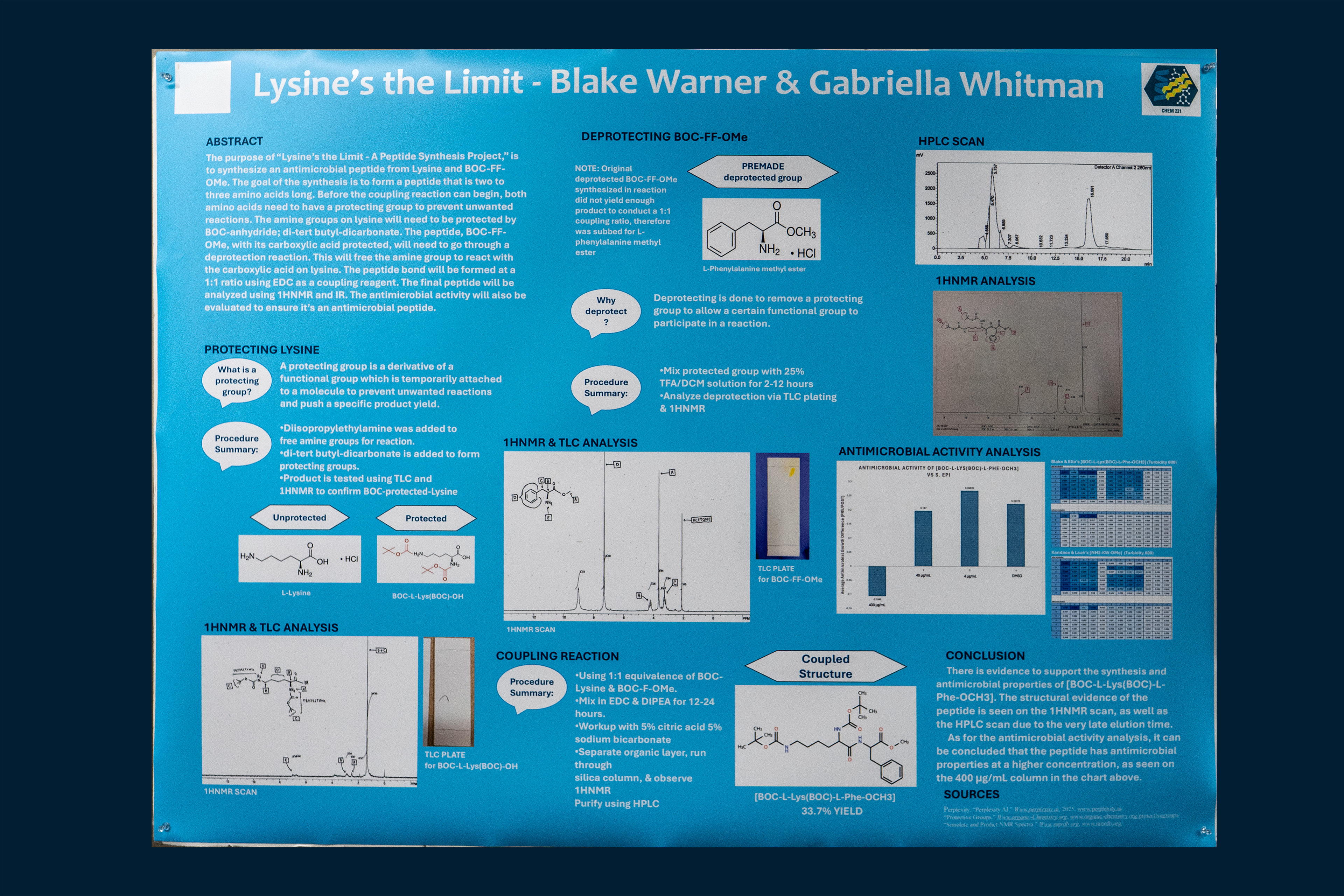
Lysine's the Limit - A Peptide Synthesis Project
CoLab, COM 100
The purpose of “Lysine’s the Limit - A Peptide Synthesis Project,” is to synthesize an antimicrobial peptide from the coupling of Lysine and BOC-FF-OMe. The goal of the synthesis is to form a peptide that is two to three amino acids long. Before the coupling reaction can begin, both amino acids need to have a protecting group to prevent unwanted reactions. The amine groups on lysine will need to be protected by BOC-anhydride; di-tert butyl-dicarbonate. The peptide, BOC-FF-OMe, with its carboxylic acid protected, will need to go through a deprotection reaction. This will free the amine group to react with the carboxylic acid on lysine. The peptide bond will then be formed using EDC as a coupling reagent. The final peptide will be analyzed using 1H NMR and IR spectra. The antimicrobial activity will also be evaluated to ensure its an antimicrobial peptide.
Comments
The faculty mentor for this project was Meagan Weldele, Chemistry.