

Location
CoLab, COM 100
Start Date
1-5-2025 11:00 AM
Document Type
Poster
Description
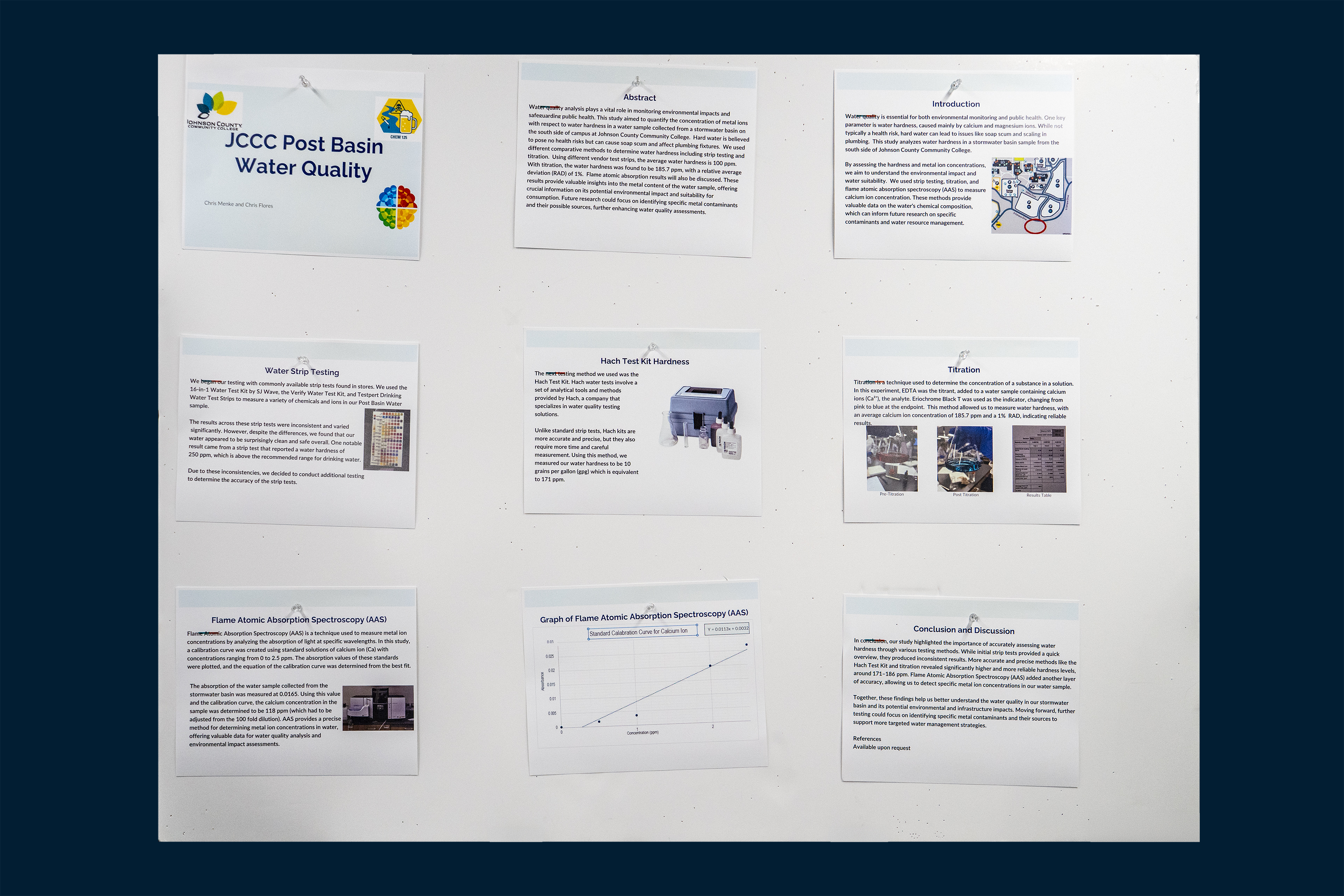
Water quality analysis plays a vital role in monitoring environmental impacts and safeguarding public health. This study aimed to quantify the concentration of metal ions with respect to water hardness in a water sample collected from a stormwater basin on the south side of campus at Johnson County Community College. Hard water is believed to pose no health risks but can cause soap scum and affect plumbing fixtures. We used different comparative methods to determine water hardness including strip testing and titration. Using different vendor test strips, the average water hardness is 100 ppm. With titration, the water hardness was found to be 185.7 ppm, with a relative average deviation (RAD) of 1%. Flame atomic absorption results will also be discussed. These results provide valuable insights into the metal content of the water sample, offering crucial information on its potential environmental impact and suitability for consumption. Future research could focus on identifying specific metal contaminants and their possible sources, further enhancing water quality assessments.
Image
JCCC Post Basin Water Quality
CoLab, COM 100
Water quality analysis plays a vital role in monitoring environmental impacts and safeguarding public health. This study aimed to quantify the concentration of metal ions with respect to water hardness in a water sample collected from a stormwater basin on the south side of campus at Johnson County Community College. Hard water is believed to pose no health risks but can cause soap scum and affect plumbing fixtures. We used different comparative methods to determine water hardness including strip testing and titration. Using different vendor test strips, the average water hardness is 100 ppm. With titration, the water hardness was found to be 185.7 ppm, with a relative average deviation (RAD) of 1%. Flame atomic absorption results will also be discussed. These results provide valuable insights into the metal content of the water sample, offering crucial information on its potential environmental impact and suitability for consumption. Future research could focus on identifying specific metal contaminants and their possible sources, further enhancing water quality assessments.
Comments
The faculty mentor for this project was Lori Slavin, Chemistry.