

Location
CoLab, COM 100
Start Date
1-5-2025 9:45 AM
Document Type
Poster
Description
Antibiotic resistance has become an increasing concern for healthcare professionals in recent years, especially with the emergence of pathogens that can resist treatment by common antibiotics. These are known as ESKAPE Pathogens, these complicate the treatment of infections, leading to longer illness durations and increased healthcare costs. As a result, there is an urgent need for the discovery of new antibiotics to effectively combat these resistant strains. To contribute to this effort, I collected soil samples from a garden in Garnett, KS, an area known for its diverse microbial ecosystem. Soil is a valuable source for identifying microorganisms that may produce novel antibiotics, as it contains a wide variety of bacterial species, many of which have the potential to produce antimicrobial compounds. The collected soil was diluted and cultured to isolate microorganisms with antibiotic-producing capabilities. After screening the samples, I identified 12 candidates that showed promising antimicrobial activity. I then focused on two candidates, 8 and 11, both of which demonstrated the ability to inhibit the growth of antibiotic-resistant bacteria, suggesting they could be potential sources of new antibiotics. To verify the purity of the cultures, I performed a streak plate assay, which confirmed that candidate 11 was a pure culture. Microscopic analysis revealed that candidate 11 was a Gram-positive, spore-forming rod, a feature commonly associated with a antibiotic-producing bacteria. These findings suggest that candidate 11 may hold significant potential as a new source of antimicrobial agents.
Image
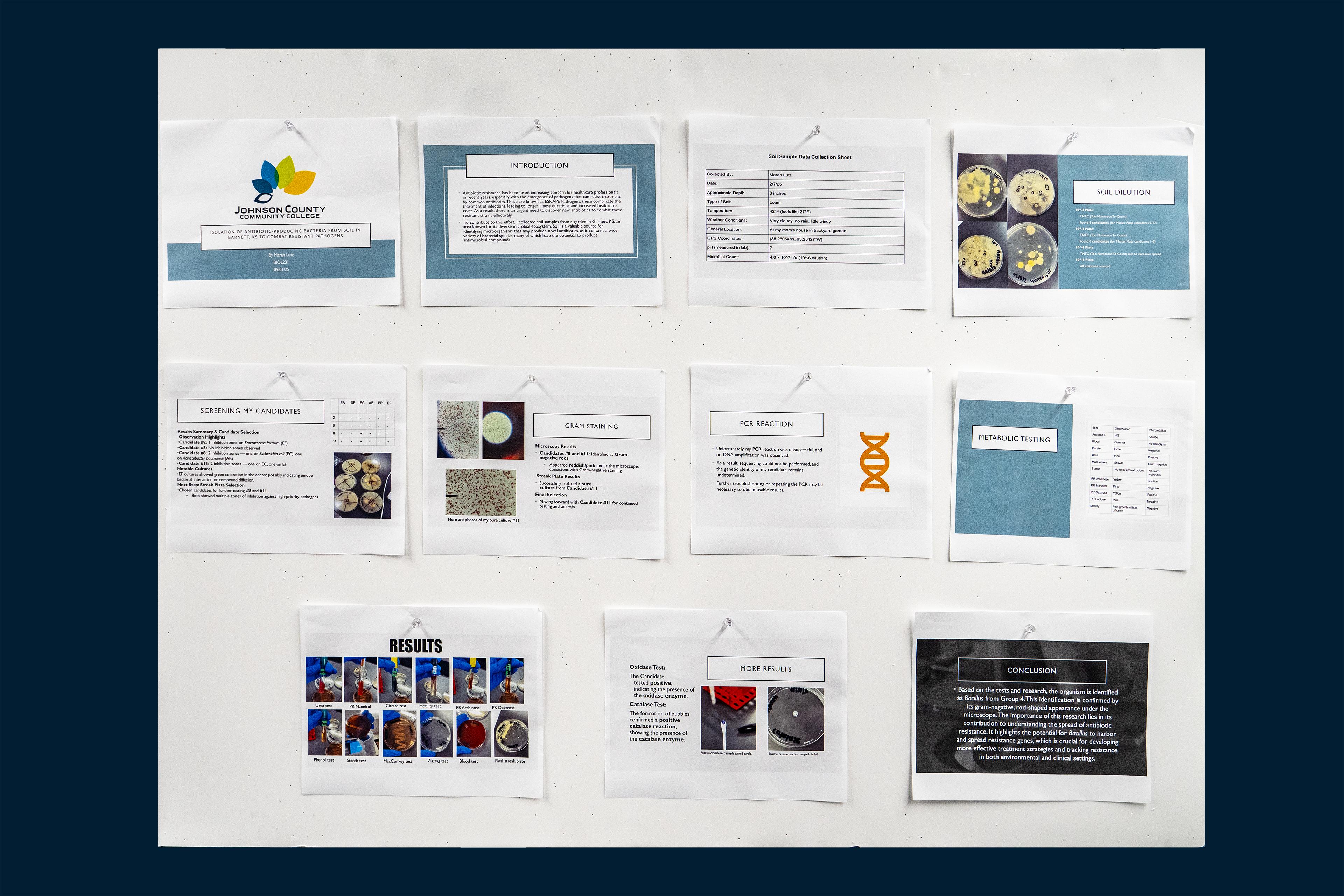
Isolation of Antibiotic-Producing Bacteria from Soil in Garnett, KS to Combat Resistant Pathogens
CoLab, COM 100
Antibiotic resistance has become an increasing concern for healthcare professionals in recent years, especially with the emergence of pathogens that can resist treatment by common antibiotics. These are known as ESKAPE Pathogens, these complicate the treatment of infections, leading to longer illness durations and increased healthcare costs. As a result, there is an urgent need for the discovery of new antibiotics to effectively combat these resistant strains. To contribute to this effort, I collected soil samples from a garden in Garnett, KS, an area known for its diverse microbial ecosystem. Soil is a valuable source for identifying microorganisms that may produce novel antibiotics, as it contains a wide variety of bacterial species, many of which have the potential to produce antimicrobial compounds. The collected soil was diluted and cultured to isolate microorganisms with antibiotic-producing capabilities. After screening the samples, I identified 12 candidates that showed promising antimicrobial activity. I then focused on two candidates, 8 and 11, both of which demonstrated the ability to inhibit the growth of antibiotic-resistant bacteria, suggesting they could be potential sources of new antibiotics. To verify the purity of the cultures, I performed a streak plate assay, which confirmed that candidate 11 was a pure culture. Microscopic analysis revealed that candidate 11 was a Gram-positive, spore-forming rod, a feature commonly associated with a antibiotic-producing bacteria. These findings suggest that candidate 11 may hold significant potential as a new source of antimicrobial agents.
Comments
The faculty mentor for this project was Matthew Ducote, Biology.