
Location
CoLab, COM 100
Start Date
1-5-2025 9:45 AM
Document Type
Poster
Description
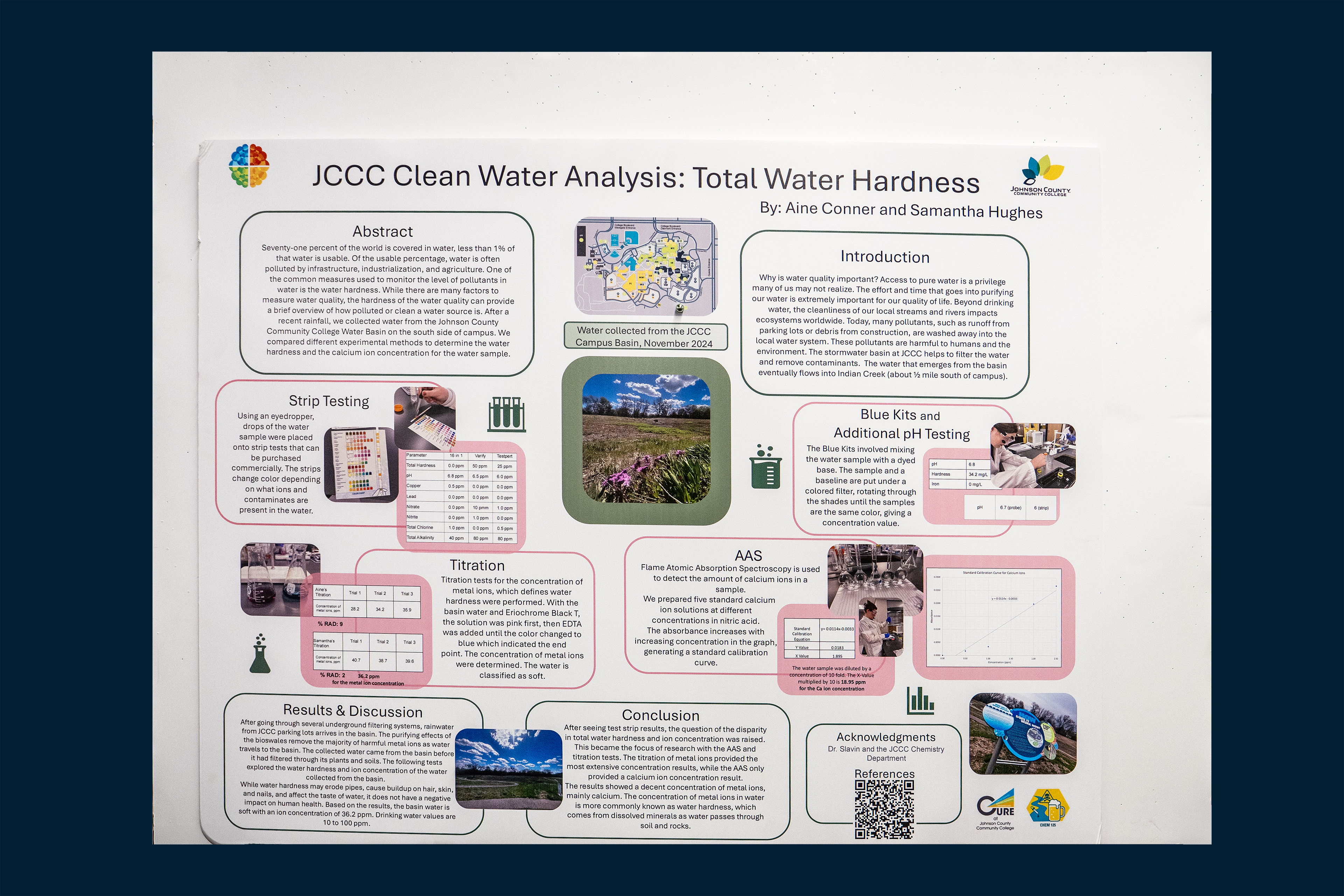
Seventy-one percent of the world is covered in water, less than 1% of that water is usable. Of the usable percentage, water is often polluted by infrastructure, industrialization, and agriculture. One of the common measures used to monitor the level of pollutants in water is the water hardness. While there are many factors to measure water quality, the hardness of the water quality can provide a brief overview of how polluted or clean a water source is. After a recent rainfall, we collected water from the Johnson County Community College Water Basin on the south side of campus. We compared different experimental methods to determine the water hardness and the calcium ion concentration for our water sample.
Image
JCCC Clean Water Analysis: Water Hardness
CoLab, COM 100
Seventy-one percent of the world is covered in water, less than 1% of that water is usable. Of the usable percentage, water is often polluted by infrastructure, industrialization, and agriculture. One of the common measures used to monitor the level of pollutants in water is the water hardness. While there are many factors to measure water quality, the hardness of the water quality can provide a brief overview of how polluted or clean a water source is. After a recent rainfall, we collected water from the Johnson County Community College Water Basin on the south side of campus. We compared different experimental methods to determine the water hardness and the calcium ion concentration for our water sample.
Comments
The faculty mentor for this project was Lori Slavin, Chemistry.