

Location
CoLab, COM 100
Start Date
1-5-2025 5:30 PM
Document Type
Poster
Description
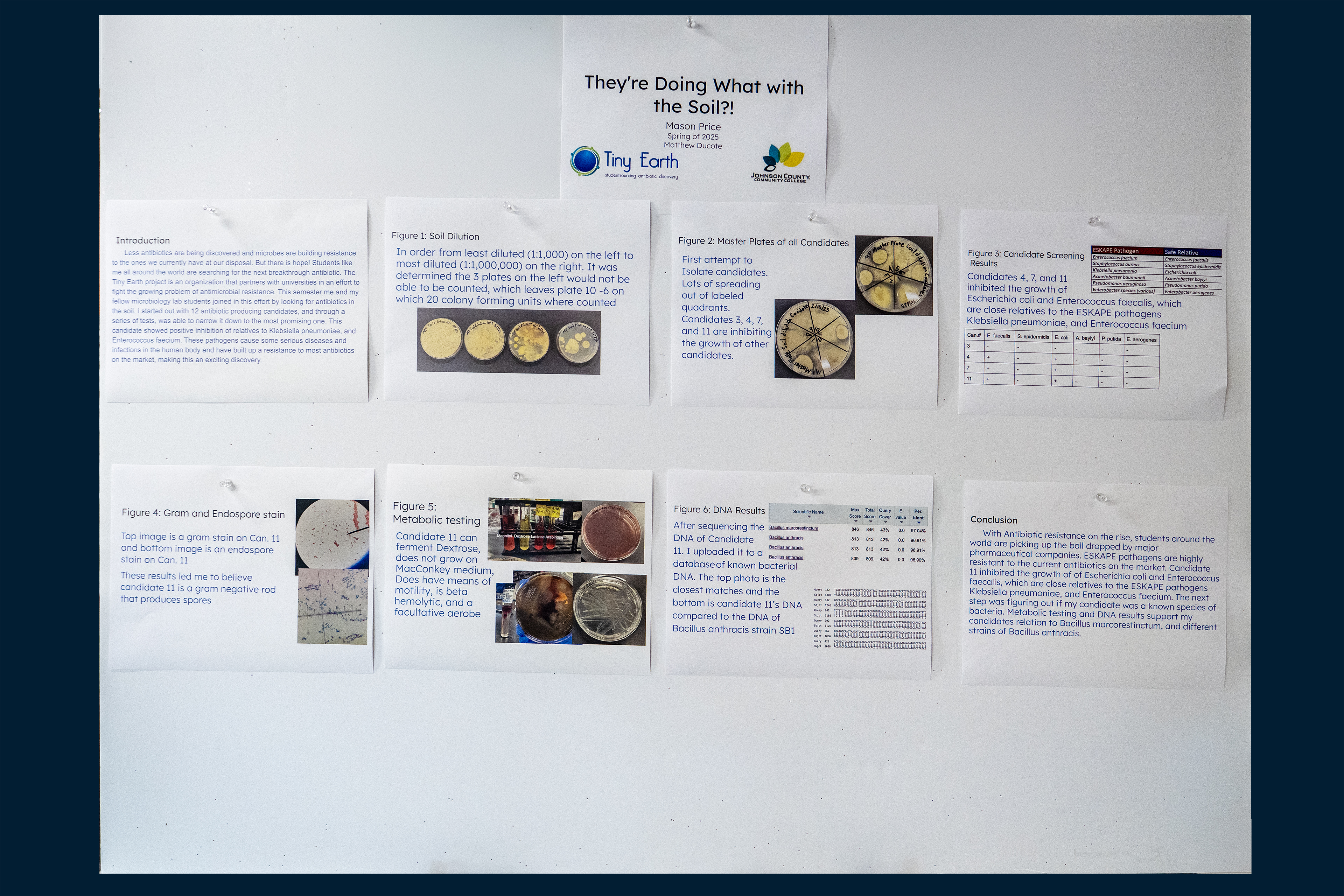
In 1928 the first antibiotic, penicillin, was discovered. After this breakthrough, new antibiotics were being researched, and created by the top pharmaceutical companies at astonishing rates. Over time however, these companies were becoming less and less successful in this pursuit. Less antibiotics are being discovered and microbes are building resistance to the ones we currently have at our disposal. But there is hope! Students like me all around the world are searching for the next breakthrough antibiotic. The Tiny Earth project is an organization that partners with universities in an effort to fight the growing problem of antimicrobial resistance. This semester me and my fellow microbiology lab students joined in this effort by looking for antibiotics in the soil. The soil is a competitive environment for microbes, this leads to some microbes developing the ability to produce antibiotics in order to have better access to their surrounding nutrients. I started out with 12 antibiotic producing candidates, and through a series of tests, was able to narrow it down to the most promising one. I have determined that this candidate is a spore producing gram negative bacilli. This candidate showed positive inhibition of Escherichia coli and Enterococcus faecalis, which are close relatives to the ESKAPE pathogens Klebsiella pneumoniae, and Enterococcus faecium. These pathogens cause some serious diseases and infections in the human body and have built up a resistance to most antibiotics on the market, making this an exciting discovery.
Image
They're Doing What with the Soil?!
CoLab, COM 100
In 1928 the first antibiotic, penicillin, was discovered. After this breakthrough, new antibiotics were being researched, and created by the top pharmaceutical companies at astonishing rates. Over time however, these companies were becoming less and less successful in this pursuit. Less antibiotics are being discovered and microbes are building resistance to the ones we currently have at our disposal. But there is hope! Students like me all around the world are searching for the next breakthrough antibiotic. The Tiny Earth project is an organization that partners with universities in an effort to fight the growing problem of antimicrobial resistance. This semester me and my fellow microbiology lab students joined in this effort by looking for antibiotics in the soil. The soil is a competitive environment for microbes, this leads to some microbes developing the ability to produce antibiotics in order to have better access to their surrounding nutrients. I started out with 12 antibiotic producing candidates, and through a series of tests, was able to narrow it down to the most promising one. I have determined that this candidate is a spore producing gram negative bacilli. This candidate showed positive inhibition of Escherichia coli and Enterococcus faecalis, which are close relatives to the ESKAPE pathogens Klebsiella pneumoniae, and Enterococcus faecium. These pathogens cause some serious diseases and infections in the human body and have built up a resistance to most antibiotics on the market, making this an exciting discovery.
Comments
The faculty mentor for this project was Matthew Ducote, Biology.