

Location
CoLab, COM 100
Start Date
1-5-2025 2:45 PM
Document Type
Poster
Description
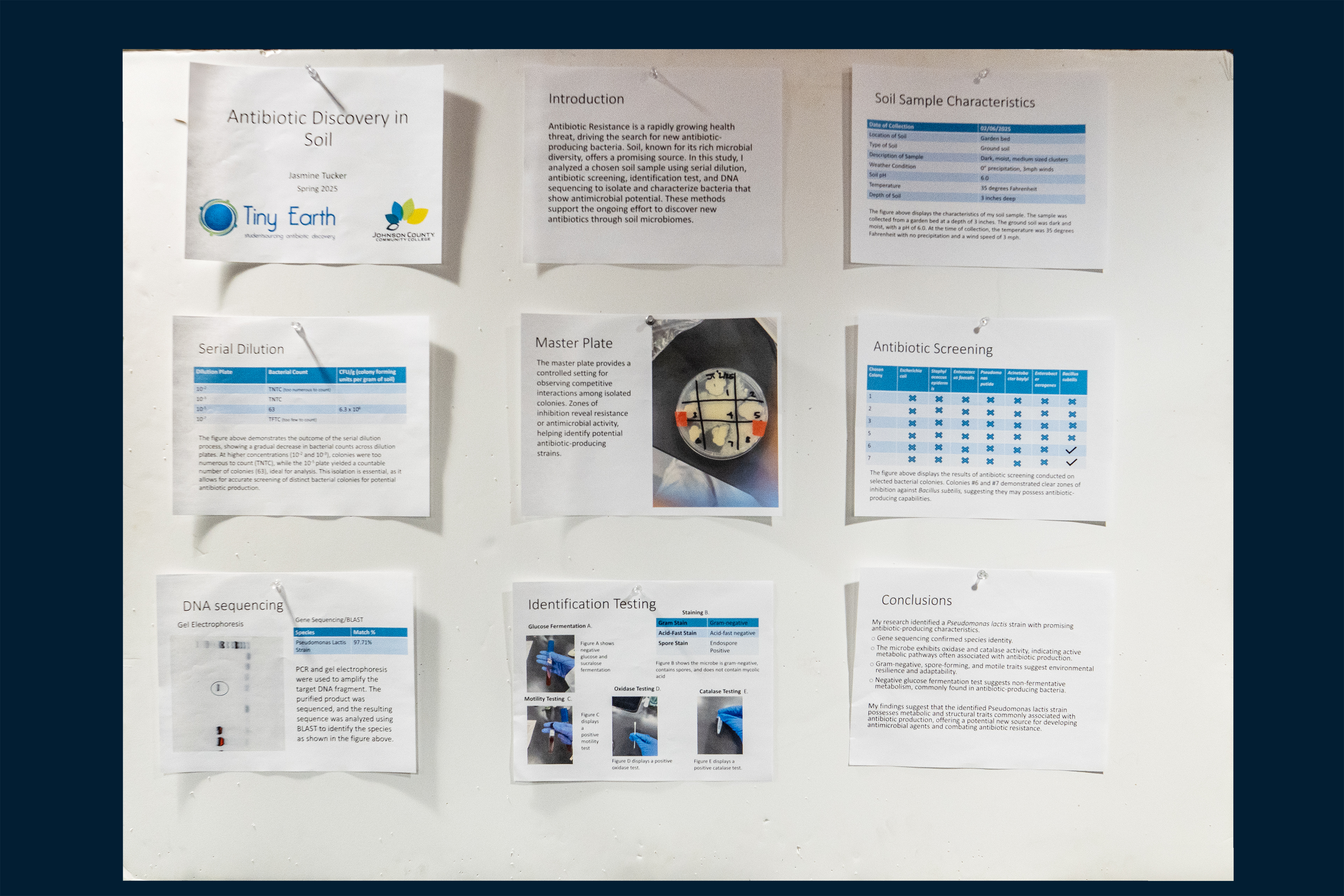
The discovery of antibiotics revolutionized modern medicine, saving millions of lives from infectious diseases. However, their widespread use now poses a new threat known as antibiotic resistance. Bacteria can now evolve and withstand treatment with some of our most common antibiotics, making curable infections deadly. In hopes of finding a solution, scientists have searched far and wide to find a good place to find new and improved antibiotic-producing bacteria from which we can develop new antibiotics. One source they have found to be very beneficial is ground soil. Soil serves as the perfect reservoir for antimicrobial growth due to the immense diversity of microbes present within a soil sample and the highly competitive environment that favors antimicrobial-producing bacteria. In this study, a series of serial dilutions were performed to quantify the number of colonies formed per gram of soil. Two soil samples from different environments were used to assess their potential to grow antibiotic-producing bacteria. After performing rounds of serial dilution with these samples, antibiotic screening was undergone with 6 safe relatives to identify antibiotic-producing bacteria found within the soil samples. This study is vital for determining which bacterial colonies show zones of inhibition and how those zones can be used to identify possible antibiotic-producing bacteria. In the future, a polymerase chain reaction, gel electrophoresis, and DNA sequencing will be utilized to identify the specific DNA genome associated with the found antibiotic-producing bacteria within these soil samples.
Image
Antibiotic Discovery in Soil
CoLab, COM 100
The discovery of antibiotics revolutionized modern medicine, saving millions of lives from infectious diseases. However, their widespread use now poses a new threat known as antibiotic resistance. Bacteria can now evolve and withstand treatment with some of our most common antibiotics, making curable infections deadly. In hopes of finding a solution, scientists have searched far and wide to find a good place to find new and improved antibiotic-producing bacteria from which we can develop new antibiotics. One source they have found to be very beneficial is ground soil. Soil serves as the perfect reservoir for antimicrobial growth due to the immense diversity of microbes present within a soil sample and the highly competitive environment that favors antimicrobial-producing bacteria. In this study, a series of serial dilutions were performed to quantify the number of colonies formed per gram of soil. Two soil samples from different environments were used to assess their potential to grow antibiotic-producing bacteria. After performing rounds of serial dilution with these samples, antibiotic screening was undergone with 6 safe relatives to identify antibiotic-producing bacteria found within the soil samples. This study is vital for determining which bacterial colonies show zones of inhibition and how those zones can be used to identify possible antibiotic-producing bacteria. In the future, a polymerase chain reaction, gel electrophoresis, and DNA sequencing will be utilized to identify the specific DNA genome associated with the found antibiotic-producing bacteria within these soil samples.
Comments
The faculty mentor for this project was Rachael Ott, Biology.