

Location
CoLab, COM 100
Start Date
1-5-2025 12:15 PM
Document Type
Poster
Description
White-nose syndrome (WNS) is a fatal disease affecting North American bats caused by the invasive fungal pathogen Pseudogynoascus destructans, which grows on the skin of bats while they hibernate. Since it was first discovered in 2006 in a cave in New York, likely by human transmission, WNS has killed millions of North American bats, desecrating populations of at least 12 different species. By controlling populations of agricultural pests and mosquitos, and, in turn, reducing the use of pesticides and the incidence of mosquito-borne diseases, bats play a vital role in our ecosystems, economy, and health. With WNS continuing its expansion across North America and no current effective methods of managing it, this presentation is a compilation of previously published data on the most promising treatment methods to assess their applicatory potential in the field and highlight their limitations.
Image
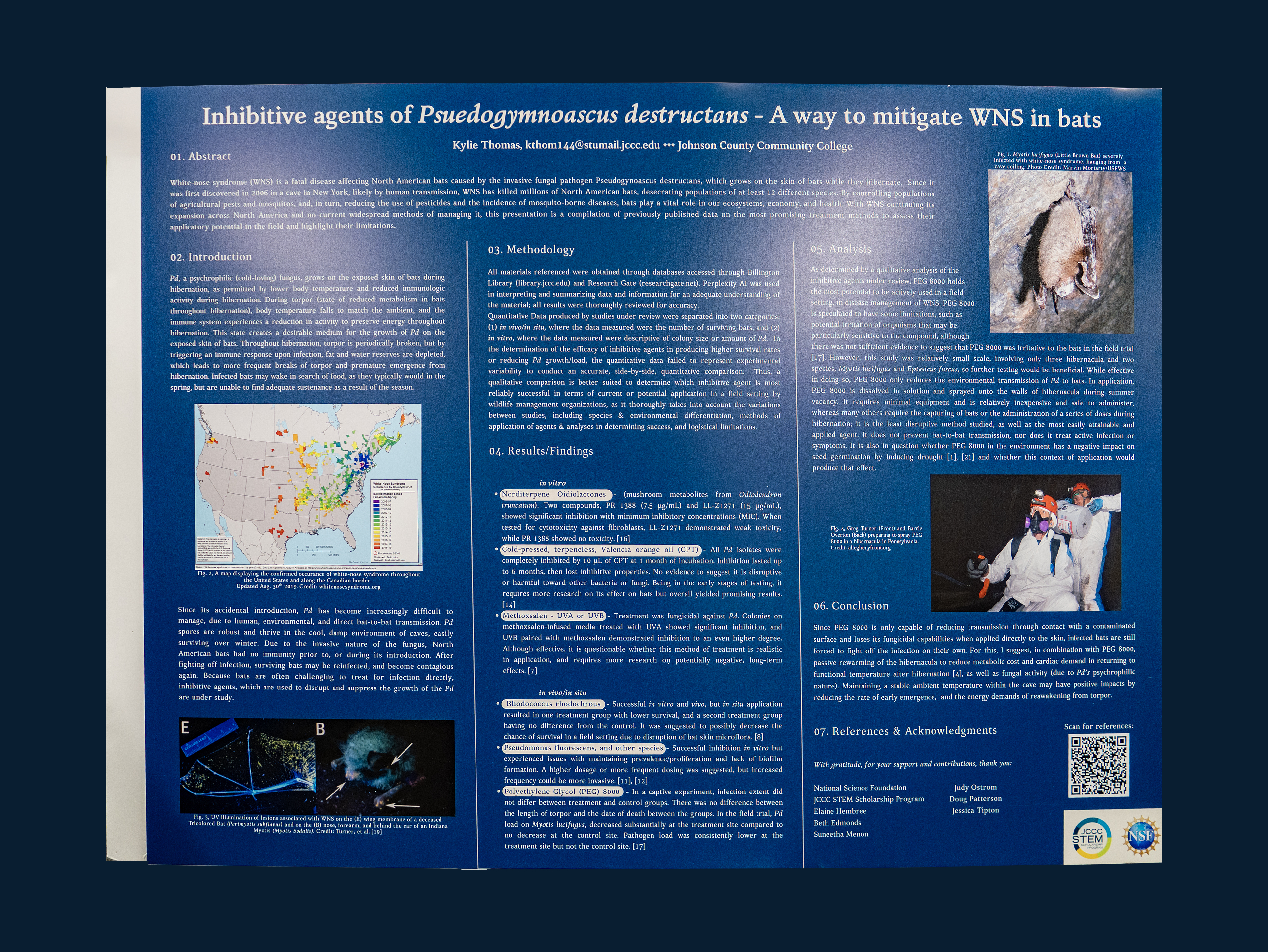
A Comparison of White-Nose Syndrome Treatment Methods for North American Bat Conservation
CoLab, COM 100
White-nose syndrome (WNS) is a fatal disease affecting North American bats caused by the invasive fungal pathogen Pseudogynoascus destructans, which grows on the skin of bats while they hibernate. Since it was first discovered in 2006 in a cave in New York, likely by human transmission, WNS has killed millions of North American bats, desecrating populations of at least 12 different species. By controlling populations of agricultural pests and mosquitos, and, in turn, reducing the use of pesticides and the incidence of mosquito-borne diseases, bats play a vital role in our ecosystems, economy, and health. With WNS continuing its expansion across North America and no current effective methods of managing it, this presentation is a compilation of previously published data on the most promising treatment methods to assess their applicatory potential in the field and highlight their limitations.
Comments
The faculty mentor for this project was Beth Edmonds, STEM Scholars.