

Location
CoLab, COM 100
Start Date
1-5-2025 11:00 AM
Document Type
Poster
Description
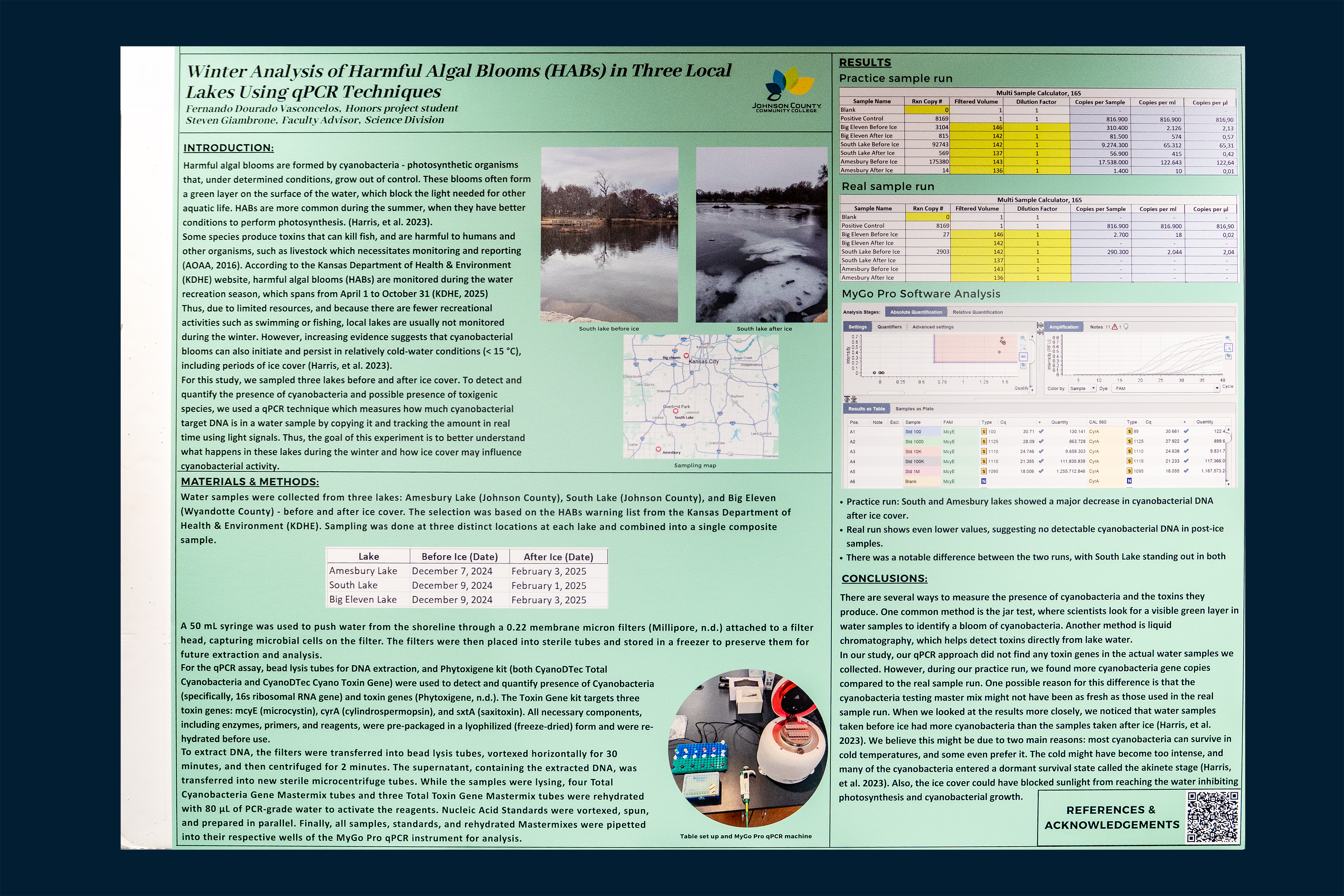
This study focusses on investigating for the presence of cyanobacteria associated with Harmful Algal Blooms (HABs) during the winter using quantitative Polymerase Chain Reaction (qPCR) techniques for detection and analysis. HABs are the result of overgrowth of these photosynthetic organisms that grow excessively in freshwater systems under the right circumstances. These organisms are a concern because they can produce toxins that can be harmful to humans, animals, and the environment. Since HABs are more commonly known to proliferate during the summer, monitoring of freshwater lakes is typically not done during the winter months. Thus, this research is important to help provide more insight into how HABs behave, since HABs have been found to occur during winter months. Three local lakes were selected for study: Amesbury Lake (Johnson County), South Lake (Johnson County), and Big Eleven (Wyandotte County). The selection was based on the HABs warning list from the Kansas Department of Health & Environment. Water samples were collected using 0.22 micron membrane filters from Millipore, at three different locations at each lake. Samples were collected before and after ice coverage of the lakes. qPCR assays targeting specific cyanobacterial species known to produce toxins associated with HABs were used to identify and quantify the genetic material of these species. The results of this study may indicate that there are no HABs in the lakes, or that conditions for HABs are more favorable either before or after ice formation.
Image
Winter Analysis of Harmful Algal Blooms (HABs) in Three Local Lakes Using qPCR Techniques
CoLab, COM 100
This study focusses on investigating for the presence of cyanobacteria associated with Harmful Algal Blooms (HABs) during the winter using quantitative Polymerase Chain Reaction (qPCR) techniques for detection and analysis. HABs are the result of overgrowth of these photosynthetic organisms that grow excessively in freshwater systems under the right circumstances. These organisms are a concern because they can produce toxins that can be harmful to humans, animals, and the environment. Since HABs are more commonly known to proliferate during the summer, monitoring of freshwater lakes is typically not done during the winter months. Thus, this research is important to help provide more insight into how HABs behave, since HABs have been found to occur during winter months. Three local lakes were selected for study: Amesbury Lake (Johnson County), South Lake (Johnson County), and Big Eleven (Wyandotte County). The selection was based on the HABs warning list from the Kansas Department of Health & Environment. Water samples were collected using 0.22 micron membrane filters from Millipore, at three different locations at each lake. Samples were collected before and after ice coverage of the lakes. qPCR assays targeting specific cyanobacterial species known to produce toxins associated with HABs were used to identify and quantify the genetic material of these species. The results of this study may indicate that there are no HABs in the lakes, or that conditions for HABs are more favorable either before or after ice formation.
Comments
The faculty mentor for this project was Steven Giambrone, Biology.