

Location
CoLab, COM 100
Start Date
1-5-2025 12:15 PM
Document Type
Poster
Description
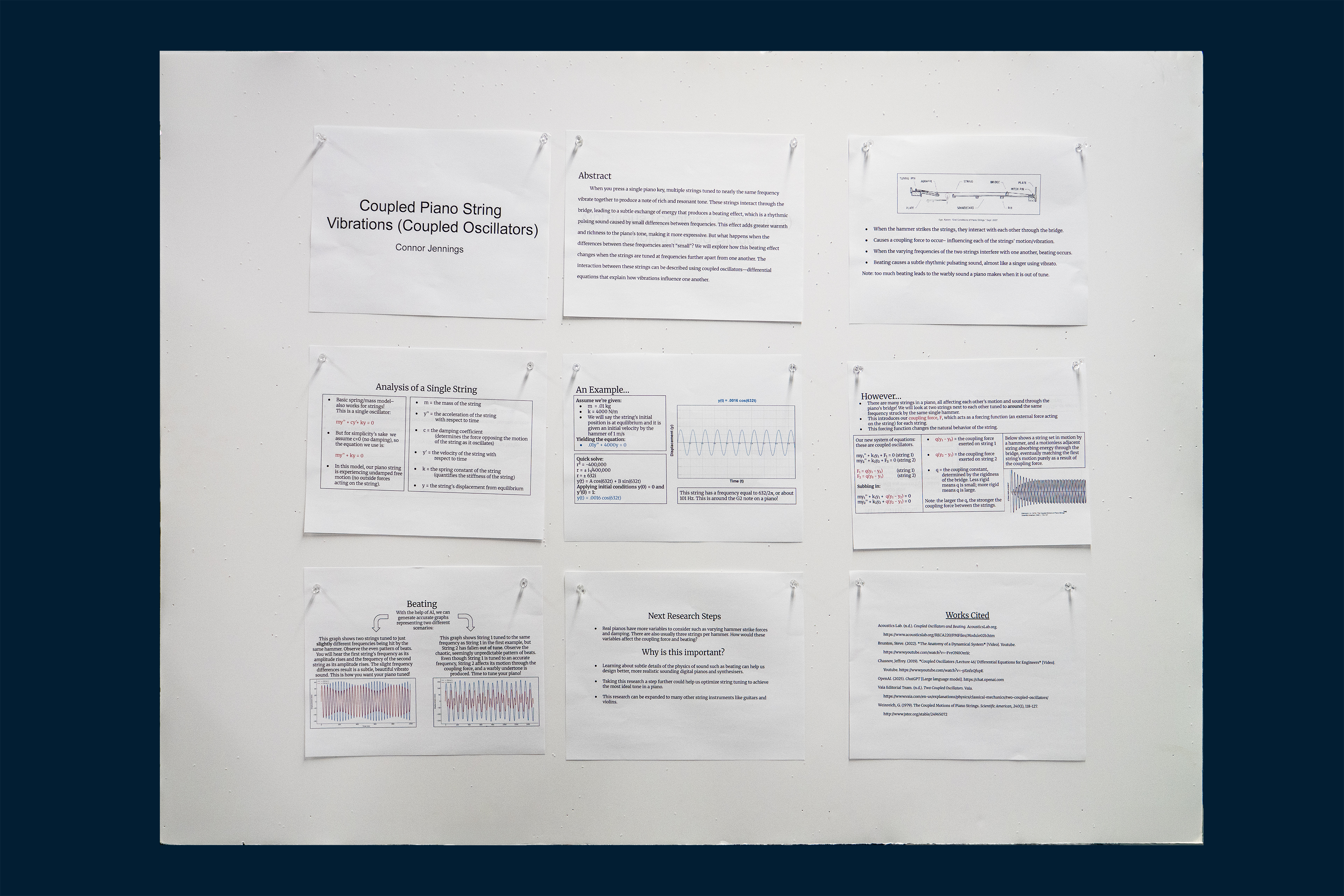
When you press a single piano key, multiple strings tuned to nearly the same frequency vibrate together to produce a note of rich and resonant tone. These strings interact through the bridge, leading to a subtle exchange of energy that produces a beating effect, which is a rhythmic pulsing sound caused by small differences between frequencies. This effect adds greater warmth and richness to the piano’s tone, making it more expressive. But what happens when the differences between these frequencies aren’t “small”? We will explore how this beating effect changes when the strings are tuned at frequencies further apart from one another. The interaction between these strings can be described using coupled oscillators—differential equations that explain how vibrations influence one another.
Image
Coupled Piano String Vibrations (Coupled Oscillators)
CoLab, COM 100
When you press a single piano key, multiple strings tuned to nearly the same frequency vibrate together to produce a note of rich and resonant tone. These strings interact through the bridge, leading to a subtle exchange of energy that produces a beating effect, which is a rhythmic pulsing sound caused by small differences between frequencies. This effect adds greater warmth and richness to the piano’s tone, making it more expressive. But what happens when the differences between these frequencies aren’t “small”? We will explore how this beating effect changes when the strings are tuned at frequencies further apart from one another. The interaction between these strings can be described using coupled oscillators—differential equations that explain how vibrations influence one another.
Comments
The faculty mentor for this project was Brenda Edmonds, Mathematics.